China: Potpourri of timeless sights
Beijing's heritage is reflected in its ancient hutongs and magnificent buildings
I didn't know much about China until a visit organised on behalf of the National Assembly of the Press in association with Etihad Airways.
I accompanied a delegation to learn about a 3,000-year-old culture. The visit was an opportunity to take part in a unique experience, learning about national treasures, dominated by the colour red and dating back thousands of years. Many stories were written about China, its secrets and its emperors who led this culture to progress.
Old Peking
Etihad Airways flew the delegation on a seven-hour flight, arriving early morning in Beijing. We spent four days there — insufficient time to learn about and appreciate its history but enough to give me a peek into the depth of its culture and secrets.
On our first day, we decided to visit one of the oldest areas on the outskirts of the capital. The trip to "Old Peking" is recommended to every visitor who wants to experience the reality of life in these streets.
The carriage took us to Hutong Street, known for preserving traditional architecture and lifestyle. We gathered in the town square for a photo opportunity with drivers of traditional carriages. A convoy of three-wheel carriages, with two passengers each, took off as the drivers confidently and unforgettably zigzagged through traffic to our destination. Upon arrival, we were greeted by a tour guide as we took a look at traditional homes by a river. We travelled on foot to the residential communities dating back to 300 years. They are known as hutongs, a word derived from the Mongolian language, which means "digging wells".
The street is not wider than three or four metres, packed with bicycles carrying a variety of food items and merchandise for sale.
We entered one of the old buildings and were escorted by a commoner through a wide garden, so simple as if abandoned.
The property's owner greeted us as if we were royalty. He then proceeded to explain that the poor live in these old buildings, which are protected by law, while the rich live in modern towers and houses. The government subsidises 50 per cent of the cost of maintaining such heritage buildings.
Forbidden City
A trip to China is incomplete without a visit to the Forbidden City. We left early on the second day for the Imperial Palace, which has been home to 42 emperors. Named by Unesco in 1987 as one of the world's most important buildings of Chinese heritage, it is one of the country's most popular tourist attractions.
The 600-year-old complex of palaces spread across 720,000 square metres is visited by more than 24,000 tourists every day.
The palace was the residence of the imperial family, from the reign of the Yongle Emperor of the Ming dynasty in the 15th century until the fall of the Qing dynasty in 1912.
The main palace, which was the residence of previous emperors, is located north of Tiananmen Square and the Forbidden City, a part of a large number of luxurious palaces. The parliament is located to the east while to the west is the Museum of the Revolution.
It took 14 years and more than a million workers to construct the complex, built entirely with wood and yellow and red bricks. The city undergoes routine maintenance and is surrounded by the Hoching River. This area represents centuries of governance and authority.
Next, we walked down to Tiananmen Square, considered the largest of its kind in the world at 440,000 square metres. The site, which can accommodate about a million people, is not only a tourist attraction but the site of some of the most significant events in modern times.
It drew the attention of the world in 1989, when demonstrations demanding democracy were held there. This is where the founder of modern China, Mao Zedong, is buried. The complex's main entrance has a sign proclaiming: "Gate to heavenly peace."
The Great Wall of China
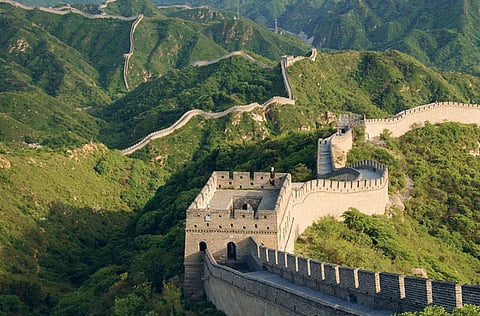
I consider the following day a favourite, as we visited the Great Wall of China, one of the Seven Wonders of the World. We travelled east to the mountains for about two hours, passing some of the most beautiful lakes and gardens.
The yard in front of the wall's entrance is full of vendors selling souvenirs and gifts. The main gate is guarded by soldiers in traditional attire. We rode a cable car to the top of the mountain, which overlooked valleys, lush with vegetation.
At 5,600 kilometres, the wall is the longest structure in history. It was built by soldiers and prisoners over hundreds of years using primitive tools. Stories are told that the construction of the wall began around 400BC and continued through the 17th century.
Scenic hub
Tourism in China has greatly expanded over the last few decades, since reforms started. Beijing is one of the most well-known cities for tourists from all over the world. As the nation's centre of government, economy, culture and international activities, the city also serves as a transportation hub for the country. Private and official airlines connect Beijing to more than 110 cities at home and abroad, while the city boasts a fine railroad and highway system.
As it is located 143 feet above sea level, Beijing has a continental climate. January is the coldest month, with an average temperature of -4C. At an average temperature of 26C, July is the warmest. The best time to visit Beijing is May, September and October.
Beijing is also known as a tourist city for its many places of interest, including ancient buildings, royal gardens, mansions, towers, temples, palaces and modern structures. It is a meeting place for artists and other talented people.
In addition to the Great Wall of China, a symbol of the ancient Chinese civilisation, there are many other places to visit in Beijing, such as the Forbidden City, the Summer Palace, the Imperial Gardens, mausoleums, temples and courtyards and Tiananmen Square.
During our trip, we spent almost a day visiting the royal gardens, the well-preserved Summer Palace spread across 294.2 hectares, the elegant Beihai Park and the ruins of the Old Summer Palace. If you would like to experience the local lifestyle, head for Beijing's hutongs and courtyards. Prince Gong's Mansion, which was the residence of an official and then, the prince, is the most magnificent site.
Other famous historical sites include the Bell and Drum Towers; the Liulichang Street ,for people interested in Chinese calligraphy, painting or other artwork; and the Lugou Bridge, carved with marvellous stone lions.
Located at the back of the Forbidden City, the Jingshan Park is Beijing's most beautiful and significant. The park, which was also an imperial garden in ancient times, offers great views of the city. The Fragrant Hills Park has beautiful red maple leaves every autumn.
The Taoranting Park is a wonderful workmanship of ancient and modern Chinese architectural skills. The Stone Flower Cave is an astonishing park of Beijing.


