Bend it, wear it, let it think
The world of smartphones is changing rapidly with mobile phone manufacturers working relentlessly to improve their devices, while adding must-have applications, pliable bodies and even artificial intelligence into the mix
It was somebody's son at a friend's place who got me thinking about the future of technology, when he approached a TV screen and tried to change the channel by moving his fingers in a quick right to left movement, as one would do with a smartphone. When this didn't work, the small fellow asked, "Daddy, what's wrong with the TV? The channels won't switch when I want to change them!"
This is the effect of the new smartphone era on the youngest generation. They're growing up with hyper-modern portable computer phones and their self-explanatory playful interfaces, and expect that anything technical should behave like one.
Getting sharper
Indeed, there has been a notable progress in smartphones since companies like Apple, Samsung and Motorola — only to name the biggest ones — have taken over the lead from former mobile phone major Nokia. In a short time, the appearance and capabilities of smartphones have changed rapidly, be it through integrated camera phones, Wi-Fi, location-based services or applications. It is easy to expect manufacturers to come up with outrageous new tools, platforms and appearances in the near future.
Smartphone producers are scrambling to make their devices thinner and thinner, squeezing them as much as technical constraints permit. This year's title for the thinnest smartphone goes to Fujitsu's Arrows F-07D, which is only 6.6 millimetres thick, and still accommodates a powerful battery and a built-in storage of 1GB.
It is only a matter of time until mobiles get foldable or even ductile. Nokia recently presented a bendable smartphone prototype called Kinetic, which can be flexed across both the vertical and horizontal planes — with bending and twisting motions controlling the interface. If the user bends the screen towards himself, it acts as a selection function, or zooms in on selected pictures. In the music mode, the user can navigate, play and pause easily with the tactile interface.
Samsung is working on a phone called Super Amoled that consists of a rollable organic light-emitting diode (OLED) display. These screens have only one layer, which not only eliminates the air gap that causes glare, but also detects touch and is integrated into the screen rather than being overlaid on top, which allows a 180-degree viewing angle and brightness in HD quality.
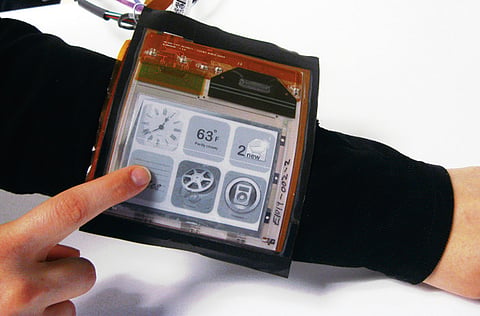
Ramon Llamas, Senior Research Analyst at global market intelligence firm IDC Mobile Devices Technology and Trends, expects smartphones to turn into fashionable accessories as they become ‘wearable'. Such phones would be worn as wristwatches or bracelets, and bend, fold and change shape to suit the user's requirement. This would also open new doors for fashion houses in combining technical features with design concepts, creating high-end accessories.
The technological basis for such pliable phones will be nanotechnology, and the body itself will be constructed from fibril proteins that will be woven into a three-dimensional mesh, allowing the whole phone, including the screen, to bend. One example of this is Nokia's prototype called Morph.
Cool applications
However, while hardware gimmicks will alter the smartphone landscape in the future, applications are expected to be at the forefront of the transformation. "Future smartphone growth will be driven largely by the number of applications available," says Llamas in the September 2011 sector report by IDC, which gives an outlook of the smartphone business up to the year 2015.
Smartphones of the future will exceed the current capabilities by far. Manufactures are now busy experimenting with Near Field Communication (NFC), which allows simplified transactions, quick data exchange and connections by merely touching other phones — to some extent, as a successor to Bluetooth. A built-in NFC chip will allow the smartphone to, for example, exchange contact information or share contents such as photos, videos, music and others by simply touching another phone.
Applications for smartphones are expected to become even more sophisticated with the implementation of artificial intelligence. The phones will then be able to collect, analyse and structure information for the user and combine it, for example, with location-based services. That way, a smartphone user would not only use a sophisticated restaurant guide that searches through reviews in the web and delivers optimised suggestions, but also have situations such as — "I am in an unfamiliar part of town, need a taxi, want to catch the latest blockbuster and would like to have dinner in a Spanish restaurant" — analysed. As Apple's Siri has demonstrated the phone would then react to queries in human voice commands and provide a solution for the situation, after combing through the respective data on the internet, in the form of a scheduled itinerary for the evening. Together with intelligent speech recognition, phones will also be able to interpret gestures as input control.
Smartphone or computer?
Last but not the least, smartphones will receive more powerful chipsets in combination with super energy-efficient batteries based on nanotechnology. This will enable them, if combined together, to act as a computer cluster with the capabilities of today's desktop computers. It is also likely that smartphones will sooner or later replace PCs and laptops and will be able to run powerful applications such as Adobe Photoshop or memory-thirsty web-game applications. Toshiba is currently working on the T-01A with an advanced Qualcomm chipset that provides the smartphone with PC power.
Other features to expect would be smartphones with pico-projectors in laser and LED technology that will allow projection videos through tiny lenses onto a big movie screen.
The latest projects try to integrate smartphone screens into glasses and contact lenses in retina-displays powered by solar cells. This would open a new world of virtual reality and would be the ultimate revolution in interface control by directing the smartphone through eye movements. This is largely in the realm of utopia now, but for how long?


