Loss of faith in RIM grows ahead of PlayBook
Many investors wary of unfamiliar product facing tough competition after a successful iPad 2 launch
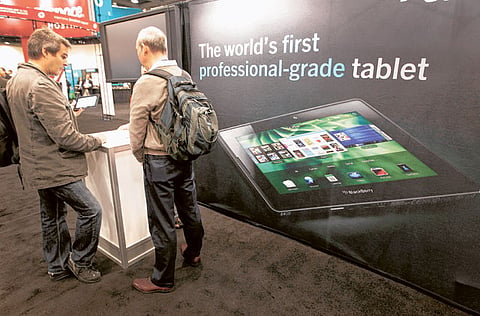
Toronto: Research In Motion is facing sceptical investors unsure the BlackBerry maker can pull off a difficult transition as it promises strong growth from a tablet and operating system few have seen.
To cushion the blow, RIM took the unusual step of providing Wall Street with a forecast for full-year earnings that topped the expectations of all but the most optimistic pundit.
The number supported RIM's contention that the pain surrounding the PlayBook launch would set the stage for long-term gain. By and large, investors and analysts were not buying that argument.
Even Deutsche Bank analyst Brian Modoff — the lone analyst with a forecast that was above RIM's full-year figure — cut almost a full dollar off his earlier estimate. He also suggested clients sell their RIM shares.
Short-sellers — who profit on bets a stock will decline — may cash their chips but are unlikely to lose interest in RIM.
"It's probably going to under perform for quite some time until they can get some traction back," said Brad Lamensdorf, who co-manages AdvisorShare's Active Bear fund and had a roughly $500,000 (Dh1.8 million) short position in RIM ahead of the earnings.
"They're giving you the bad news right now — they're airing their dirty laundry," he said.
RIM has spent heavily developing and marketing the PlayBook, designed to snatch some glory away from Apple's iPad, which virtually invented the now-crowded tablet market.
Highlighting the challenge, Apple fans queued up worldwide to be the first to get their hands on the iPad 2. One of reasons that Deutsche's Modoff cut his rating was a loss of faith that RIM can reverse its fortunes with the introduction of the QNX operating system, which will make its debut on the PlayBook.
Modoff, among others, believes it's imperative that RIM move quickly to put QNX on its touch-based BlackBerry smartphones due out this year, replacing an outdated platform that's ill-equipped for today's data-heavy applications.
In need of reboot
But RIM said QNX won't appear on its phones until early next year. "With no QNX on handsets until calendar 2012, we think RIM will likely continue to lose share to Android smartphones whose prices are rapidly falling," Deutsche's Modoff said in a note.
Google provides its Android software to Motorola Mobility, Samsung, HTC and other device makers.
Susquehanna Financial analyst Jeff Fidacaro said RIM desperately needs a high-end smartphone to woo back disgruntled users in North America. The Torch, launched in August with an improved browser, didn't fill the void.
Adding to worries, RIM said the launch of the PlayBook would hit the company's prized gross profit margins and they would likely not recover anytime soon. Yet the PlayBook, loaded with impressive parts and priced at par with the equivalent iPad 2, is only part of the reason RIM's margins are slipping.
"That is not 100 per cent due to the PlayBook being put into the mix. There is some core degradation in the gross margin of their smartphone business," Susquehanna's Fidacaro said in an interview. "And I think that really surprised the bulls."
RIM is leaning on sales of its cheaper devices outside the lucrative North American and Western European markets as Apple's iPhone and Android-based devices steal thunder.While those devices bring in decent income for the cost of production, sales volumes need to be high to keep revenue up.
When RIM finally brings out QNX-equipped smartphones — what it dubs "superphones" — the big question is whether they will impress when stacked against the fast-moving competition.
Hardware innovation
More broadly, analysts are wondering if RIM should cling to its own platform and fight the Google software's scale coupled with rivals setting a furious pace of hardware innovation.
"We've got Google out there flipping OS by themselves three times in a year and then all their hardware partner guys, beating their feet to the market as fast as they can with their latest and greatest hardware," said Ed Snyder from Charter Equity Research.
Nokia, a global leader which for years poured money into its own software, dumped its platform in favour in Microsoft's Windows Phone."Any one company that tries to do this by themselves will probably lose — including Apple in the long run," he said.
Security concerns last year in Saudi Arabia, India and the UAE about encrypted BlackBerry phone messenger services do not appear to have affected global sales of handheld devices for its Canadian manufacturer, Research in Motion (RIM). The company has reported for the fiscal year ending February 26, 2011 global revenues of $19.9 billion, an increase of 33 per cent from $15 billion last year.
Leif-Olof Wallin, research vice-president with Gartner, said security concerns in Middle East and Asia didn't likely affect the global position of RIM. "I think it's fair to say the three countries in question [Saudi Arabia, UAE and India] are important markets but not huge markets for BlackBerry," he said.
Despite the concerns, Wallin said the wrangling last year "didn't have a huge impact." The upside is that globally, the smartphone market experienced huge popularity over regular phones leading to higher demand for more intelligent handhelds and boosting sales for all phone manufacturers.
Officials with RIM said times ahead look promising for more smartphone sales. "As we enter 2012, RIM is in an excellent position to benefit from the continuing convergence of the mobile communications and mobile computing markets," said Jim Balsillie, co-CEO of RIM, in a statement.
"We are laying a strong foundation for RIM's expanding market opportunity through focused investments and we are extremely excited about our smartphone, tablet and platform roadmaps," he said.
The company reported in its year-end results that "net income for fiscal 2011 was $3.4 billion, or $6.34 share diluted, up 47 per cent over fiscal 2010." The jump in sales was linked to what the company called "record BlackBerry smartphone shipments of 52.3 million [that] that grew 43 per cent over fiscal 2010."
RIM shipped 14.9 million BlackBerry smartphones in the fourth quarter, alone. Officials with RIM claimed that BlackBerry was the number-one selling smartphone in US, Canada and Latin America in 2010. The company said it will launch April 19 its Playbook tablet, showcased by Balsillie at Gitex Dubai last year.
In its look ahead, RIM said "revenue for the first quarter of fiscal 2012, ending May 28, 2011, is expected to be in the range of $5.2 to $5.6 billion.
With inputs from Reuters


