Indian yield curve shows rate hikes will hit growth
Gap between short- and long-term bonds shrinks
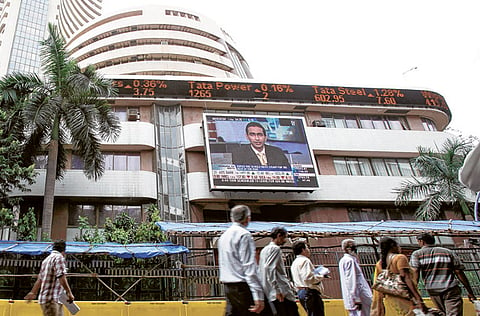
Mumbai: The difference in yields between India's short- and long-term bonds has shrunk to a 28-month low, suggesting investors expect policy makers will raise borrowing costs to curb inflation even at the risk of slowing the economy.
The gap between the rates on two- and 10-year government debt was 17 basis points yesterday, the least since December 2008, according to data compiled by Bloomberg. The yield curve, a gauge of investors' expectations on inflation and economic growth, compares with a spread of 149 in Germany, 270 in the US and 277 in Australia.
Wholesale-price gains in India accelerated to 8.98 per cent in March from 8.31 per cent the previous month, prompting Standard Chartered, Barclays and Nomura Holdings to boost their estimates for rate increases. The central bank will raise the benchmark repurchase rate by a quarter point to 7 per cent when it meets on May 3, according to 17 of 22 economists in a Bloomberg News survey. Five forecast a half-point increase.
"The flattening of the curve indicates heightened market expectations of more rate hikes," said Manish Wadhawan, the head of fixed-income trading at HSBC Holdings. "The current inflation trajectory looks scary. The pace of growth will slow this year as the central bank raises rates."
Growth in Asia's third-biggest economy will slow to 8.2 per cent in the year that began in April from 10.4 per cent in the prior 12 months as policy makers raise borrowing costs, the International Monetary Fund said in its regional economic outlook released on Thursday. Goldman Sachs Group cut its gross domestic product growth forecast on April 21 to 7.8 per cent from 8.7 per cent.
Eight increases
The yield on India's 7.8 per cent bond due April 2021, the new benchmark, has climbed 13 basis points to 8.12 per cent since April 15. Official data released that day showed inflation overshot the central bank's forecast by almost 1 percentage point in March, suggesting that eight increases to the repurchase rate in the past 13 months haven't sufficiently curbed price pressures. A basis point is 0.01 percentage point.
India's benchmark inflation rate is the highest among the Brics nations after Russia. Consumer prices rose 5.4 per cent in China last month, 9.5 per cent in Russia, 6.3 per cent in Brazil and 4.1 per cent in South Africa.
"Inflation will remain elevated this year," Dhawal Dalal, Mumbai-based head of fixed-income at DSP Blackrock Investment Managers, said in an interview on Tuesday. "We expect a 25-basis point increase on May 3 rather than one of 50 basis points that might scare the market."
Dalal predicted the yield on the 10-year bond will rise to 8.25 per cent by the end of May. HSBC's Wadhawan also forecast a 25-basis point increase, and said the yield will reach 8.35 per cent by the end of September.
The federal government resumed debt sales on April 8 after a two-month hiatus, contributing to a decline in the value of rupee bonds this month. India's notes lost 0.7 per cent, the worst performance among 10 Asian local-currency debt markets outside Japan, according to indexes compiled by HSBC.
The Reserve Bank will sell Rs120 billion (Dh10 billion) of debt securities this week on behalf of the government. Policymakers seek to raise Rs4.17 trillion from the debt markets in the current financial year to bridge the fiscal deficit, compared with a planned Rs4.47 trillion in the prior 12 months. The debt supply will avert a situation where the yield on short-dated maturities could eclipse those on longer-dated bonds, according to Standard Chartered.
"I don't expect the yield curve to invert in the near term," said Nagaraj Kulkarni, a Mumbai-based fixed-income strategist at the UK bank. "With government borrowing gaining momentum and expectations of further monetary tightening intact, we expect yields at the long end to move higher."
Industrial output
Kulkarni predicted the 10-year yield will reach 8.5 per cent by June, while the difference in yields between two- and 10-year bonds will remain at the current level until September.
India's curtailed growth outlook will limit what the central bank can do to curb inflation, according to Mumbai-based CARE Ratings. Industrial output rose 3.6 per cent in February, official data showed on April 11, less than the 5.1 per cent economists predicted in a Bloomberg survey.
"Economic growth is already showing signs of moderation," Madan Sabnavis, an economist at the ratings company, said in an interview. "The RBI has already tightened rates quite a lot and we are looking at not more than 50 basis points of increases from here."
The rupee has gained 0.5 per cent this month as the yield premium on India's assets rose. The difference in rates between 10-year government debt and similar-maturity US Treasuries widened to 479 basis points from a nine-month low of 436 on April 8.


