Security concern slows global response to famine
More than 3m Somalis face the risk of starvation
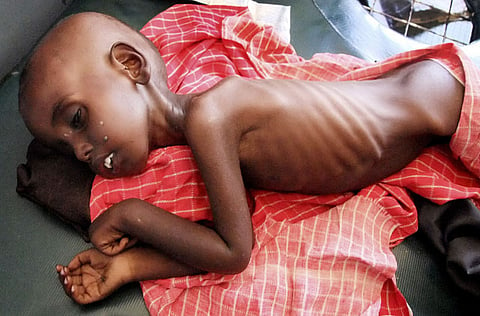
Mogadishu: Despite an estimated 12 million lives hanging in the balance, international food aid has been slow to arrive to strife-stricken Somalia and neighbouring countries caught in the grip of what is now being called East Africa's worst drought in 60 years.
Causing the holdup: security concerns and an international community caught off guard by the severity of the drought.
On Tuesday the United Nations' World Food Program put off for at least a day the start of an airlift of emergency provisions into various sites in the bone-dry Horn of Africa. In addition, an international donors' conference set for yesterday in Nairobi was abruptly cancelled, according to Oxfam officials, the two setbacks underscoring the difficulties Somalia relief plans have encountered.
The UN declared last week that famine conditions exist in two regions of southern Somalia, putting more than 3 million Somalis there at risk of starvation. The UN also declared an emergency humanitarian crisis throughout the Horn of Africa, as thousands of Somalis leave their homes every day in search of food either in the capital, Mogadishu, or across the border in Kenya and Ethiopia.
Refugee camp
Already Somali refugees who have poured across the border into the Dadaab refugee camp in Kenya have made it the largest such site in the world — with a population of 360,000.
UN officials had pinned their hopes on the donors' conference to raise global interest in East Africa's food crisis. The UN said on Monday that at least $1.6 billion (Dh5.87 billion) in food assistance would be needed over the next year. Nearly one-fourth of that amount will be needed almost immediately to avoid mass starvation in the coming weeks, UN food and agriculture officials say.
It was not immediately clear on Tuesday why the donors' conference was called off.
Yet experts say that everything from donor fatigue to the particular challenges of getting assistance to the region's displaced and hungry — not to mention concerns about aid falling into the hands of extremists in southern Somalia — is playing a part in the slow global response.
"In this case, the biggest problem is that the need is so enormous — and growing at such a fast rate," says Semhar Araia, Horn of Africa regional policy adviser for Oxfam, the international relief and development organisation.
"It's also a problem of access," she adds, "it's just very difficult to reach certain parts of the Horn, particularly in Somalia".
While different agencies and organisations cite different numbers, Oxfam estimates that more than 3,500 refugees arrive every day in Ethiopia and Kenya, with 9,000 arriving every week at the Dadaab camp alone.
Still, the current crisis is not simply the result of a particularly bad drought, Araia says, but also has at its roots a number of man-made causes.


