Insurgent strikes fail to deter Iraqi voters
Ballot draws enthusiastic response despite rash of bomb and grenade attacks that leave dozens dead
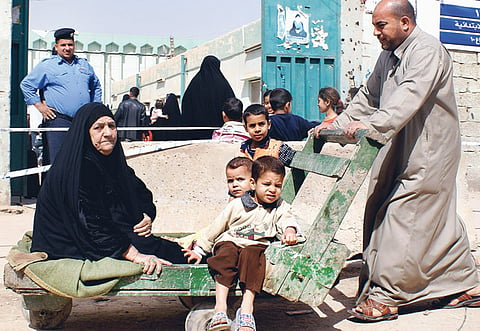
Baghdad: Insurgents bombed a polling station and lobbed grenades at voters yesterday, killing more than 35 people in attacks aimed at intimidating Iraqis participating in an election that will determine whether the country can overcome jagged sectarian divisions that have plagued it since the 2003 US-led invasion.
Iraqis hope the election will put them on a path toward national reconciliation as the US prepares to withdraw combat forces by late summer and all American troops by the end of next year.
Prime Minister Nouri Al Maliki is fighting for his political future with challenges from a coalition of mainly Shiite groups on one side and a secular alliance combining Shiites and Sunnis on the other.
Despite mortars raining down nearby, voters in the capital still came to the polls. In the predominantly Sunni neighborhood of Azamiyah in northern Baghdad, Walid Abed, a 40-year-old father of two, was speaking as mortars landed several hundreds yards away. Police reported at least 20 mortar attacks in the neighbourhood shortly after daybreak and mortars were also launched toward the Green Zone — home to the US embassy and the prime minister's office.
"I am not scared and I am not going to stay put at home," Abed said. "Until when? We need to change things. If I stay home and not come to vote, Azamiyah will get worse."
First step
"These acts will not undermine the will of the Iraqi people," Al Maliki said of the attacks yesterday, speaking to reporters after casting his ballot.
Exiting the polls, Iraqis waved purple-inked fingers — the now-iconic image synonymous with voting in this oil-rich country home to roughly 28 million people.
But observers have warned that the election is only the first step in the political process, and with the fractured nature of Iraqi politics, it could take months of negotiations after results are released in the coming days for a government to be formed.
Extraordinary security measures did not foil insurgents who vowed to disrupt the elections — which they see as validating the Shiite-led government and the US occupation. They launched a spate of mortar, grenade and bomb attacks throughout the morning.In a posting early yesterday on an Islamist website, the Al Qaida front group Islamic State in Iraq warned that anyone taking part in the voting would be exposing themselves to "God's wrath and to the mujahideen's weapons," saying the process bolsters Iraq's Shiite majority.
In Baghdad's northeast Hurriyah neighbourhood, where mosque loudspeakers exhorted people to vote as "arrows to the enemies' chest", three people were killed when someone threw a hand grenade at a crowd heading to the polls, according to police and hospital officials.
In the city of Mahmoudiya, about 30 kilometres south of Baghdad, a bomb inside a polling centre killed a policeman, said Iraqi Army Colonel Abdul Hussain.
At least 14 people died in northeastern Baghdad after explosions levelled two buildings about a mile apart, and mortar attacks in western Baghdad killed seven people in two different neighbourhoods, police and hospital officials said.
An explosion in the mixed neighbourhood of Kirayaat, in northern Baghdad, killed one person, said police and hospital officials.
US troops had received reports of 44 significant attacks in Baghdad but most were small. "These are intimidation tactics, and we are hearing that the focus is on mostly Sunni areas to keep Sunnis from voting and to exacerbate the Sunni-Shiite divide," said Major William Voorhies, a military official.
About 6,200 candidates are competing for 325 seats in the new parliament, Iraq's second, full-term legislature since the 2003 US-led invasion seven years ago this month.
Despite persistent violence and frustration over years of government failure to provide even basic services such as water and electricity to the public, many Iraqis were still excited to vote. In the city of Nasiriyah, in the Shiite south, crowds of people filled the streets .
"I voted in 2005. There were a lot less people then," said Ahmad Sa'ad Chadian. "Today, participation is much higher."
In the Shiite holy city of Najaf, south of Baghdad, dozens of voters also lined up to cast their ballots.
"We came to participate in this national day, and we don't care about the explosions," said Sahib Jabr, a 34-year-old old taxi driver.


