Anger grows in Beirut as officials meet over clashes
Citizens say army and Internal Security not doing duty
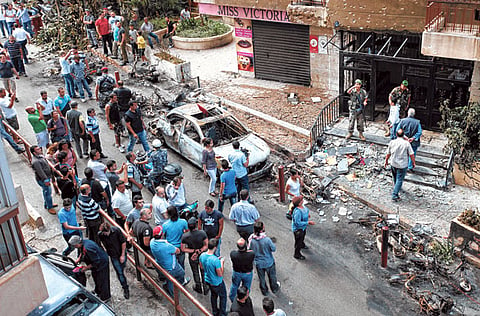
Beirut: The aftermath of overnight clashes in Beirut left many Lebanese searching for strong leadership.
However government officials did little but offer lip service to growing Sunni anger over the killings of prominent cleric Shaikh Ahmad Abdul Wahid and his companion the previous day in Tripoli.
Led by Prime Minister Najib Miqati, government officials lamented the army's poor performance and called on senior officials to assume full responsibility for what occurred on the ground.
Miqati left a hurriedly called meeting of the Higher Islamic Council without making a statement. The gathering, which was boycotted by former Prime Minister Fouad Siniora —and current head of the Al Mustaqbal parliamentary coalition — was supposed to discuss the aftermath of the killing of Shaikh Abdul Wahid by army personnel.
Importantly, the Council met under Mufti Shaikh Mohammad Rashid Qabbani at Dar Al Fatwah, the highest ranking Sunni instance in Lebanon.
At the end of the meeting, Mount Lebanon Mufti Mohammad Ali Al Jouzou read a strongly worded statement, asserting that Shaikh Abdul Wahid's death was an "assassination" and that officials — meaning the Prime Minister and his cabinet — should bear the consequences of the crime.
Parallel to such pronouncements, local broadcasts reported a series of political denunciations from March 14 leaders, which reflected the growing public anger. The mood was getting worse as ordinary citizens complained that the army and the Internal Security were not doing their duty to protect citizens.
Resentment
While most Beirutis were at work, tensions remained high, with a profound sense of disappointment with the army, perceived by many to be the last beacon of hope in a country that witnessed a long and unending civil war.
Most were wary of fresh clashes, and resented the politicisation of the institution, especially after the army gave the impression that it was applying the law selectively in Tripoli and elsewhere.
A few called for the resignation of the Miqati government, though this was unlikely given Sa'ad Hariri's absence from Lebanon, as well as the lack of a consensus for a technocratic cabinet that would presumably act as a caretaker government.
The Lebanese are wary of war, especially the Syrian-imposed kind that wished to link the uprisings there with alleged weapons smuggling operations. Saddened by events in neighbouring Syria, the ordinary Lebanese empathise with their brethren subjected to daily acts of violence, and want to avoid that fate.
Polarised
Most are anxious — although rage towards the Miqati Government is no longer hidden — ostensibly because the prime minister failed to guarantee internal security.
Commentators wonder whether the call that arose in Tripoli to create a Free Lebanese Army would divide the LAF in 2012 even if avoided at the height of the 1975-1990 Civil War.
Should such a development occur, chances would be excellent to further polarise the Lebanese who were looking forward to a prosperous summer tourism season, to help redress dire economic conditions.
Following Bahraini, Qatari and Emirati warnings, Kuwait issued a similar warning to its citizens yesterday, advising nationals to avoid travel to Lebanon.
It called on those currently in the country to leave because of the unstable security situation.
Rumours the UAE was considering evacuating its nationals could not be confirmed as Gulf News went to press.
Still, it was critical to ask whether Saudi Arabia, which maintained a low profile in the past few days, would join its GCC allies in issuing a travel warning. A decision by Riyadh to that effect would seal the summer season and, perhaps, the fate of the Miqati government.


