Defence treaty with Australia faces rough sailing in Philippine Senate
One senator voices opposition to passage
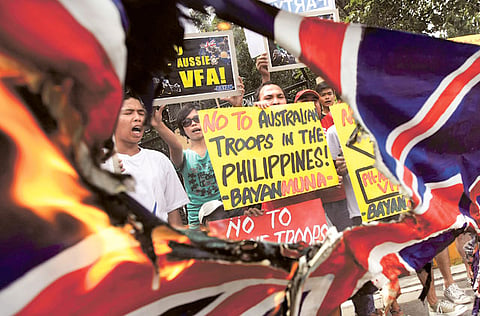
Manila: An agreement aimed at institutionalising the conduct of joint military exercises between Filipino and Australian troops faces further rough sailing at the Senate after one of the senators voiced opposition to its passage.
Senator Miriam Defensor Santiago said she would vote against concurrence with President Benigno Aquino III’s ratification of the Philippines-Australia Status of Visiting Forces Agreement (SOVFA) because its provisions does not concur with Philippine laws.
According to Defensor-Santiago, the Philippines-Australian SOFVA could have negative implications for the Philippines because, particularly in cases where Australian soldiers have committed crimes of offences during the conduct of joint military exercises.
She said that the VFA rules on criminal jurisdiction might be unconstitutional, because it impinges on the exclusive power of the Supreme Court to “promulgate rules concerning pleadings, practice and procedure in all courts” under the Constitution.
“This treaty violates the doctrine of void for vagueness. It is so vague that it will spawn myriad irritants in RP (Republic of the Philippines)-Australia relations,” said Santiago, an expert in international law and former chair of the Senate foreign relations committee
“The Philippine Constitution allows the death penalty for ‘compelling reasons involving heinous crimes,’” Santiago said. “Thus, there seems to be a conflict between the SOVFA and the Philippine Constitution,” she said.
Santiago said that the proponents of the RP-Australian VFA have not made clear what is the constitutional basis for the Philippines to allow our military forces to be trained by a Visiting Force in Philippine territory.
Aquino had certified the treaty as urgent, and it was sponsored last Monday by Sen. Loren Legarda.
The SOFVA had earlier been approved by then President Gloria Macapagal-Arroyo in 2007, but just like any other treaty entered into by the chief executive, it has to pass successive ratification by the Senate. But for some reason, the agreement did not make it past the Upper Chamber scrutiny due to some deficiencies.
Santiago pointed to a provision in the SOFVA, Article 5, para. 1, which provides that the Visiting Forces may temporarily use such defined land and sea areas, air space or facilities, of the Receiving State mutually determined by the Parties, for “combined training, exercises, or other activities mutually approved by the Parties.”
“The term ‘other activities’ is so open-ended and wide-ranging that it will become elastic, with virtual freedom for Australian forces to engage in any kind of activity within Philippine territory. That is unacceptable,” Santiago said.
On another point, Santiago criticised the VFA because it does not specify the magnitude of Australian military presence within the Philippines.
“This VFA will reduce Philippine sovereignty and may even pose a threat to the security of the Filipino people. Malacañang must clarify and renegotiate if necessary, what will be the specific activities of the Australian Visiting Forces,” Santiago said.
The SOFVA is a bilateral agreement between the Philippines and the Commonwealth of Australia with regards to the status of visiting forces from each state while in the territory of another state. It concerns the rights waived by either state since in the case of the Philippines, the Constitution bars the presence of armed forces of another country within its territory.
Currently, only forces of the United States is allowed in the country under the mantle of the Visiting Forces Agreement (VFA).


