Darshana Joshi: A role model for students who dream big
It has been a long road from Delhi to Cambridge, but electrician’s daughter hopes her story will inspire others
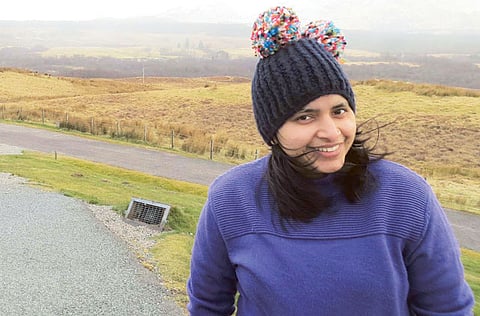
New Delhi: Darshana Joshi’s story starts from winning a ‘tiffin box’ in school to being awarded the Women’s International Network (Win) NavKiran Award 2012. The award has been given in a special category, ‘role models for the future’, making her the youngest recipient of this award.
The 23-year-old is one of those students who have time and again proved that educating oneself in a government school is not a bad idea after all. It’s just that one must have that spark to break the shackles of poverty, for there are enough support systems to let the students spread their wings and fulfil their aspirations.
Joshi, too, has institutions to thank for being where she is — from a Municipal Corporation School in Delhi to Cambridge University in the UK.
An electrician’s daughter, she says: “My monthly cost of living at Cambridge is more than half of my father’s annual income. It would have been beyond my imagination to even think of studying in the UK if it were not for the support from Udayan Care and Vatika real estate group.”
Here, Joshi speaks to Gulf News in an exclusive interview.
GULF NEWS: Government schools in India are often ridiculed for both education and their faculties. How much credit would you give to both for your achievements?
DARSHANA JOSHI: I was born into a lower middle-class orthodox family of marginal farmers in a village in the foothills of [the] Himalayas. My father moved to Delhi so that he could provide his three children [including my elder sister and a younger brother] a better education. I was enrolled into Class 3 in the Delhi government-run school, Nagar Nigam Prathmik Vidhyalaya, wherein I stood third in class and received a small tiffin box as a prize. This prize was extremely encouraging and motivated me to work hard. Supported by my teachers, I went on to win numerous certificates and cash prizes.
While passing out from this school, my class teacher advised my father to apply for admission to the Rajkiya Pratibha Vikas Vidhyalaya (RPVV) nicknamed ‘superability’. RPVV selected toppers from municipal schools and provided them with quality teaching and infrastructure at par with leading private schools. There has been no looking back after that.
I believe that this guidance was one of the most significant contributions, as it defined the direction for the rest of my life. I stress that the will to work for the betterment of students is what sets some [government school] teachers apart and they have the capacity to influence and shape their students in many ways.
GN: What role has the non-governmental organisation (NGO) Udayan Care played in your life?
DJ: My principal at RPVV had recommended me for the Udayan Shalini Fellowship (USF) programme of Udayan Care, considering my academic and socio-economic background. This fellowship has played a crucial role in my life and has helped in changing the attitude of my parents and family. So far, this programme has nurtured more than 3,000 girls from five different cities in India.
It is because of them that a shy dreamer like me turned into a determined person and persuaded my parents to let me go out of Delhi to study. Udayan supported me all through my high school and undergraduate studies. I was sent to the Jawaharlal Nehru Centre for advanced scientific research in Bangalore. And it continues to support me even today, as they have arranged half of the total funds required for my graduate studies at Cambridge. So, if you remove USF from my life, everything else goes away.
GN: Since you come from a humble background, do your parents find it tough to take care of your personal needs [like pocket money] in the UK?
DJ: The total financial liability towards my studies at Cambridge is taken care of by a combination of two scholarships. The first half came from VCare Trust of Vatika real estate group, which was also mobilised by Udayan. This helped me in winning the other half of financial support from the Nehru Trust for Cambridge University fellowship. These contribute towards my tuition and college fees and a marginal living stipend that I spend on my accommodation and other needs.
GN: What research programme are you doing at Cambridge?
DJ: My area of research interest is high efficiency and environment-friendly fast processors and light-emitting and energy-harvesting devices based on quantum principles. The next level of miniaturisation in electronic devices will be attained by mechanisms based on the quantum principles using nanotechnology. My work in these fields will play a crucial role in semi-conductor technology in future.
GN: Where do you see yourself 10 years from now?
DJ: I see myself returning to India after completing doctoral and post-doctoral studies with some exposure of working in industries. I would then like to take up research in one of the academic institutions of higher education and simultaneously pursue my passion for teaching. I wish to bring this culture to India, where collaborations between industry and academia are seldom heard of.
GN: How’s life at Cambridge?
DJ: I could feel the difference in our education and in the UK on the very first day. While in India things were only around academics, with long working hours and no time to pursue other interests, Cambridge is an altogether different training ground, where you learn from every small thing you come across.
It also came as a culture shock. In India, we are not used to the male chivalry, but here it is always ‘after you’. I am enjoying life at Cambridge, which is much more than academics. It is about fair practices and good work ethics.
GN: Have different situations and circumstances helped in making you a stronger person?
DJ: Seeing my parents struggle constantly for making ends meet within the limited financial resources and still being satisfied, has inculcated in me the value to help others. The faith shown by my family and friends is a constant driving force in my life and I wish to give much more back to society by helping the less fortunate.
BOX
• Darshana Joshi was born on October 12, 1989 to mother Jankee and father Harish Chander Joshi in Kairakoat village in Almora district, Uttarakhand.
• Studied at the Nagar Nigam Prathmik Vidhyalaya, New Delhi till 1999 and thereafter at the Rajkiya Pratibha Vikas Vidhyalaya, till 2006.
• Graduated from Miranda House, University of Delhi with a Bachelor of Science in Physics (Honours) in 2009.
• Masters in Material Science from Jawaharlal Nehru Centre for Advanced Scientific Research, Bangalore in 2012.


