Scars of attacks still run deep
In the shadow of New York's tragic events of 2001, post-traumatic stress disorder has quickly become a public health issue
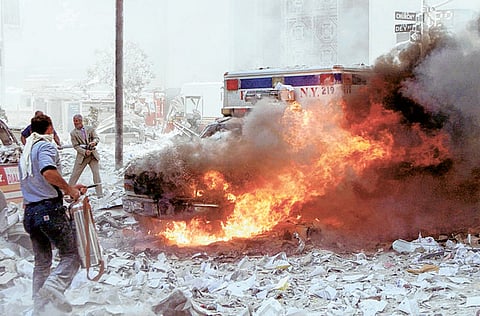
New York: For New York City resident Esperanza Munoz, the attack on the World Trade Centers is not over ten years later — not by a long shot. At odd moments, the stench of death still rises to her nose, and the 55-year-old woman slides into a haze of nausea and tears.
She suffers headaches and is awakened several times a week by nightmares of headless bodies and shoes with bits of feet left inside. She dreads the sound of sirens or a passing plane. Munoz lives in the New York City borough of Queens, and can't — or won't — go into Manhattan, even to attend her support group.
She went to a meeting a few blocks from the site of the former World Trade Center once, six or seven years ago, but she became so panicked she had to leave.
Munoz has a classic case of post-traumatic stress disorder, or PTSD, even though she is not a classic victim of the disorder. She has not survived a violent crime, warfare or even a clear sense that her life was threatened. She watched the fiery collapse of the World Trade Center towers from the roof of her apartment building in Queens, horrified but safe. Two days later, the office and residential cleaning company that employed Munoz assigned her to the blocks surrounding ground zero, where she picked up office mementos, charred debris and body parts from the ground almost every day for nearly four years.
A new phenomenon
By 2009, the woman who had left a peaceful life in Colombia so she could send her son to college had twice attempted suicide. When Al Qaida terrorists violently seized control of four US jetliners and crashed them, post-traumatic stress disorder was a diagnosis that had been in psychiatry's diagnostic manual for just 11 years.
If soldiers, police officers and others whose jobs revolve around mayhem complained of nightmares, flashbacks and disabling anxiety, they were more likely to be accused of malingering than they were to be ushered into therapy. But the events of September 11 set in motion dramatic changes on all those fronts. Afflicted firefighters, police and recovery workers were hailed as haunted heroes, not slackers. And a new generation of victims would soon bring the disorder to nearly every community in America.
The sudden abundance of sufferers from the condition, and of research on them, has prompted the nation's psychiatrists to broaden their criteria for diagnosing the disorder in ways that would make room for people like Munoz, whose exposure to the twin towers' fall was distant and whose symptoms took time to materialise. In the process, psychiatric leaders pondered for the first time how factors such as community cohesion, poverty and media coverage can affect the public's mental health when mass disaster strikes.
New reality
"9/11 changed the picture of PTSD, and transformed it from being simply a mental disorder that psychiatrists deal with to a public health issue," says Charles Figley, a pioneer in the study of the disorder who directs Tulane University's Traumatology Institute and Psychological Stress Research Programme.
For clinicians and researchers who had laboured through the 1980s to understand PTSD, those affected by the events of September 11 were a grim windfall — a population large and diverse enough to reveal important truths about the disorder.
The disaster gave researchers opportunities to study how trauma scrambles the brain. They could measure how often it appears in a typical population exposed to trauma and how long it causes disruption and disability (disease progression). For the first time, the size of the population affected by a single trauma allowed researchers to discern which attributes or experiences make some people more vulnerable to the disorder and which may be a source of resilience for others.
"Before we had the current notion of PTSD, we tended to think that those who developed it were people with character disorders — there was a sort of ‘blame the victim' quality to our thinking," says Dr David Spiegel, director of Stanford University's Centre on Stress and Health. September 11, he says, has challenged much of that thinking.
Researchers have followed populations of cleanup workers like Munoz, emergency responders, family members of those who perished and Manhattan residents affected by the coordinated attacks. Experts hope that if they can find a way to predict who is at greatest risk of developing PTSD and identify ways to protect against it, they could fortify vulnerable populations to withstand future disasters.
Lessons on trauma from terror strikes
Here's what a decade of research on those whose lives were changed on September 11, 2001, has taught us about the disorder.
How common is PTSD? In the first few months following September 11, surveys revealed that more than one in ten Manhattan residents showed symptoms suggestive of the disorder.
Their sleep was fitful; they had nightmares; they were edgy, irritable and easily rattled, and were bothered by the unpredictable return of frightening memories; and they took active efforts to avoid places, people and activities that reminded them of their trauma.
Among those living within close range of the twin towers' debris cloud, one in five reported a level of stress high enough to satisfy a PTSD diagnosis. For most people, such symptoms weakened within weeks or months, as New Yorkers regained their psychological balance.
Researchers found that six months after the attacks, 2 per cent to 5 per cent of New York City residents still could be said to suffer from the condition, and rates remained high among those who lived or worked in Lower Manhattan at the time of the attack. What factors make people more vulnerable to PTSD?
In at least 34 studies, researchers plumbed the distress symptoms of people directly affected by the September 11 attacks, including evacuees from the World Trade Center and workers at the Pentagon.
Those studies found consistent evidence that certain demographic factors could predict higher rates of the disorder — often twice as high, said psychologist Yuval Neria, director of trauma and PTSD at the New York State Psychiatric Institute.
Among the attributes that make people more vulnerable are low income, immigrant status, being female and having a history of depression or other mental illness. Dr Carol North, a professor of crisis psychiatry at University of Texas' Southwestern Medical Centre in Dallas, says that many of those factors clearly overlap. Low income, says North, "makes everything worse," including higher rates of victimisation, more chronic health problems and fewer resources to escape trauma or its psychological toll.
Sense of responsibility
Finally, shame, guilt and a sense of responsibility or blame can be powerful accelerators of the disorder, Spiegel says. In the face of helplessness, many victims of trauma would rather believe they could have done more to stop the crime or save the wounded, and they assume blame for events beyond their control. "That inappropriate shame or guilt is a big part of PTSD," he says.
Are there things that protect against PTSD? An emerging line of research is finding that people who weathered the tragic events in the midst of families, close friends and strong communities were much less likely to develop stress symptoms than those who said they felt lonely or lacked social networks as they dealt with the stress of the attacks.
Can you develop PTSD by watching gruesome images on TV? In its latest rewrite of the Diagnostic and Statistical Manual of Mental Disorders, the main book on mental health, the American Psychiatric Association has decreed that the answer is no.
People cannot get PTSD by experiencing disturbing events "through electronic media, television, movies or pictures, unless this exposure is work related." But some researchers are not so sure. Direct exposure to trauma "is an important but not necessary condition," Neria says.
Is PTSD real if it develops years after a traumatic event? It certainly can be. After September 11, studies found that the onset of the disorder was very often delayed among firefighters and emergency responders — workers whose training allows them to suppress their initial reactions to trauma and gore.
The fact that post-September 11 PTSD was more common in people who had experienced previous traumas also suggests that symptoms may not always develop immediately, experts say.
The survivor of one trauma may be scarred but not broken by her first experience, but that wound may reopen in response to a fresh trauma. Figley says that's a key lesson learned in the decade since September 11: that a person's response to trauma is defined by the lifetime of experience she brought to the event.
— Los Angeles Times


