Flagging up identity
The emirates that signed the treaty with Britain have had their individual flags since the early 19th century. These simple but functional pennants helped differentiate between enemy and ally in the days of pirate-ridden waters. Some of these flags are still in use today
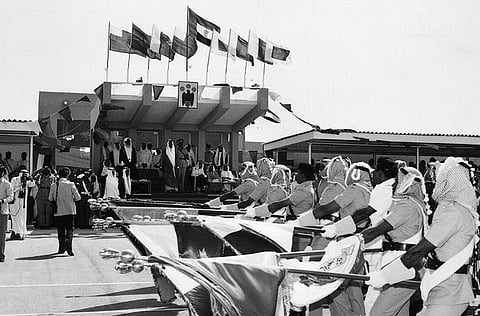
The emirates that signed the treaty with Britain have had their individual flags since the early 19th century. These simple but functional pennants helped differentiate between enemy and ally in the days of pirate-ridden waters. Some of these flags are still in use today
We are all familiar with the UAE flag, with its red, green, white and black bands, but very few of us know that the seven individual emirates also have their own flags, some of which are in use to this day. For example, in Abu Dhabi it is common on emirate government buildings to see the red flag with a white quarter near the flagpole. Dubai also makes frequent use of its red flag with a vertical white block next to the flagpole. Sharjah and Ras Al Khaimah share the same flag, red with a white border, which is a reminder of their common history as both emirates are Al Qasimi territories.
The story of these separate emirate flags goes back almost two centuries to 1820, when a General Treaty of Peace was signed between nine Gulf rulers and the British Indian Empire. Trade had moved for centuries from Bombay (now Mumbai) and Karachi up the Gulf to Basra and other Arab ports, and this had been agreed with the Persian empire, which was the dominant force in the Gulf at the time. But its authority started to fail in the late 1700s, giving way to the new naval power of the Al Qasimi (Qawasim) fleets as they operated from their towns in Ras Al Khaimah and Sharjah on this side of the Gulf, and Qishm island on the Persian side.
The British based in Bombay urgently wanted to establish a system by which trade could pass unmolested, and they needed to establish formal relations with the Gulf rulers to achieve this. So talks were started during the early years of the 1800s, culminating in a major naval expedition to the Gulf headed by Sir William Keir who was commissioned by the Governor of Bombay, the Honourable Mountstuart Elphinstone, to agree terms with the Arab rulers.
In 1820, the General Treaty of Peace was signed at a series of meetings between the British and the rulers of Ras Al Khaimah, Jazira Al Hamra, Abu Dhabi, Rams, Dubai, Sharjah, Bahrain, Ajman and Umm Al Quwain. The ruler of Muscat and Oman, Sayyid Saeed, was at the first great meeting in 1820, but he did not sign the treaty and left the meeting. Several years later the two rulers of Jazira Al Hamra and Rams surrendered their authority to the ruler of Ras Al Khaimah.
The treaty was not just a simple military imposition of British authority. Both sides agreed that the British would police the treaty, and a subsequent tour in 1823 by the British Resident in the Gulf, based in Bushehr (in modern day Iran), went a long way to agree with the rulers how this would work. The roving British naval force was seen by the emirates as an efficient way to stop attacks by pirates on their own shipping, which they had been suffering for some years but had been unable to find the power to resist effectively.
An important part of the treaty was that all ships from emirates that had signed the treaty would carry a red and white flag, both so that they would be immune to British naval action against piracy and from those areas which had not signed the treaty, but also to identify themselves as friendly to shipping from other treaty emirates. Each emirate developed its own design, which often changed slightly over the years, but the designs of those old flags are the roots of the flags that are still in use to this day.
The treaty system was not only applied to the emirates which much later became the UAE. Similar treaties applied to the Arab emirates further up the Gulf, as is illustrated by the red (or close to red) flags of Qatar (maroon with a white flank with a jagged edge), and Bahrain (red with a white flank with a jagged edge), and even the old (pre-1961) Kuwaiti flag (red with a thin white flank with a wavy edge, and white Arabic letters spelling out Kuwait).
Today Abu Dhabi, Dubai, Sharjah and Ras Al Khaimah all use their flags frequently, flying them on government buildings, or using them as insignia on official emirate documents, and often on the car number plates of significant government officials. Ajman shares the same flag as Dubai through a historical quirk, and Umm Al Quwain differentiates the basic red flag with a thin white stripe next to the flagpole and a white crescent and star.
The exception is Fujairah, which used an undifferenced plain red flag. It faces the Indian Ocean from the Arabian Sea coast, and since it is outside the Arabian Gulf it did not sign the General Treaty of Peace (just as Oman did not). So when an emirate flag was required, Fujairah was able to use the simple red without any differentiating mark.


