Home is where the Porsche kitchen is...
Increasing disposable income and status consciousness have fuelled a meteoric rise of luxury real estate developments in India
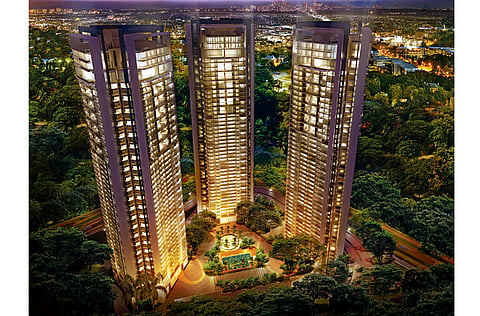
Ever since 1991, when India broke away from its socialist shackles and the infamous licence raj gave way to the luxury era, the axiom of every man for himself began to take capitalistic root. Ever since, it hasn't mattered whether bulls or bears stalked the stock market and the economic climate has ensured that the heirs to capitalism live in unfettered extravagance.
"In the 1960s, indoor comfort was symbolised by the electric ceiling fan. The next generation grew up in homes that had air-conditioned bedrooms, while today luxury is defined by splash pools, plunge pools and Jacuzzis, along with private gardens with hydrotherapy areas," says Sagar Chordia, Director, Panchshil Realty.
As the country rides high on the improving economy, real estate has emerged as one of the fastest growing sectors, according to business insight analysts Dun & Bradstreet (D&B) India. The company points to a healthy rise in demand in the premium housing segment, with luxury homes now a key focus area for developers.
Early this year, billionaire real estate developer Donald Trump announced a luxury residential tower in Mumbai in collaboration with local company Rohan Landscapes. His son, Donald Trump Jr, told Bloomberg at the time: "The [Indian] marketplace is beginning to understand and appreciate luxury, so there is a great opening for us there, as well as in resorts."
Also in Mumbai, Oberoi Realty's flagship project, Oberoi Garden City, is being marketed as a ‘city within a city' and is being described as the future of developments. The 80-acre project will have a mall, five-star hotel, international school and premium office complex. Further afield is Yoopune, a stunning new residential development from global design brand Yoo, in the western city of Pune. Set within an expanse of 17 acres including a five-acre rainforest, it promises access to a slew of exclusive services on its premises. Then there is M3M Golf Estate, in one of the most strategic locations — Golf Course Extension Road, Gurgaon, NCR — with lush golf greens spread around stunning towers, and with every apartment assured a great view.
According to consulting firm Technopak India's luxury market is pegged at $1.9 billion (Dh6.9 billion). Of this, the home décor segment, which is showing an impressive growth of 15-18 per cent per year, is estimated to be over $76 million.
Trump Towers and Armani Casa have certainly given a new spin to the luxury life. "The definition of luxury homes in India has seen a sea change. With rising aspirations, the globe trotter consumer is seeking exclusivity and customisation in every nook and corner of his home," says Vikram O. Datta, Vice-President, Marketing and Sales, Unitech, a developer with projects in Chennai and Gurgaon.
Providing this exclusivity are brands such as Fendi Casa, Cavalli, Versace Homes, Villeroy & Boch sanitary ware, Hansgrohe bath fittings and Porsche kitchens. When you're spending Rs40 million (Dh3.2 million) on a designer home, Rs5 million spent on designer Italian kitchens, is small change after all. These prices — starting at Rs1.5 million and rising to an astronomical Rs80.5 million — compare to the best in Dubai Marina, Singapore's Orchard Road or maybe even Manhattan.
But keep in mind that the Indian property landscape has undergone a very recent metamorphosis. Some of the more insignificant aspects of life in the UAE or in the West — that are often taken for granted in developed countries — are also included in the sales pitch, such as 24-hour security, uninterrupted electricity, modular kitchens and personal gyms.
Devotees of opulence
These new-age consumers of this uber lifestyle are buying not just a house, but social status, membership into an exclusive club and a showcase for their achievements. Nothing says ‘I've made it' like coughing up Rs80 million for a home. And in case the thought crossed your mind, expect your neighbours to be industrialists, media professionals, investment bankers, fund managers, corporate heads, diamond merchants and even stars of the Bollywood screen.
However, in all of this, let us not forget the Non-Resident Indians (NRIs) or expatriates. "They [NRIs] are keener than ever before to come back to India," says Ananta Singh Raghuvanshi, Director, Sales and Marketing, DLF India. "And they are the ones who are increasingly investing in luxury real estate so that they can enjoy the same amenities and living standards that they enjoyed all their lives overseas. The NRI investment in luxury real estate varies from state to state, [according to] the financial status they enjoy overseas and the location of the project. In DLF, NRI investment ranges from 20 to 50 per cent of the total number of customers in a project. For example, NRI investment in DLF luxury properties is 43 per cent in Kochi, 20 per cent in Chennai and 20 per cent in Bengaluru."
Sumptuousness in short supply
Although the demand for luxury real estate can never be nearly as high as that of middle-income housing, the future for this segment looks increasingly promising. "The segment is grossly under supplied. With incomes rising rapidly, more and more people have the purchasing power to invest in high-end luxury housing," says Chordia.
"Only a handful of builders today have both the knowledge and experience capital to enter into this segment and deliver a product that lives up to their promise. This makes the demand-supply gap wide, with demand exceeding supply," he adds.
Boutique homes are constructed in limited numbers, in high-profile locations that are in high demand, especially considering the steady percolation of wealth among a cross section of the population, leading to the rise of a new breed of affluent class whose lush lifestyle allows for nothing less.
‘Indians are becoming quality and designer savvy,' says Twinkle Khanna
Who would have thought Twinkle Khanna's claim to fame lay not in her impeccable lineage or her Bollywood roots, but in her aesthetically approachable and contemporary living spaces. The former film star has made a name for herself as an interior designer, most recently collaborating with the developer Panchshil on new projects in the western city of Pune. She talked aesthetics and Gaudi with GN Focus.
Why do you think there is an increasing demand for designer homes in India?
Indians are becoming quality and designer savvy. With rising incomes, luxury brands entering the market, and more Indians travelling abroad than ever before, we have become more aware of how we live and our outlook has become global. The concept of designer homes is ripe for a big boom in India as it assures a better quality of life in the home, more conveniences and facilities, a seasoned and elevated aesthetic sense and style, and a symbol to show that you ‘have arrived'.
But are Indians willing to try out new things?
As the world becomes more and more of a global village, Indians have rapidly become savvy consumers and are integrating the best design sensibility from the East and West. However, when it comes to trying out new things and being experimental, Indians are traditional in some aspects.
How would you describe your design philosophy?
I grew up with an appreciation of nature, craftsmanship and aesthetics. I have held the values very strongly and am very intuitive and perceptive during the design process. I am very passionate about homes being an organic place that can grow and give space for families to create dreams.
I am greatly inspired by the ocean and gardens. I strive to create homes that ‘bring the outside in', adding classic vintage pieces that add depth and style, all with a contemporary, natural feel. Another great inspiration is my Indian heritage. I'm also constantly seeking little treasures on my travels. My personal favourites include Antonio Gaudi — I love his wonderful architecture, organic and tactile shapes; and old Mughal art and motifs in the East, for the excellent craftsmanship and exquisite beauty.
Are you conscious of keeping things eco-friendly?
Yes, given the environmental problems we face in the world today, I use a lot of eco-friendly materials and fabrics in my work. These are exemplified in natural textures and colours.
What are you doing with Panchshil?
I have created three style palettes exclusively for Panchshil, which are designed to evolve and grow with the people who live there. By creating homes that use the modern and classic, seamlessly take the luxurious, dramatic quotient a notch higher. These contemporary styles create stylish, comfort and elegant living for the clients.


