Time to let actions speak
President Obama's failure to protect the very rights and peace he has called for is a heavy blow to Palestinians
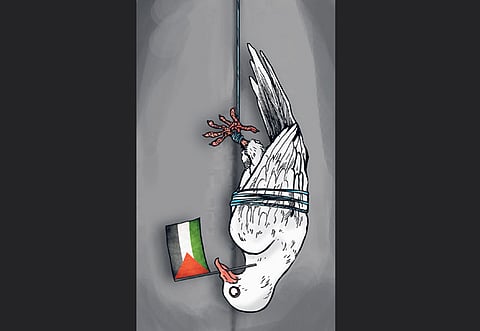
The elected Palestinian leadership is weak. And even with US Vice-President Joe Biden's visit to Israel, the West Bank and Jordan, the renewed Middle East peace process appears to be little more than a charade.
Israel has taken this opportunity to crack down on Palestinians who advocate non-violent protests against the Israeli West Bank separation wall and charged them based on questionable or false evidence.
I know: I was arrested for talking too much. All we Palestinians want is a life free from racial discrimination.
During 2009, 89 peaceful protesters were arrested; since January, more than 40 have been arrested.
The US president's support for non-violent protest could go a long way. However, President Barack Obama's repeated failure to protect the very rights and peace he has called for is a heavy blow to Palestinians. Especially now that Israel has taken to crushing the grass-roots equivalent of Palestinian Gandhis and Martin Luther Kings.
The power and importance of non-violent protest is close to America's heart. Decades after the African-Americans' historic sit-in at the Woolworth's counter, Palestinians live under a regime strikingly similar to Jim Crow. My Palestinian friends from the West Bank cannot eat dinner with me at my favourite restaurant in Occupied Jerusalem. They would need to obtain Israeli "permits" to visit me, a privilege given to very few. For my friends in Gaza, getting a permit to visit Occupied Jerusalem is nothing but a dream. Meanwhile, Israeli colonists live illegally on our land, sail through checkpoints and travel freely.
And it does not end there. One of the world's strongest armies pounded our cities in Gaza with white phosphorous and enclosed us in isolation almost with impunity.
Yet, every Friday, Palestinian villagers losing precious agricultural land to Israel's wall, turn out to protest peacefully. Unarmed farmers and entire families march to defend their lands. They do so though 16 have been killed, many just kids. They continue to show up though thousands have been injured.
In October, I expressed concern over the arrest of my colleague Mohammad Othman. Shortly before his arrest, Israeli soldiers at a West Bank checkpoint took him aside and warned: "We're going to arrest you, but it's difficult with you because all you do is talk." I wrote then: "If talking is a crime, if urging the international community to hold Israel accountable for theft of our land is a crime, then we all are vulnerable."
Less than two months later I, too, was sitting in an Israeli prison cell — for talking too much.
As they dragged me from my house, Israeli occupation forces threatened my family's well-being, saying they would only see me again after a prisoner exchange.
Because we Palestinians are under military occupation, where military decrees sharply limit political activity, the struggle for our most basic human rights is, by default, criminalised. Fortunately, individuals around the world, including European diplomats, demanded my release. Amnesty International's role was vital in suggesting that detained activists such as Abdullah Abu Rahma, Othman and I were in fact prisoners of conscience. Othman and I were released within a week of Amnesty's intervention.
Abu Rahma from the West Bank village of Bilin, however, is still in prison. He is charged with "illegal possession" of Israeli army equipment; charges which stem from his possession of spent tear gas canisters and bullet casings, which he keeps as evidence of the methods the Israeli army uses against the villagers when they protest the illegal confiscation of their land.
Last month, 40 Israeli soldiers raided our Ramallah office. They spent three hours turning it upside down and confiscating documents, research material, computers and electronic equipment.
More than six months ago, Obama delivered a powerful speech in Cairo in which he asserted America's commitment to promote the right to "speak your mind," to have "confidence in the rule of law and the equal administration of justice," all basic elements of democracy. His speech temporarily gripped a large part of the Palestinian people. We were cautiously hopeful.
But Obama's quick and near-total reversal on Israeli colonist activity and his silence in the face of the Israeli onslaught on Palestinian human rights and democratic freedoms came as a shock to those of us who dared to hope.
Because Obama is unwilling to stand up to Israeli Prime Minister Benjamin Netanyahu and domestic critics, Palestinian civil society leaders are subject to unchecked seizure by Israeli forces in the middle of the night.
Critics in America say the solution is for a Palestinian Gandhi to emerge from within our society. This seems increasingly untenable when unarmed teens and real- life Palestinian Gandhis such as Bassem Abu Rahma are killed by an occupying army that regularly counters non-violence with violence.
What Palestinians want are simple demands: self-determination, the right of our refugees to return, a life free from racial discrimination, an end to the brutal occupation and the immediate dismantling of the illegal wall.
Less than 50 years ago, the American civil rights movement had inspired people worldwide with its many successes in pursuing social change through nonviolent means. Today, the US vice-president doesn't inspire when he visits Israel and fails to denounce the illegal occupation and clamour in a clear moral voice for Palestinians' freedom. Instead, America has provided $30 billion (Dh110.34 billion) over the past 10 years to Israel in military aid. And Obama has fallen silent on the issue of Palestinian non-violent protests.
By speaking up for communities being ruined by the wall, for protesters being killed or maimed and for community leaders being hauled away in the middle of the night, the Nobel Peace Prize laureate will not only imbue his Cairo words with meaning, but will be promoting basic elements of democracy.
Jamal Juma is the coordinator of the Palestinian grass-roots Anti-Apartheid Wall Campaign. He was released from an Israeli prison on January 12.


