The power of connectivity
Television, social networking and cell phones have evolved into weapons for change
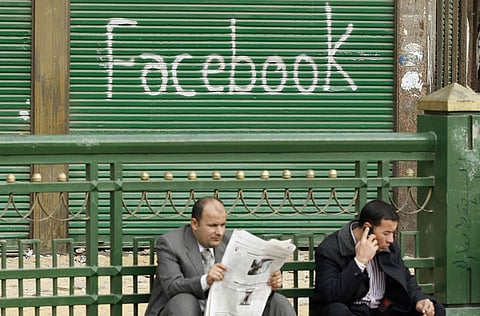
It took only a few seconds for the appeal to protest to turn into a hot item on Facebook. What happened after that has become an unforgettable part of Egypt's history.
The Arab world is waking up to a new surrounding — one which has never been experienced on such a large scale before. Social networks have offered people across the region a channel which has never been exploited on a mass scale. Virtual reality after all will indeed dictate its own terms — virtually.
Today, how we view events and form opinions has been redefined by the connectivity of the internet and satellite television. The question is not really about how this is bringing about change in the lives of people in the region. Rather, it is how users in the Arab world — for the first time — have utilised it to its maximum capacity.
Never has any country experienced immediacy of connectivity on such a scale.
Have we reached an era where change could not take place, whatever it is, without the involvement of the big screens — those of the television, the computer, and the mobile phone?
The minute-by-minute detail of the unfolding events first in Tunisia and later in Egypt could not be described except as being mind-boggling. The clashes, the violence, and the intensity of the emotions on the part of all those who were on the streets of Tunis and Cairo seemed so real and hence intimate.
In fact, the two forms of social media — Twitter and Facebook — were instrumental in enabling the initial stage of organising an organic movement by the people. This was the case even after severe restrictions were imposed by the authorities.
Bloggers
Furthermore, blogs have also been an essential part of this network of connectivity. Bloggers seem to have taken on a dual role. On one hand, their blogging kept everyone in touch and abreast of the latest developments.
At the same time, by directly reporting what was taking place, bloggers became eyewitnesses whose accounts amounted to being a valuable collection of information. Not only were they keeping those who are within their circles in contact but also maintaining it beyond that.
There is no question, of course, that live television coverage is not new. It was present even decades ago when dramatic changes were watched by millions across the globe. What is different today though is this bond between all those mediums of television and the virtual world of the internet, which has lent it power beyond imagination.
The images of protesters in Tunisia dominated the screens for weeks until change of the status quo became inevitable. Similarly in Egypt, the constant images and updates are having an irrevocable impact.
East or West, day or night — the live coverage had something for the viewers, feeding them by the hour. What was even more amazing about this entire experience is the manner in which international powers were reacting.
It was as if policy-making was being decided by the live updates of what was happening on the ground and what was being reported live. This was surely a making of the news — literally — and a virtual reality that you can never turn off.
Had anyone expected to be in full, instantaneous, uninterrupted view of opposing parties throwing stones at each other tirelessly for hours? Had anyone anticipated that the coverage from the frontline at Tahrir Square would transform how conflicts will be fought from now on and by which means change will be enforced?
This is a new age of live coverage. It is one that will shape how conflicts will evolve — and even get out of control — as the events are being followed by the minute as they unfold. And it is the new generation which has come of age with the existence of social networks that are spearheading and commencing such change.
Still, a lack of live coverage or absence of social networks would by no means stifle people's reaction. Perhaps, grievances would have still been aired on the streets.
Yet one could not take the impact of the tweet and the upload lightly. And at the same time, one should not be disillusioned about the capability of the virtual world to ensure the free movement of information and communication. For the same tweet that can be picked up and re-generated by the millions of websites, it can also be tracked down by watchful eyes.
The power of the image and the update, whether via social networks, on television or the mobile phone has been converted into a mass global product with a massive impact — one that can never be unplugged.


