The Mediterranean crucible
Europe's financial problems will only worsen if it does nothing to create the economic and social progress sought by the rapidly growing young Arab population in its neighbourhood
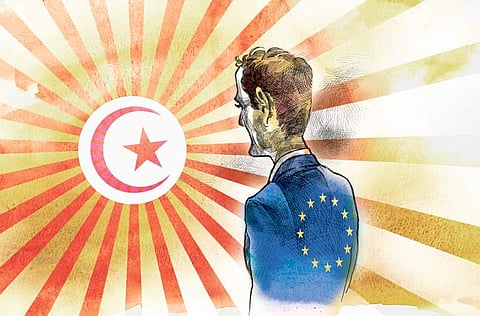
For most Europeans, the Mediterranean is an annual object of longing — the holiday idyll where they spend the best weeks of the year. But many Europeans' sunny view of the region has yielded to lowering clouds of pessimism.
Inside the European Union, the ugly term PIGS (Portugal, Italy/Ireland, Greece, Spain) is now a commonplace, denoting countries that have endangered the euro's stability and are forcing northern Europeans into costly bailouts. Where not long ago sunshine and solidarity were the order of the day, depression and confrontation are now the rule. Worse still, Europe's debt and confidence crisis is also the EU's gravest political crisis since its inception: at stake is nothing less then the future of the European project itself.
And now the crisis has reached the southern shore of the Mediterranean, in the form of a revolution in Tunisia and a political showdown in Lebanon that has once again brought the country to the verge of war and disaster. With the EU's Mediterranean member states simultaneously faltering, great changes are afoot in Europe's southern neighbourhood.
So it is time to think geopolitically, not just fiscally, about the Mediterranean. What the EU is facing in the Mediterranean isn't primarily a currency problem; first and foremost, it is a strategic problem — one that requires solutions urgently.
The overthrow of Tunisia's Zine Al Abidine Bin Ali is the first such spontaneous democratic uprising in the Arab world, showing that in an age of satellite television and the internet, suppression of information and free expression by individual governments doesn't really work anymore.
Add to this the fact that the Arab world's nationalist regimes lost their popular legitimacy long ago. The ‘Chinese option' — economic rights and prosperity in exchange for public quiescence — is not feasible, owing to these regimes' ineptness and rampant corruption. As a result, their inability to reform, combined with rapid population growth and a rising cohort of young people, is placing them under pressure, creating a possibility of explosive change.
Whether a development will occur in the Arab world similar to that in eastern Europe after the fall of the Iron Curtain is impossible to predict for the time being. In eastern Europe, with the withdrawal and eventual disappearance of the Soviet hegemony, the floodgates were opened, and a torrent of change washed over the region.
In the Middle East and the Maghreb, this external factor is missing; democratic change must come from within each society. Tunisia shows that no government that has lost its legitimacy and is supported only by bayonets is sustainable in the long term.
Dire consequences
Whether Tunisia becomes a democratic, economic, and social success story or, instead, sees its revolution end in chaos, civil war, and a new authoritarian regime will have consequences far beyond the country's borders.
Europe, as Tunisia's northern neighbour, will be directly affected either way, and should therefore become seriously involved in terms of promoting democracy and aiding economic progress. Whatever mistakes Europe may have made vis-à-vis the region's authoritarian regimes in the past, it can now correct them by providing decisive help.
Indeed, Tunisia is a stern test of the EU's ‘Mediterranean partnership' — a long-promoted policy that so far consists of little more than empty phrases. Tunisia's revolution is a unique historical opportunity, and the EU's stake in the outcome can hardly be overestimated. European officials in Brussels and the major EU governments should not go for political and economic half-measures.
Specifically, beyond direct help for Tunisia at this critical moment, the EU must breathe new life into the Mediterranean partnership. Projects for strategic cooperation in energy — say, production of solar and wind energy in the Sahara for sale to Europe — would be especially valuable.
The EU and its member states should make this new form of energy production and cooperation the key project of the Mediterranean partnership, and must ensure the necessary political conditions to accomplish it rapidly. This would create new prospects for the countries in the EU's southern neighbourhood, and thus give the transformation process an economic and technological impetus.
Moreover, such projects would promote cooperation between the states in the EU's southern neighbourhood, potentially boosting investments in education, infrastructure, and industrial development. This would create the most important thing that these states and their rapidly growing young populations need to produce stability within the framework of democratic development: grounds for hope of economic and social progress.
If the Europeans continue to look inward, allowing accountants to dominate discussions of Europe's future, they will miss a historic opportunity — one that will directly affect Europe's security. In that case, the costs tomorrow would be far higher than the savings today.
— Project Syndicate/Institute for Human Sciences, 2011


