Surprising indifference of US media to the Iran story
The neglect with which the influential have treated news of nuclear talks from and about Tehran is instinctive
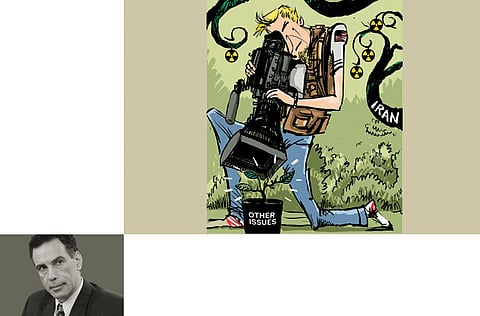
I write from Washington. The past two weeks witnessed significant developments in the ongoing Iranian crisis. But you would not know it from the press or watching the countless news networks in the United States. The Iranian crisis seemed such a distant concern. It hardly made any headlines and whatever news there was had no urgency to it and was discretely buried among similar non urgent news items.
The mass media were principally preoccupied with President Barack Obama’s statement that he supported same-sex marriage. Public opinion polls suggested that although support for same-sex marriage has increased among the general public, Obama’s statement, while popular with certain sections of the population, is not likely to have a major impact on his election prospects.
American commitment to preventing Iran from developing nuclear weapons, on the other hand, has been defined as a national security issue. How Obama ultimately handles the crisis is likely to have a significant impact on his ability to secure a second mandate.
This interesting state of affairs is one of those quirks of the interaction between the politics of mass media and the politics of election year campaigns. It has to do, among other things, with the issue of how the mass media operate and how its obsession with dramatic and dramatised coverage of certain news, decide what goes on the political agenda nd what priority the public is encouraged to give it.
This can lead to manipulative results and sometimes catastrophic consequences. As for example, when Judith Miller used her influential position with the New York Times to dramatise unsupported statements about the existence of weapons of mass destruction in Iraq, and in so doing drummed up support for the war in Iraq. With no weapons of mass destruction to be found in Iraq, a sober recognition that the American people had been deceived slowly but inevitably emerged. The New York Times recognised its culpability in allowing itself to be part of the deception. It apologised to its readers and let Miller go.
Or take the example of the Arab Spring. The drama of streets filled with protesters demanding and bringing about revolutionary changes captured the imagination and the attention of the Western media. But the hard work of imagining democracy and building its institutions lacked the drama of upheavals and street revolutions and therefore proved unable to attract and maintain the interest of the Western media, let alone that of the political establishment.
And how does one explain the general indifference towards the bloodshed in Syria, while the Libyan rebels were quickly made to benefit from Nato military might and airpower to defeat Muammar Gaddafi? The latter’s sudden U-turn from a self-styled nationalist to a practical globalist and his readiness to renounce nuclear weapons did not earn him any grace. He died an ignominious death.
Maybe, the neglect with which the influential and the mass media treated the news from and about Iran was instinctive. The American public, after all, has been conditioned to associate Iran with bad news. To the American public, the Iranian state readily brings to mind images of “rogue state”; a “sponsor of terrorism”, and of “fanatical Mullahs” running amok. In the case of Iran, the Western media instinctively reacts with alacrity to bad news. Good news that contradicts these negative images are played down or considered as aberrations.
But the news from and about Iran was indeed rather encouraging. The Istanbul nuclear talks between Iran and the group of 5+1 (USA, Russia, China, England, France plus Germany) were generally considered by the parties as constructive. Only a few days before the next meeting scheduled on Wednesday in Baghdad, the parallel talk, in Vienna, between Iran and the International Atomic Energy Agency yielded encouraging results. The nuclear negotiators resolved previously deadlocked issues regarding access to Iranian military installations.
Last week, the German government expressed hope that Wednesday’s meeting in Baghdad will result in a “compromise” on the Iranian nuclear issue.
To which Iranian Foreign Minister Ali Akbar responded by telling Fars News that if the same spirit of cooperation that emerged at the Istanbul meeting continues to influence the Baghdad talks, there is good reason to believe that the Baghdad meeting will produce positive results.
And then there is of course Israel, a major player that the Iranians wish to bring under the control, but that the six world powers cannot ignore.
Like the conditioned Western media, the Israeli government of Benjamin Netanyahoo is instinctively inclined to reject good news from and about Iran.
It was no surprise, therefore, when the Israeli newspaper, Haaretz, reported that Israel “feared” the forthcoming nuclear talks might produce an agreement and that Israel viewed that prospect “with some bitterness, perhaps even with hope that they will fail completely.”
This view is not shared by the negotiators. Catherine Ashton, European Union High Representative for Foreign Affairs and Security Policy stated last week that she hoped the Baghdad talks will mark the “beginning of the end” of the Iranian crisis.
A possible interim agreement will allow Iran to enrich uranium to the level of 20 per cent — approaching the levels for a nuclear weapon — but would force Iran to stop enriching the uranium underground. In return, the six world powers will gradually suspend some of the sanctions already in place; an agreement, which Israel “completely rejects.”
Israel’s position is not surprising. Nothing will satisfy the current Israeli government that fails short of completely denying Iran the military means of challenging the present balance of power in the region crushingly dominated by Israel.
But why the indifference shown by the Western media to the reports of progress? If the Iranian crisis was a ‘good story’ when there were threats of war; surely it ought to be an equally ‘good story’ when there is talk of peace.
Adel Safty is Distinguished Visiting Professor and Special Adviser to the Rector at the Siberian Academy of Public Administration, Russia. His book, Might Over Right, is endorsed by Noam Chomsky and published in England by Garnet, 2009.


