Speaker holds key to Lebanon’s political future
Only bold decisions will exhibit the speaker’s farsightedness in Lebanon
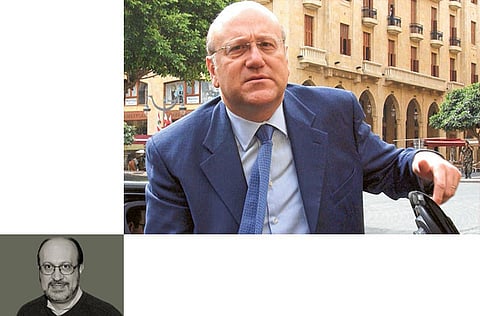
When Najeeb Mikati resigned last Friday, after his own ministers snubbed the prime minister by denying both, a routine appointment as well as authorise the creation of a commission to oversee the scheduled June 9, 2013, parliamentary elections, Lebanon faced a genuine political vacuum. Its fate was now squarely in parliament’s shaky laps.
To be sure, senior leaders insisted that the Lebanese should not be concerned about a political void because, in the words of President Michel Sulaiman, “a new government can be formed [to replace] the one that resigned.” In reality, few believed that the nation’s concerns could be solved with a fresh cabinet, even if it enjoyed consensus.
In the event, Speaker Nabih Berri called for holding a national dialogue before the formation of a new government. He insisted that in the absence of such “an agreement, a new government will not be formed even 15 years from now”. “Dialogue,” he hammered in an interview with the daily Al Hayat, “should be held before the parliamentary consultations in order to reach consensus on some essential issues that would facilitate the formation of a government”.
Still, it was difficult to see how various antagonists would accept to gather under the president’s leadership, ostensibly to commit to a solution, when political vacuum remained the ideal objective precisely to force “others” to commit egregious errors. Indeed, the speaker’s colourful “15-years-from-now” reference spoke volumes, though neither he nor Lebanon has that long to put their respective houses in order.
Rather, Berri knew that his mandate would end on June 20, 2013, when the parliament’s term would expire. Although the affable speaker assumed that his challenge was easy and could be resolved by a new round of bargaining that the Lebanese built their shaky reputations around, in reality, the challenges were ominous.
It was important to re-emphasise that all deputies ceased to be representatives on June 21 because the Constitution denied wily politicians automatic extensions. Under the circumstances, the speaker had two options: Convene parliament to vote on a new electoral law, that would allow fresh elections to be held within a specifically defined timetable. Or, extend parliament’s mandate for a specific period of time, which could range from six months to three years. In the absence of a consensus law that was acceptable to all leading parties, and because everyone rejected the current 1960 legal framework, few anticipated elections as scheduled.
Consequently, chances were excellent that Berri would propose, and all elites would accept, an extension.
Beirut, nevertheless, confronted a shorter-term abyss — the formation of a new government, even if there were many disputes. The speaker, for example, voiced support for the formation of a national unity government as opposed to a cabinet of technocrats, even if he knew that constitutional rules stipulated an appointment without preconditions. Unflinching in his rationale, he wondered whether a technocratic government was the answer, since he correctly assumed that ministers would simply “refer back to the [political] leadership that nominated them.” Courageously, he expressed a preference for a national unity government formed by political factions, even if two such previous experiments had failed to achieve anything substantive.
Others were equally adamant. The Kataeb Party called for a salvation government, the Free Patriotic Movement backed a coalition cabinet, while the Future Movement advocated the formation of a neutral administration. Even if these positions were bargaining chips, they all reflected deep-rooted divisions, which confirmed how deadlocked the Lebanese elites were. Only Walid Junblatt, the head of the Progressive Socialist Party, was contemplative. In as much as it was Junblatt’s doing that facilitated the political coup d’état that ousted prime minister Sa’ad Hariri two years ago, his current mood highlighted an intrinsic dilemma: Should he rejoin the March 14 camp that would then enjoy a parliamentary majority?
The trouble with Lebanon was that its senior leaders were all beholden to narrow constituencies, though Speaker Berri had a rare opportunity to break out of his straightjacket, overcome sectarian biases and place the interests of the entire country ahead of any other considerations. What was required was a two-pronged vision.
First, to deliver an honest summons that would address the Lebanese, if only to confirm that a full-fledged political deadlock prevented parliamentary elections because no consensus existed over a new electoral law. Berri ought to also acknowledge that his remaining choice was to extend parliament’s mandate for three years. Such a breathing space may help clarify available options and prevent Beirut from confronting a real political as well as a security vacuum on June 21.
Second, the speaker ought to also distance himself from the failed national unity government option, if he wished to end the Lebanese penchant for indecisiveness. He ought to persuade his on-and-off ally, Junblatt, to side with the parliamentary majority that was duly elected in 2009 — if for no other reason than to protect Lebanon from both regional convulsions as well as internal gambles that reflected a regrettable preference for political martyrdom.
Only such bold decisions will exhibit the speaker’s farsightedness. And only he can salvage what can easily become Beirut’s latest nightmare.
Dr Joseph A. Kechichian is the author of Legal and Political Reforms in Saudi Arabia.


