Netanyahu's chance to make history
The Israeli premier has to show the political will to take Palestinian peace talks to their logical conclusion
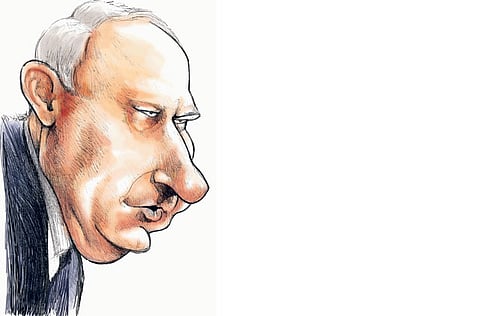
It is clear that the road to a peaceful settlement of the Arab-Israeli conflict winds through Washington. The late Egyptian president Anwar Sadat understood this reality.
In 1972, Sadat dramatically put an end to the special relationship Egypt had with the Soviet Union, expelled Russian advisers, and made it clear that he was ready for a change of alignment.
Washington either failed to see the magnitude of the ideological and strategic changes Sadat's policies implied, or perhaps the Nixon administration paralysed by the Watergate scandal had no energy to sponsor the search for peace in the Middle East.
Disillusioned by Washington's lack of appreciation for his dramatic gesture, Sadat found himself in the ironic position of having to accept a famous dictum of his predecessor Jamal Abdul Nasser (whose policy Sadat had just dismantled): ‘What is taken by force can only be recovered by force'.
It was only after Sadat successfully coordinated with Syria a military offensive against the Israeli army occupying the Egyptian Sinai and the Syrian Golan Heights that Washington got involved in arranging military agreements for separation of forces in the Sinai.
This reality of the primordial role played by Washington, strengthened by President Barack Obama's sustained interest unprecedented in the history of the conflict is again in evidence.
Obama has made it clear to Israel that he is dissatisfied by the slow pace of progress. The Israelis are not insensitive to this message from Washington. Notwithstanding the large number of pundits who have been claiming that Israeli Prime Minister Benjamin Netanyahu has withstood the pressure from the Obama administration, and had even outmaneuvered Obama himself, the Israeli press has reported that Netanyahu is, in fact, ready to accept an American peace plan.
The plan calls for peace talks between Israelis and Palestinians that will last for two years, be based on the establishment of a Palestinian state on the June 4, 1967, lines, and include an exchange of territory. The plan is reported to include discussions on two core issues: Occupied Jerusalem and the Palestinian refugees.
Both Netanyahu and Palestinian President Mahmoud Abbas met with Egypt's President Hosni Mubarak and discussed the plan. Mubarak sought and received the support of some Arab countries including, crucially, Saudi Arabia. Egyptian envoys met with officials of the Obama administration on Friday in Washington.
US Secretary of State Hillary Clinton added weight to speculation about the plan by stating that the Obama administration wanted a viable Palestinian state based on the pre-1967 lines with agreed exchange of territories, and a secure Israel within boundaries that reflect current demographic realities.
Showing promise
There is therefore cause for cautious optimism. But it is important to bear in mind that Israeli leaders in the past have failed to demonstrate the necessary courage and political will needed to conclude an agreement.
An Israeli document obtained and exclusively cited in the Israeli newspaper Haaretz on December 13, 2007, showed that at the Camp David Summit in July 2000, Palestinians and Israelis had achieved significant progress on core issues. Although the late Palestinian president Yasser Arafat has been blamed by US president Bill Clinton for the failure of the Summit, the Israeli document shows that the Palestinians "were willing to show flexibility, and had agreed to adjustments to the June 4, 1967, borders."
Haaretz also quoted the Israeli document as saying that the Palestinians "showed understanding of the sensitivity of the issue [of refugees' right of return] for Israel, and willingness to find a formulation that would balance these feelings with their national needs."
Furthermore, the final joint declaration of the Taba (Egypt) negotiations (released on January 28, 2001) stated that "the two sides declare that they have never been closer to reaching an agreement." Yet, then Israeli prime minister Ehud Olmert found it necessary to spend more time on the election campaign trail. He withdrew from the negotiations two days earlier than planned.
Late last year, Haaretz also made public for the first time the map that Olmert proposed to Abbas in September 2008 as a basis for borders between Israel and the Palestinian state.
Olmert proposed annexing to Israel 6.3 per cent of the West Bank comprising 75 per cent of the colonies in the occupied Palestinian territories. In return, 5.8 per cent of Israeli territories was to be transferred to the Palestinians. But Olmert refused to give Abbas an official copy of his proposed map before Abbas agreed to signing a comprehensive and final agreement.
It is therefore a welcome development that Netanyahu seems to appreciate the fact that Washington cannot be bypassed. Obama's sustained interest in a lasting resolution cannot be indefinitely defied.
Still, Netanyahu has been criticised in the past for reneging on agreements and for frustrating US efforts to bridge the gaps between the positions of the parties. He now has a unique opportunity to change this legacy, and make history.
Adel Safty is distinguished professor adjunct at the Siberian Academy of Public Administration, Russia. His new book, Might Over Right, is endorsed by Noam Chomsky.


