National unity above all else
The demand for a caretaker government in Bangladesh is a very valid one
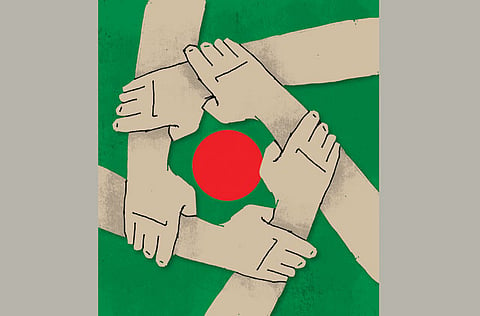
Forty-one years after Bangladesh gained independence on Victory Day — December 16, 1971 — its citizens are faced with two stark choices before them that are dividing the nation of 150 million people.
One involves the war crimes trial and atrocities committed by some 40,000 collaborators of the Pakistani Army during the country’s independence war. The other involves the issue of holding free and fair elections under a neutral caretaker administration.
The people of Bangladesh are largely united in their opinion on both issues. Unfortunately, the two leading political parties — the ruling Awami League and the main opposition, Bangladesh Nationalist Party (BNP) – have taken opposing stand on this.
Awami League, which once championed the institution of caretaker governments to ensure free and fair elections, now opposes it — due to its fear of losing the polls. The BNP, which vehemently opposed it while in power, now demands it in order to be able to come to power — with the help of the Jamaat-e-Islami party.
A majority of the war crime suspects currently on trial are leaders of the Jamaat, which relies on BNP’s support to survive, while the BNP relies on the Jamaat to win general elections.
The Jamaat and its allies worked closely with the Pakistani military in conspiracies, attacking, arresting and torturing freedom fighters. Its members were allegedly involved in the rape of women and mass killings of pro-independence forces. Its cadres helped kill intellectuals a few days before the surrender of the Pakistani Army. Bangladesh had banned the organisation after independence. However, the BNP, established by General Ziaur Rahman — a freedom fighter — helped rehabilitate it while Rahman’s widow, Khalida Zia, did the rest by helping it emerge as a force again.
BNP was voted to power in 1991 with the indirect support of Jamaat, while it lost elections in 1996 when the latter contested polls separately. In 2001, the BNP formed an alliance with the Jamaat to secure a landslide victory that increased its dependence on the latter — so much so, that for the first time in Bangladesh’s history, two of its members suspected of war crimes were appointed cabinet ministers.
Thus, those who helped kill freedom fighters and rape women during the war of independence were seen commuting in cars carrying the national flag — all in just 30 years after independence!
Moreover, extremism and terrorist activities have peaked in an otherwise secular Bangladesh during the reign of the BNP–Jamaat between 2001 and 2006.
As the trial of war crimes enters its crucial stage, the Jamaat is trying its best to save its leaders from prosecution through agitation. The recent attacks on policemen and public property are a desperate attempt to create unrest in the country.
Trial of the suspected war criminals is a national demand. However, it seems that the Jamaat has succeeded in pursuing the BNP to play their game.
A valid demand
The demand for a caretaker government is a very valid one and no right thinking person in Bangladesh will oppose it. So, the BNP has a solid issue to rally public support. It does not need to dance to the tune of the Jamaat. BNP is a party of many patriots. It has its share of freedom fighters who should help its leaders refocus on the more important national issues rather than play into the hands of suspected war criminals.
However, the ruling Awami League could show some intelligence by coaxing the BNP to join ranks to strengthen national unity on the war crimes trial. For that, the Awami League will do well to agree to the opposition demand of holding elections under a caretaker administration. It is time to show some pragmatism and courage to rise above the occasion. Both parties will have to give up somethings: ego, for one.
In this way, they both will help the country achieve two key national objectives — ensuring free and fair elections and the trial of war criminals. In return, they both will win wider public respect, trust and confidence and help eliminate the threat of third-party interference in the country’s national politics.
This is the best gift they can offer on Bangladesh’s Victory Day.


