It’s time for another ‘Arab awakening’
Despite one’s insistence on optimism, current political discourse is hateful
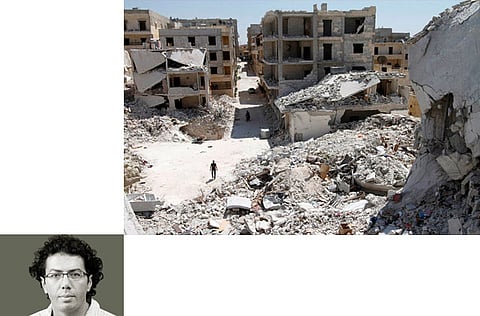
When innocent 14-year-old Mohammad Qataa was shot in the face, apparently by North African Arab “rebels” in the Syrian city of Aleppo on June 10, the criminality of that act was another addition to a much greater crisis permeating through the Middle East. The boy was condemned to death for “blasphemy”, thus signalling that the level of extremism and sheer savagery by all parties at work in Syria, has crossed every humane boundary there is.
According to the boy’s younger brother, three men kidnapped Mohammad from a local cafe where he worked, for referring to Prophet Mohammad (PBUH) in a way they deemed disrespectful. They brought back his tortured body while he was still alive and then, following a brief speech by the gang’s leader, they fired two bullets in the boy’s neck and mouth in front of his family. Soon after his murder, when I saw close-up footage of the child, I was tormented by the thought of his parents kneeling down as he lay dead at some dirty street corner.
In such harrowing scenes, no words suffice, nor does logic, intellectual debate or religious wrangling of any sort. Islam is innocent of this barbarity even if the criminals insist upon appropriating religious text to justify the blowing up of a child’s face. This is not the kind of Syria that the Syrian people want, regardless of where they may stand politically or otherwise. No child should be subjected to this, no mother or father should be forced to bear this, no brother should witness the execution of his older sibling and stand in front of a camera to explain the harrowing details.
Still, there is much that must be discussed and confronted with absolute clarity.
Firstly, this savagery is not limited to just one Syrian town, but is becoming the defining, overriding factor of the civil war in Syria. Secondly, and equally important, traces of such extremism can be found in various aspects of Arab societies, propelled by intellectual and religious extremism and funded by various governments in the region. The degree of hate that is polarising and regrouping many Arab societies around religious, sectarian and ethnic lines seems inexhaustible.
Following the so-called Arab Spring, I visited the Middle East several times. In my first visit, I was enthralled by the fact that people spoke louder and clearer by using a unifying language that was saturated with hope. Now, the fear and hushed voices are unmistakable. The mistrust is intense and disheartening. I have no doubt that the promoters of sectarianism, whether conscious of it or not, have staged the largest counter-revolutionary act there is. And they are winning.
In my first visit, I was engaged in many discussions pertaining to freedom, reforms, justice, human rights, developments and various possible manifestations of Arab unity. Now, speaking of such topics will make one seem removed from reality. Other discussions, at least for now, seem more urgent.
My friend Hanna is a Syrian and also a Christian. The latter fact was rarely of consequence, except whenever he wished to boast about the contributions of Arab Christians to Middle Eastern cultures. Of course, he is right. The modern Arab identity has been formulated through a fascinating mix of religions, sects and races. Christianity, as well as Islam, is deeply-rooted in many aspects of Arab life. Needless to say, the bond between Islam and Christianity is simply unbreakable.
“I am Christian, but, in terms of culture, I am equally a Muslim,” he told me by way of introduction to a daunting realisation. “But now, I am very worried.”
Hanna’s list of worries is long. Foremost among them is the fact that Christian Arabs in some Arab societies are being increasingly viewed as “foreigners” or “guests” in their own countries. At times, as was the case in Iraq, they are punished by one extremist group or another for embracing the same religion that US-western zealots claim to represent. Churches were blown up in brutal retribution for a brutal war that former US president George W. Bush and many of his ilk maintained to be between good and evil — using the most brazen religious references as they savaged Iraq, sparing neither Muslims nor Christians.
To some extent, Arab revolutions were rightly understood as a response to all of this. It was a collective retort to oppression of all sorts, dictatorships, injustice, inequality and the numerous divides that espoused endless fears, however irrational.
Soon after the Egyptian revolution, I walked the streets of Cairo, reminiscing, with much giddiness — about the past and the encouraging future. A “new Egypt” was being born, one with ample room for all of its children. An Egypt where the poor were given their fair share and where Muslims and Christians and the rest would march forward, hand in hand, as equals, compelled by the vision of a new generation and the hopes and dreams of many more. It was not a romantic idea, but thoughts inspired by millions of Egyptians, by bearded Muslim men protecting churches in Cairo against government plots to stir religious tensions, by Christian youth guarding the Tahrir Square as Muslim youth prayed, before they all resumed their fight for freedom.
Despite one’s insistence on optimism, the current political discourse is utterly hateful, polarising and extremely defeatist. While Muslim political elites are sharply divided between Shiite and Sunni, assigning layers of meaning to the fact that one is born this way or that, this wrangling has been weaved into a power play that has destroyed Syria, awakened past animosities in Lebanon and revitalised existing conflict in Iraq, further devastating the very Arab identity.
Iraq’s historical dilemma, exploited by the US for immediate gains, has now become a pan-Arab dilemma. Arab and Middle Eastern media is fomenting that conflict using terminology loaded with sectarianism and obsessed with erecting the kind of divides that will bring nothing but mistrust, misery and war.
Resurrecting Arab nationalism of yesteryears may no longer be possible, or even useful, but there is a compelling need for an alternative discourse to the type of intellectual extremism that justifies with disturbing lucidity the butchering of the inhabitants of an entire village in Syria because of their sect or religion. It is time for yet another “Arab awakening” — even if as an ode to a 14-year-old Syrian boy named Mohammad and countless others like him.
Ramzy Baroud is an internationally-syndicated columnist and the editor of PalestineChronicle.com. His latest book is: My Father was A Freedom Fighter: Gaza’s Untold Story (Pluto Press).


