Iran is bolstering Al Maliki
A renewed grand alliance might alienate some Sunnis
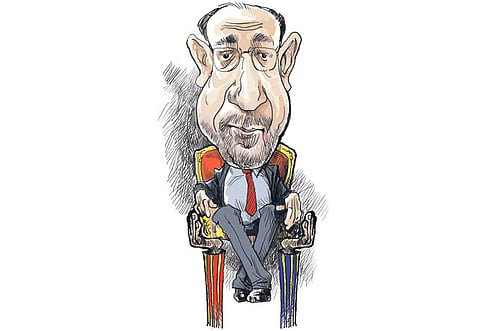
Following the inconclusive election in Iraq, the political negotiations are fraught with dangers, and Iraq's new democracy may not survive unless three political leaders recognise the dangers of drifting towards renewed civil war.
The incumbent Nouri Al Maliki, whose State of Law party came a very narrow second with 89 seats, declared soon after the results that he would not give up power and demanded a recount, although since then he has been hard at work trying to form a coalition. Eyad Allawi's anti-Iranian opposition party, Iraqiya, won 91 seats, but his party officials have already threatened a boycott of the new national assembly if Iraqiya is not given the right to form a government, with a hint that violence might not be ruled out.
The third element in the triangle is Moqtada Al Sadr, the leader of the Sadrist party whose 40 seats make it the largest element in the 70-strong Iraqi National Alliance. But since the results have been released Al Sadr has made no statement from exile in Iran, where he has been since his Mahdi Army was crushed by American and Iraqi Army forces.
Iran's dominant role in trying to build an Iran-friendly coalition in Iraq is made obvious by the way that senior representatives of the three parties opposed to Allawi have been in close talks with Iranian officials after the election results were declared. Iran wants to keep Allawi's secular and Sunni Iraqiya party out of power, so Iranian officials are working hard to get the other three parties to form a firm coalition as soon as possible.
After the results of the elections became clear, senior officials from Al Maliki's incumbent State of Law party rushed to Iran for talks with Al Sadr. In addition, President Jalal Talabani, who is also the leader of one of the two Kurdish parties, was in Tehran this weekend talking to President Mahmoud Ahmadinejad and Supreme Leader Ayatollah Ali Khamenei. He travelled with Iraqi Vice President Adel Abdul Mahdi, who is also a leader of the Islamic Supreme Council of Iraq (ISCI), part of the Iraqi National Alliance.
The unfortunate Allawi does not have such active backers. The United States is desperate to get its troops out of Iraq, and it will leave the electoral results to the Iraqis to work out. Iraq's Sunni neighbouring states, such as Saudi Arabia and Jordan, both of which Allawi visited before the elections and where he was well received, also do not want to get sucked into managing Iraqi coalition politics, despite their keen shared interest in reducing Iranian influence in Iraq — if possible.
So the likely outcome of the election is that the Shiite-Kurdish alliance (the core of Al Maliki's present government) will retain power, thus excluding the secular and Sunni groups that backed Allawi, and the Kurds will keep their senior positions in the federal government. However, the danger is that the Sunnis might well feel disenfranchised and reject the result, leading to increased violence.
On the streets of Fallujah and Baghdad, it will not really help to know that democracy means parties winning and losing, but it is an important lesson for Iraq that results such as Allawi's can happen. After decades of dictatorial one-party rule, the experience of negotiating for real power is exciting for all politicians.
It is also possible to overdo the sectarian analysis of events — it is a long-established truism that all politics is local. Al Maliki's poor showing could well be the voters punishing his government for bad government, poor infrastructure, frequent power and water cuts, a failing economy and not many new jobs, as well as his sectarian position.
Kurdish revival
As events in Baghdad take their course, Iraq's Kurds know that they are in the best situation they have experienced since the end of the Ottoman Empire in 1918. They have a strong regional government that has control of almost all aspects of life in Kurdistan and they also have the Peshmerga, a very tough, 70,000-strong militia.
The two parties in Kurdistan fought a bitter civil war in the mid-1990s, but Massoud Barzani's Kurdistan Democratic Party and Jalal Talabani's Patriotic Union of Kurdistan now work together, both in Kurdistan and in the Kurdish Alliance at a federal level. Barzani has presidency of the Kurdish Regional Government, and Talabani is the federal president. Therefore a future flashpoint in Kurdistan is not likely to be between Kurds, but with the federal government.
A strong federal government would want to bring the Kurds more firmly into the federal structure, rather than allow them their present semi-independence. But a renewed Shiite-Kurdish alliance at a federal level under Al Maliki might help the Kurds fend off pressure over their oil concessions, which the regional government has given without federal approval; and might continue to delay a resolution over the status of Kirkuk, which the Kurds want to be included in Kurdistan, and the rest of Iraq does not. A new Al Maliki coalition will not be strong enough to tackle the Kurds on these core issues, whatever else it might do in the rest of Iraq.


