Holbrooke: A complete diplomat
Holbrooke, who died Sunday in Washington, was arguably one of the most successful US envoys since the Second World War
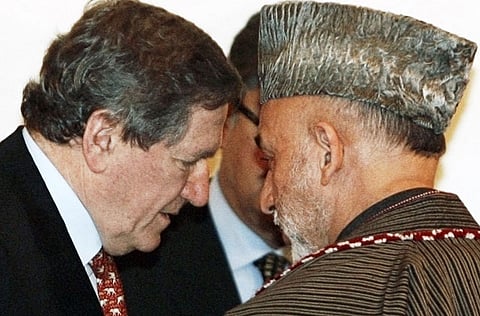
You could never tell with Richard Holbrooke. Was that smile actually a smirk, or the other way around? Was that frown a sign of gravitas or a signal of boredom? Was that nod an indication of approval or just a hint that he'd heard what you'd said? Was that shrug of the shoulders a suggestion of a turndown, or was it simply a way to telegraph indifference?
It was precisely the uncertainty that Holbrooke engendered in others about his thoughts and temperament that made him such an extraordinary diplomat, negotiator and adviser to successive Democratic presidents of the US over the last four decades. Holbrooke, who died yesterday in Washington, was arguably one of the most successful American envoys since the Second World War.
He was the prime architect of the 1995 Dayton Peace Accords, which ended the conflict in Bosnia which, along with Croatia, Slovenia and Macedonia, had seceded from the erstwhile Yugoslavia. The secession spawned horrific ethnic cleansing of Muslims that left humanitarian, social and political scars.
Holbrooke did not try to heal those deep scars: he always said that as a negotiator his prime job was to end the fighting to the political satisfaction of all. He should have been awarded the Nobel Peace Prize for shepherding the Dayton agreement, but in one of those inexplicable acts in which the Norwegian Parliament sometimes indulges, the ambassador was passed over.
That must have hurt, for Holbrooke was an immensely ambitious man. The signs of his ego were displayed at Brown University from where, after his graduation, he brashly offered his services to the New York Times. The Times, not a newspaper to turn down applicants from fancy colleges for junior-level posts, did not stick to form. The young man was rejected, whereupon he joined the US Foreign Service.
Notwithstanding the rejection, the media always fascinated Holbrooke. It was an irony that his third wife, Katie Marton, herself an author and journalist, had been married to the ABC News anchor Peter Jennings. One wondered what was going on in both superstars' minds when Jennings, who died not long ago, occasionally interviewed Holbrooke on air.
Holbrooke, to be sure, would never let on. He and I were once at a meeting at the Council on Foreign Relations — the New York-based policy institution of which both of us were elected life members — and I asked him if he expected to become US secretary of state under ‘President' Hillary Clinton. The American presidential campaign was under way at the time, and Clinton was battling a relatively unknown senator from Illinois, Barack Obama, for the Democratic nomination.
"I'm not going to discuss my personal politics," Holbrooke said to me in a tone that I thought did not take into consideration the many years we'd known each other. But after the meeting, he took me aside, and smiled broadly. "Come on, Pranay," he said, "you know the answer to that one, right?"
Holbrooke was like that. He could be abrupt and abrasive one moment, and then he could turn on the charm. But he was a loyal friend, not a characteristic of many public officials for whom loyalty is a commodity to be traded during election time or when seeking appointments to high office.
Holbrooke never was that kind of trader. He did not have to be. He was a fiendishly hard-working man whose towering intellect and acuity, and stellar track record, made him a sought-after advisor by chieftains in the public and private sectors. I said earlier in this essay that Holbrooke did not see himself as a healer when on duty as a diplomat. That wasn't entirely correct: in his most recent job as US Special Representative for Afghanistan and Pakistan, he quietly bled at the atrocities there. He also led the Global Business Coalition on HIV/Aids, Tuberculosis and Malaria. And as chairman of The Asia Society, he emphasised the need to reach out to minority communities, and to civilisations such as Islam which, he felt, offered enduring lessons in tolerance and cultural understanding.
That, in my view, made Holbrooke a complete diplomat and a rare human being. Of course, he would never let on.
Pranay Gupte's next book, on India and the Gulf, will be published in early 2011. He is currently working on his memoirs of more than four decades in international journalism.


