Guantanamo blacklist
A detainee might be suspected of having returned to the 'fight' because he has no known source of income. But if he gets a job, he could be taken off the list
I have here in my hand a list of ... names." When Senator Joseph McCarthy told the Ohio County Women's Republican Club of Wheeling, West Virginia, on February 9, 1950, that he held a list of 205 communists employed by the State Department, he ignited a firestorm and launched a career. We now know there was no list.
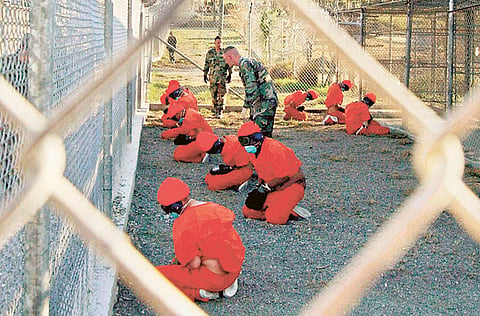
Even then, it was obvious McCarthy was not particularly punctilious about the numbers. In Wheeling it was 205; in Salt Lake City it was 57; on the Senate floor it was 81. Nor was he especially careful about the allegation. Maybe they weren't all ‘card-carrying' communists. The number, so peculiar and precise, seemed like the product of careful calculation by government insiders. I thought of all this recently because the ‘list' is back. January 11 marked 10 years since the first prisoners arrived at the US military prison at Guantanamo Bay, Cuba.
About 170 remain, even though most have been cleared for transfer by both the George W. Bush and Obama administrations, meaning they have been cleared for release from US custody and transfer to the custody of another country. Yet none of these cleared prisoners is likely to leave any time soon, thanks to Congress' annual pot-clanging fest, also known as the National Defence Authorisation Act. Every year, Congress conditions money for the Defence Department on all manner of draconian amendments. This year Congress added restrictions that make it all but impossible for the president to transfer prisoners from the base. Congress passed the amendments in the name of national security and dared the president to veto the bill as we head into a presidential election. Obama blinked.
And you wonder why Americans hate politics. And the favourite argument to keep them forever is the so-called list of recidivists. Senator John McCain, Republican-Arizona, for instance, warned during the Senate debate over the defence spending bill that "27 per cent of detainees who were released got back in the fight". Claims like this surface periodically.
The last time this issue came up, a colleague and I tried to get to the bottom of it. We filed a request under the Freedom of Information Act. Turns out this ‘list' is like Gertrude Stein's quote "Oakland: There's no there there". Former Guantanamo prisoners are tracked by the Defence Intelligence Agency (DIA).
No firm guidelines
But in response to our request, we learned that the DIA has no fixed criteria to determine whether a person has ‘returned' to anything: "DIA does not endeavour to create any sort of firm guidelines for identifying a detainee as having returned to the fight. The data collected to support this determination simply varies too greatly to allow for categorical simplification."
For that reason, the DIA letter said, "the number of persons suspected of having returned to the fight is subject to constant change. ... That number will rise and fall as DIA analysts gather new data and information and as those analysts revise their assessments of previously gathered evidence and intelligence."
A person today might be suspected of having returned to the fight because he has no known source of income. But if he gets a job the next day, he could be taken off the list. Recently, the director of national intelligence told Congress that "81 [former detainees] are confirmed and 69 are suspected of re-engaging in terrorist or insurgent activities after transfer".
He said a person can be ‘confirmed' based on a preponderance of the evidence but ‘suspected' based on nothing more than ‘plausible but unverified' information.
It is certainly true that some people have left Guantanamo and engaged in violent behaviour. Independent studies by researchers at Seton Hall University indicate the number is substantially lower than the government's estimate.
Only a small percentage who have been released to Afghanistan or Pakistan, where US forces are engaged, are suspected of wrongdoing. But in a time of superhuman demons and cowed leaders, anyone who claims to hold in their hands a list of names will get what they want, and even cleared prisoners will stay locked up.
— Los Angeles Times
Joseph Margulies is an attorney with the MacArthur Justice Centre and a law professor at Northwestern University. He is the author of Guantanamo and the Abuse of Presidential Power. He is counsel for Abu Zubaydah, a prisoner at the base in Cuba.


