Civil society is key to development
Mohammad's contributions in the humanitarian arena have had a far-reaching effect
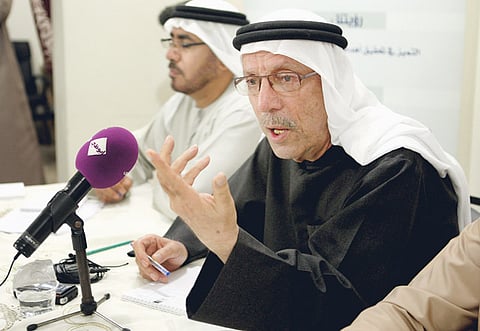
A few days ago during Ramadan, a contract was signed for constructing the Emirates Human Rights Association building. The association itself represents the best of public benefit organisations, not only in the UAE, but all across the civilised world. The mere existence of an association that adopts the issue of human rights in any community is an accomplishment.
Moreover, when an administrative authority in a country accepts the activities of human rights organisations in the country, then that authority is determined to be seen as an equal with other governments around the globe that act with civility.
One of the first steps is to establish a civil society that is not steeped in sectarianism, ethnic divisions or tribalism.
The evidence of this approach can be seen in the methods to be adopted for the upcoming Federal National Council elections, where the has government prohibited those taking part in the elections from engaging in any type of tribal, sectarian or ethnic provocation, or any other similar harmful actions.
Events and facts everywhere have proven that divisions and factionalism are harmful and create obstacles in the path of development. They stand against the growth of a civilisation and the development of a civil society.
His Highness Shaikh Mohammad Bin Rashid Al Maktoum, Vice-President and Prime Minister of the UAE and Ruler of Dubai, after ascending the premiership in 2006, came to embody what was planned by the wise leadership of the country — the Presidency, the UAE Supreme Council, and the cabinet. The plan was set for the UAE to become an oasis for demographic diversity. The country became a model of peaceful co-existence between different nationalities and ethnicities.
When the Emirates Human Rights Association was founded in Abu Dhabi on February 5 2006, after its board of directors was chosen, some of those who did not believe in team work tried to impede the association’s growth.
However, there was Shaikh Mohammad, the visionary who stood against all negativity and deliberate deception. He did not allow any wrong plan to emerge, for he knew that the emergence of the Emirates Human Rights Association formed the basis of a a civilised entity. This is a reflection of his humanitarian values.
Not only did Shaikh Mohammad back the project morally, he also decided to sponsor it and offer the financial support needed to for the association and its charity work. He generously ordered land for the association, and offered it Dh15 million to construct its head quarters on the property. Such a move was unprecedented anywhere in the Middle East and probably across the globe as well. It is truly very rare to hear about a government that extends this type of generous backing to a public benefit foundation.
Hence, it is only fair to point out that Shaikh Mohammad’s contributions in the humanitarian arena have had a far-reaching effect. His endeavours have put him in the ranks of international personalities who have chosen the road of charity and good deeds.
It is the duty of all those working to promote these civil achievements to praise the efforts of this magnanimous person.
Shaikh Mohammad’s book My Vision - Challenges in the Race for Excellence is a window to the humanitarian concerns of this great personality, especially in the context of his views regarding the civil society on which Dubai’s development was founded.
Shaikh Mohammad said: “Excellence does not recognise religious or ethnic discrimination, because its overall humanity is above what sets people apart from each other. Everyone lives in peace, and all people strive to work, produce and benefit in an equal opportunity environment of rights and duties; hence, maintaining security and peace is the responsibility of everyone. Moreover, the foundations of continual production, protecting interests, cooperation are based on the co-existence of religions, the coexistence of differences, and the coexistence of values, concepts and so forth.
“The greatest accomplishment of the Arab Andalusia civilisation is not the Al Hamra Palace nor the great Cordoba mosque, the Al Zahra city or the Seville palace. Instead, it is the unique humanitarian model it has presented the world till this very day, where civilisations and religions co-existed, where everyone worked together to achieve excellence.
“What took the place of the scientific establishment in Cordoba? Sadly, it was the Inquisitions. And what substituted culture and arts in Cordoba? Regrettably, it was the burning of books and the imprisonment of all those found by the Inquisition courts to be working on a book. Moreover, instead of coexistence in Cordoba came discrimination.
“Most of the new world’s civilisations have fallen prey to this discrimination, because, at that time, the Spaniards had no regards for the diversity of human civilisations as one of the most beautiful human traits. Instead they saw it as the enemy, to be treated mercilessly.
“Diversity gives civilisation its distinguished taste. Diversity is one of the secrets of the charm of both Dubai and Cordoba. This mix in any other location may be something totally different.
“We too have presented humanity a renewable model of co-existence between different civilisations, religions and the cooperation of all to achieve excellence at all levels, a thousand of years after the end of the Caliphate in Andalusia.
“Those who talk today about the clash of civilisations, the animosity between Islam and the West, and claim that the West cannot co-exist with Islam, that we revere death and disregard life, have not visited Dubai.
“They are unaware of the history of Cordoba and the history of all Arab civilisations which co-existed with other religions, as they do today.
“We present evidence once again that living in the end is nothing but the co-existence called upon by the Islamic religion and where the features of our civilisation flourish.”
Abdul Gaffar Hussain is the Chairman of the Emirates Human Rights Association.


