A window for peace has opened
Pakistan's Chief of Army Staff Pervez Kayani has jolted India's past thinking by advocating peaceful coexistence between the two countries
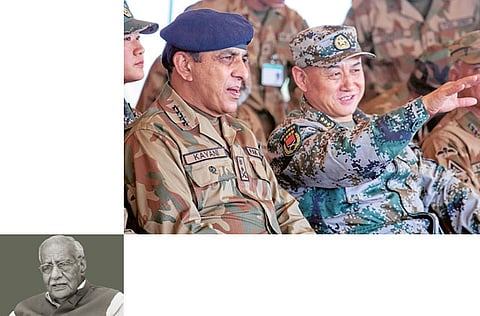
India and Pakistan are seldom on the same page. Partly, it is because they carry the baggage of tragic history and partly because they have no trust in each other. Above all, there is a general perception in India that since the army is a decisive factor in the affairs of Pakistan, it is not possible to foster any meaningful relationship until it becomes a democratic polity in the real sense. In fact, from the time General Mohammad Ayoub Khan took over the reins of Pakistan in 1958, India has assumed that no peace between the two countries was achievable.
After becoming the Martial Law Administrator, General Ayoub offered even a ‘joint defence pact.' India's then prime minister Jawaharlal Nehru spurned the offer with the remark: "Joint defence against whom?" The leaders of the two other military regimes in the seventies and later — General Zia-ul Haq and General Pervez Musharraf — were never taken seriously because New Delhi believed that their say from the military point of view would never allow any exercise for peace to succeed.
Pakistan's Chief of Army Staff Pervez Kayani has jolted India's past thinking by advocating "peaceful coexistence" between the two countries. Gen Kayani's proposal does not stop at the Siachen Glacier. He has hinted at a follow-up and has thus belied the impression that peace between India and Pakistan is a hostage to the army's hawkish thinking. He has given a window of opportunity which the governments on both sides should grab with both hands to normalise relations.
Unless there is a back channel working on Kayani's suggestion, New Delhi is not reacting officially. The media has by and large welcomed Kayani's proposal but otherwise comment has been guarded. The question is whether the Indian forces would withdraw from the Siachen Glacier because President Asif Ali Zardari has rejected the unilateral withdrawal as was suggested by former prime minister Nawaz Sharif.
However, if Pakistan were to do so, it would put India under a lot of pressure to reciprocate. Morally, New Delhi's position would be so untenable that it would have to withdraw the forces. Even if we rule out this line of thinking, Pakistan would have to assure India that Islamabad would not try to occupy the vacant area if and when New Delhi withdraws. After all, when India sent its troops to Siachen Glacier in 1984, it suspected that Pakistan was going to do so. (Indian intelligence agencies found that Pakistan had ordered high-altitude mountaineering gear from a London trader who used to supply the same to New Delhi).
Whatever Pakistan decides, it has to have the nod of Gen Kayani. He cannot go against the wishes of the Pakistani people who want peace with India. Gen Kayani can neither be oblivious to the fact that a military takeover in Pakistan is well-nigh impossible when all political parties have now joined hands to uphold the dictum of democratic change.
I wish the reaction in India had been more forthcoming. There is a long dreary period of mistrust. But it has to be dispelled by sitting across the table and not putting any conditions before doing so. The starting point can be the Siachen Glacier as Gen Kayani's remarks indicate. After visiting the sites where more than 100 Pakistani soldiers were buried in snow he was moved and saw the futility of perching his forces at the height of some 23,000 feet. The same is the case with India which too has lost hundreds of soldiers on the Siachen Glacier over a period time. But the main worry is that what happens when its forces withdraw from the glacier?
Climate for dialogue
The solution to Siachen Glacier should present no problems because both sides have gone over the details in the last several years. There was a time when former prime minister Rajiv Gandhi had initialled a settlement, agreeing to a no-mans land status. But the signatures could not take place because some Indian army commanders had a different point of view. They saw some strategic advantage which some other commanders dispute. If the Line of Control could be delineated after the Shimla Conference up to the area near the glacier, the same line can be extended right up to the end.
The climate for a dialogue on all problems is conducive. People on both sides want it. Gen Kayani said that the army understood well the need to bring down the defence budget, adding, "we would like to spend less on defence" because ultimately "security doesn't only mean secure border but the welfare of the people." This means that the army is ready to take cuts. This also means the reduction of troops on the border.
The solutions to Siachen Glacier and Sir Creek, which Prime Minister Manmohan Singh has said are "doable," will create an atmosphere of give and take and some way out may be found to solve Kashmir. If Gen Kayani, a soldier, can talk of permanent peace between the two countries why not the rulers? By not trusting, both have fought three wars, apart from the Kargil incursion. Let them, for a change, trust each other. Otherwise, history will hold the present governments responsible for letting the opportunity for peace go by.
Kuldip Nayar is a former Indian High Commissioner to the United Kingdom and a former Rajya Sabha member.


