A Saudi step in the right direction
The move to enfranchise women in the kingdom has been hailed as a catalyst for more reforms
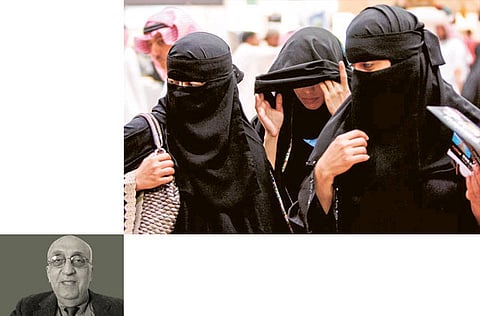
The freedom-seeking Arab Spring now engulfing the Arab world has scored another pace-setting achievement; this time in Saudi Arabia and more importantly opened the doors for the enfranchisement of Saudi women who are usually house-bound and subject to the whims of male chaperons for any trespassing downtown.
But King Abdullah Bin Abdul Aziz, seen as a cautious reformer by many Saudi men and women, has almost turned the Saudi tables upside down without triggering much fuss in the conservative and oil-rich country, which has just marked its 79th National Day anniversary.
In his annual speech before the Shura Council or consultative assembly on September 26, he announced that starting in the coming 18 months or so Saudi women will be able to join this non-voting body and be allowed to run as candidates and vote in the country's municipal elections in 2015.
"Because we refuse to marginalise women in society in all roles that comply with Sharia" the king declared, "we have decided, after deliberation with our senior ulemas [clerics] ... to involve women in the Shura Council as members, starting from the next term. Women will be able to run as candidates in the municipal election [in 2015] and will even have a right to vote."
A Saudi television commentator, Muna Abu Sulaiman, was quoted as saying the monarch's decision "is not enough, but given that we were nowhere yesterday this is a big step". She continued, "The whole idea that women can fully participate in what is available, that is a major cultural shift that is occurring in Saudi Arabia. Little girls growing up knowing that they can be part of the Shura Council will change the way they feel about themselves." Almost simultaneously, King Abdullah has also cancelled the public flogging of Shaima Jastania, the woman who was sentenced to 10 lashes with a whip for driving a family member to the hospital. News of the king's decision was viewed as a victory by the coalition of Saudi women activists, known as Saudi Women for Driving. More than a handful of other women have been recently detained while driving their cars in Jeddah.
"While we are thankful the sentence against Shaima was revoked, this is a small step rather than a giant leap," said a representative of Saudi Women for Driving. "We will continue fighting for our right to drive and exercise our basic rights."
Princess Amerah Al Taweel, wife of King Abdullah's nephew, Prince Al Waleed Bin Talal, said on Twitter that the cancellation of the flogging sentence was "symbolic both inside and outside ... No matter how many great things we do [we will] always be judged as a country that suppresses women and because we're the only country in the world where women can't drive."
Following in the footsteps of the monarch, the Saudi Labour Minister, Adel Fakih, announced that his ministry has started looking for ways to both regulate the work that Saudi women are undertaking and increasing job opportunities for them as well.
Need for more jobs
He also pointed out that there is a growing number of university graduates, prompting a need for more job opportunities for Saudis. However, he explained that Saudi Arabia employs 8 million expatriates, including 6 million in the private sector, while thousands of Saudis — estimated by one source at 448,000 — remain jobless. He also underlined that expatriates send home about 98 billion Saudi riyals (Dh95.95 billion) a year.
An American author of two books on the Saudi royals, Simon Henderson, gives credit for this initial step to the Saudi king's daughter, Adila, "who has been a known advocate of her gender's increased participation in public life, particularly driving, for several years."
Writing in Foreign Policy.com, he added, "Adila was also seen as being the moving force in the 2009 appointment of Noora Al Faiz as deputy minister of education — the first woman to achieve such prominence in government".
There are many Saudi women whose achievements are well recognised and appreciated but regrettably their public role in their homeland is not highlighted sufficiently.
A typical example has been the case of Dr Samia Al Amoudi, a single mother of two, who has been diagnosed with breast cancer several years ago. "But rather than merely endure the pain and treatment," the introduction to the article reported, "she has become the leading voice in Saudi Arabia and the Arab world for breast cancer awareness, and she has founded a centre for breast cancer research and education".
Her story appeared on the cover of the September/October issue of the Saudi Aramco World, a bimonthly magazine published in the US, in recognition of her commitment to her children and others elsewhere.
The much-appreciated king's move is the first step but more steps are still needed. Hopefully, they will taken in the very near future.
George S. Hishmeh is a Washington-based columnist. He is a former editor in chief of The Daily Star.


