'Shawing off in India
A 3,000 kilometre odyssey from Goa in India to Nepal in an 8bhp auto rickshaw? Surely, it can't be that difficult?
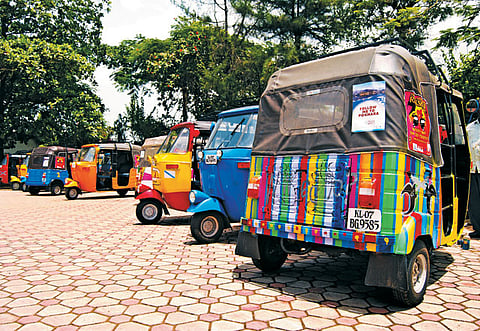
The ‘pitch' seemed attractive: two weeks in a rickshaw motoring across the Indian sub-continent with two lovely ladies, visiting astounding locations while being filmed for a TV documentary. Right up my alley in terms of adventure, but I just wasn't sure if my stomach could handle two weeks of spicy cuisine for breakfast, lunch and dinner.
I'm no Alan Whicker, but the production company promised an all-expenses-paid round trip starting in Colva on the Goan coast, heading inland through Bhopal, Khajuraho and Varanasi. We would make our way into Nepal for our final destination in the foothills of the Himalayas on an event called ‘The Rickshaw Run'. Had I known (or possibly done an iota of research) about some of the places we'd be staying in, I'd have had some idea of just how short the expenses sheet would be. To say India's interior lacks quality hotel accommodation is as much an understatement as saying that the roads could do with a lick of tarmac.
Perusing a road map of our route across India, I presumed that it would be a doddle since much of our journey would be on national highways. However, while a four-by-four or your average ornate Tata truck simply glides over the broken and rutted surfaces, in our little auto rickshaw with its 8in wheels and primitive suspension, it was like driving across the cratered surface of the moon.
Not to mention avoiding the goats, roadkill, stray dogs and cattle which seemed oblivious to the rural and city traffic chugging past them 24 hours a day. Having only three wheels also meant you got horrendous understeer into any corner above 15kph — this was not helped by the fact that the vehicle was very heavy on top with several kilograms of luggage strapped to the roof. The best way of countering this was to adopt the bike riders lean into the turns, although this still only had limited effect on front grip levels.
This made the nine-hour-plus driving days even longer and more arduous for our three-member crew which included Katie Campbell, an ex-cabin crew member, and Shelley Foster, a UK-based TV presenter. While the girls supplied the necessary glamour for the film crew, I like to think I supplied the mechanical know-how to get us out of trouble. And a bit of eye-candy for the ladies as well!
And so with hands on the twist grip and a full 150cc behind us, we hit the road which took us up over the mountainous Western Ghats and into the boulder-strewn, muddy and dusty passes. While I was avoiding sheer cliff faces, oncoming trucks, potholes that would swallow a small dog, and fist-sized rocks, I was told by my female passengers that the view down into the lush valley through the tall palms was quite stunning. Yeah, thanks!
Even on Day One we were more fortunate than some teams whose rickshaws had been breaking down constantly with fuel feed problems from the moment they hit the mountains. All we suffered was a loose speedo cable and the sensation of having shattered a few vertebrae.
Day Two was our first experience of city traffic as we stumbled into the 12th century town of Belgaum. The lessons learnt included flashing your headlights, shouting at other drivers, waving at friends and the fact that the horn replaces indicators. By the time we hit Bijapur the following day, we were seasoned professionals weaving like a bright orange mosquito through the black and yellow taxi rickshaws, our little buzzer of a horn chirruping through the cacophony of exhausts and hooters, our lungs filling with fumes, dust and the ever-present waft of curry powder.
Other rickshaw-wallas in their customised taxis waved and seemed pretty impressed with our newly-acquired roadcraft. But they obviously hadn't seen us in Solapur stalling in midday traffic three times in a row at a busy intersection (I hasten to add, I wasn't driving) or running out of fuel just outside a truck stop north of Osmanabad. In our defence, the rickshaw doesn't have a fuel gauge and our consumption estimates were wild guesses at best. The rickshaw does have a reserve tank but, as we later found out, we had been driving on reserve and the lever to change over from the main tank was broken. Fortunately, having a couple of attractive ladies on-board helped immensely in coercing the locals to offer a lift to the nearest petrol station.
While the rear-mounted — just like in a Porsche 911 — 8bhp engine didn't have exceptional ‘poke', it did eventually manage to drag us up the foothills of the Himalayas. Occasionally you'd have to twist down to a lower gear but the L'il Lady (as she became known) kept on pulling. And apart from bruising both elbows in the first few days from whacking them on the metal framework as I was yanking the starter lever, the only time we had engine problems was after filling up.
Being a two-stroke engine, the rickshaw brought back memories of my first 50cc Garelli and the hassle of mixing oil and petrol together in the tank. A lot of the fuel pump attendants couldn't quite grasp the idea of a ‘10 per cent oil to 90 per cent petrol' mix and more than once we coughed to a halt with puffs of dark grey smoke sputtering from the exhaust pipe, only then realising that they'd poured the oil and petrol in one after the other. After the third time, we bought a six-litre container and pre-mixed the fuel and oil. It also gave us a useful emergency supply in case our calculations were completely screwed, which was generally the case.
The electrics in general weren't too hot either. The horn sounded like an asthmatic kazoo player, the windscreen wiper was useless, and while every evening we started with all the lights working — if you can call a one candle-power headlight ‘working' — by the end of our daily journey you could guarantee that the indicators had died, as had the horn and most possibly the headlight. If it hadn't been for our support vehicle behind us we'd have been driving in virtual blackout.
Mechanically, we only suffered a broken clutch cable — which we'd fortunately brought along a spare for — and two punctures. Although, not having a jack, we had to rely on the combined weight of the girls and a lump of concrete and length of wood to raise the rear, much to the amusement of the Maharashtrian customs officials across whose border we'd just trundled. But considering the kind of terrain over which we were taking our L'il Lady, she fared pretty well. OK, there was the broken chassis which had to be welded while we went and ogled 1,000-year old carvings on the temples in Khajuraho; and there was the roof-rack incident in Bhopal where we got snagged on a low hanging electricity cable which tore our luggage off; and then nearly drowning during a very dodgy ‘ferry' crossing (for ‘ferry' read ‘leaky metal tub') over the Narmada River; and the drive through bandit country later that night which offered a potentially much worse fate.
And then there was this cow: on our way out of Aurangabad after having had our first Indian Domino's Pizza (Heaven!), Shelley encountered a subtly suicidal cow on the road which first sold us a dummy and then just walked right out in front of us. The crew say we were on two wheels as Shelley swerved to avoid it. I'm pretty sure our rickshaw would have come off worse from the collision.
But for these very reasons, I can't imagine a more vital way to see a country than in the open-air semi-comfort of an auto rickshaw. You smell your environment — pleasant and polluted; you feel the elements — sun, wind, monsoon rain; you are in direct contact with the locals — a little too closely at times; and you see the road and landscape rushing past every second of your journey. It's not all good, but it's all unforgettable.


