For the love of the Porsche
Wheels drives the new 911 Turbo S to the other end of the country and back... In no time
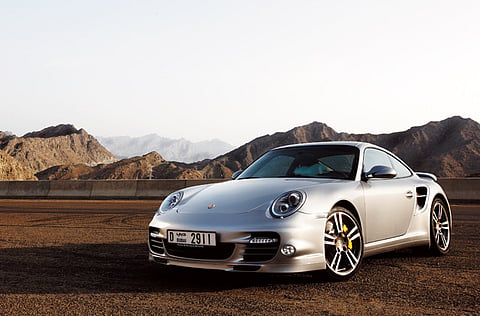
Is it possible to love a machine? I dropped my Dell the other day and shrugged my shoulders, kicked its edges back straight and rewound the Pikes Peak video on YouTube a few seconds.
My phone has more blemishes than Mickey Rourke's face, which is why I always buy the monochrome Dh90 thingies anyway. Even if my Xbox caught fire I wouldn't cry, I'd just make sure to get the Forza 3 disc out in time.
A car is different though. To most people sizzling brakes smell like burning money, but to me, it's better than steak. A whiff of burning Michelins is intoxicating! I prefer the fumes of 98 Octane to something from CK with a name such as Is or Are. Or CK Be… Oh hang on…
Anyway, where was I…
Oh yes, then there's the sound. The ones that catch you out are the best: there you are standing on the street corner minding your own business when a Yank big-block thunders by. That paralysing moment where your joints all lock into place and you stiffen up like a wet cat.
And all your senses are hopelessly captivated by the sound, your mind stricken, unable to send signals for your jaw to pick itself up off the ground. It sails past and the roar is dissipating, it's now long gone, yet you gaze into the distance, clutching in desperation to the V8's echo. It doesn't matter whether I'm listening to a C32B bouncing off its 8k limiter, a Group A S14 or the deafening din of a V12 inches behind my ears, but ask me if we should rather check what's on the radio and I'll punch you in the face.
Yes, you can certainly love a machine.
The s in the Turbo S
With my affinity towards the Stuttgart carmaker hardly a secret, I could love a 911 if it came out with a squint and a limp in one wheel. Thankfully the new Porsche 911 Turbo S has neither handicap. On the contrary, it's blessed with one of the best turbocharged engines in the world; a chassis that shrugs off 530bhp at 6,750rpm like it's merely stretching its legs; and an all-wheel drive system that surely brought out the harakiri knife at Nissan.
I know, I know, you're now probably shouting that it's just a Turbo with the boost turned up. Well you're wrong. Porsche's 3.8-litre flat-six direct-injected twin-turbo motor with variable turbine geometry (nothing to do with the old hardcore GT1-derived turbo engines, this one's all new) has gained revised intake valve timing, as well as a new carbon fibre airbox that, besides doing healthy stuff to the dyno sheet, also looks awesome. Oh, and yes, they've turned up the boost, to 1.2 bar.
All this has endowed the Turbo S with an extra 30bhp available between 6,250 and 6,750rpm, instead of the S-less Turbo's 6,000rpm peak.
Torque remains the same, but only next to a Turbo fitted with the costly (Dh13,700) Sport Chrono and its overboost function. Of course an S has to justify its near-Dh600K price, and it does that with the torque available at any time instead of only when you jab a ‘Sport' button. Remarkably, the efficient (relatively speaking) 3.8-litre engine doesn't spew any extra dirty air into the atmosphere over its lesser brother, and fuel consumption stays at 24mpg. Although my full-day blast tossed that claim into Hatta's lake, but I'll get to that in a bit.
In case you've been living in a cave, you should know that Porsche likes cash, so every conceivable extra on the normal Turbo is a cost option. Painted front air intakes? Dh2,350. Posh floormats? Dh1,360. Fancy wheels? Dh11,370. However, don't stress because the S already comes with all that, and more. Beautiful monolock 19in ‘RS Spyder' wheels are included, as are adaptive seats, cornering lights, the eye-poppingly outrageous ceramic brakes (otherwise a Dh28,220 option) and active engine mounts just to name a few.
There are also more acronyms in here than at an IT convention. PASM, PDK, PTM, PTV… They all mean Porsche-something-something and they're all tasked with making you feel like Walter Röhrl, when really, you couldn't even tie Alex Yoong's shoelaces. The Active Stability Management does what it says on the tin; it actively stabilises management — of your driving.
Porsche Torque Vectoring is some microchips coupled with a mechanical rear diff to brake an inside wheel if you stuff up a bend and dart in too fast — which is quite difficult to achieve in a Turbo S as I found out. Almost done; and Porsche Stability Management is a fancier way of saying traction control. Finally, Porsche Traction Management distributes those 530 horses across the four wheels vigilantly so you don't slither off every set of lights or, much more expensively, drift into the nearest Armco.
And how can we forget the PDK seven-speed transmission, the only transmission available on the Turbo S. This time it's controlled by proper paddle shifters instead of unintuitive buttons, although the new three-spoke wheel with readouts on each arm loses its multi-functional commands.
Match made in heaven
A hardcore supercar isn't much outside of a hardcore environment, so as soon as I got out of Dubai Silicon Oasis and Porsche's new HQ, I blasted it down E102 and towards the sleepy town of Huwaylat. There begins a 10km odyssey of some of the most challenging tarmac in the region. Yes it's a bit low on distance, but it's a bit low on traffic too, and with the varying surfaces, blind crests, slippery wadis and minimal run-off down its entire length, this road fits the Turbo S like a glove.
Meandering through the flats with fourth gear sweeps at the start, the enveloping mountains quickly make a demand for much tighter corner radii. The rest of the stuff is mostly third gear with short upshift bursts, and a couple of hairpins at the two uppermost points. This rollercoaster ride is enough to suss out a dodgy chassis, geometrically challenged suspension or fading brakes within the first five klicks. The Turbo S was relentless.
It took about 100km to get here, and the 67-litre tank was showing close to 400km left in the range. Powering up and down my own private Special Stage took me into the yellow warning light after just ten rounds! Which means the Turbo S didn't get any time off, no special treatment, just a right foot which got progressively heavier as I started believing Porsche's hype more and more. Sport and Sport Plus really don't harm the ride as much as I'd have expected, with the PTM, PSM and PASM systems providing not much else other than advantages; a sportier shift and suspension map.
After it became painfully obvious that it was nearly impossible to swing the tail out for the camera with the amount of grip available from the 235/35 and 305/30 ZR19 (front:rear) Bridgestones, combined with the merciless traction that Porsche's AWD brings with it, I ventured into the ‘PSM off' realm.
And even then, there were just two sections that made my palms mildly sweaty; a pair of linked uphill esses requiring vigorous weight transfers, which failed to bring on even a tiny bit of body roll, but succeeded in gently tapping the back end out of line just before the final left where the hard braking on slippery yellow lines unsettled the dead-on flow.
Still, it was only trail braking oversteer rather than power oversteer. A more purposeful tilt of the tail took place consistently after a right swoop into a valley, leading to the bottom and into a flattened left. Accelerating from third into fourth at the exit of this epic rising-dropping right-hander, the brakes would get the biggest workout of the ‘Stage' at the base, where a mighty shove was followed by two downshifts into the tight left which swung the rear out. I don't think I've ever been this flattered by a car, so simple it was to pull off corrective lock. In fact, you could hardly call it lock; all it took was about 20-30 degrees. Chassis balance is incredible.
Ruthlessly pumping the brake pedal throughout the day — regardless of whether we were plummeting down a mine-shaft straight or getting out of trouble mid-corner — never produced an ounce of fade. The steering ratio too, seemed spot on, as I don't remember ever having to cross my arms. It's typically Porsche-stiff, and doesn't really offer the most connective relationship between wheel and man (you need a GT3 for that), but considering the 1.6-tonne weight of this monster, I found it more than acceptable.
Having experienced this same patch of blacktop in a Nissan GT-R, I can safely say that the Turbo S raises things to another level. Its excellent all-round visibility makes you feel almost like you're in a single-seater, or at least a centre-seater, and you find yourself taking ludicrous shoulder cuts, the mirrors barely edging through. It turns out that the Porsche is shorter and narrower than both the GT-R and the Ferrari 458, and it shows.
It's very easy to get to grips with and certainly builds up confidence much faster than a self-help book. I mean, what other car can you take to within an inch of your limit (unless you spend weekends strapped in a race seat, you're not likely to reach the car's limit) after half an hour of on-the-edge hysterics?
Everything in the Turbo S is the epitome, the pinnacle of Porsche technology. The onslaught of the turbocharged power beggars belief, especially mid-gear acceleration.
You have to clutch your heart to stop it from shouting, "That's it, I'm done" and jumping ship. Porsche claims 3.3 seconds to 100kph, and while I didn't have the opportunity to prove them right, I don't doubt the acceleration for a second. I've experienced the regular Turbo launch-control itself to 100kph from rest in less than 3.3, so with an extra 30 horses and barely a grocery bag of added weight in the S, I reckon you could easily dip into the 3.1s.
Name me a Dh595,000 car that can do that? In fact, name me a million dirham car that can do that? Porsche also makes another high claim; 315kph top speed. All I'll say on that matter is I firmly believe that too. The handling, astonishing in itself, is so well-balanced that it easily rubbishes any claims that Stuttgart insists on putting the engine in the wrong place. Technology has carried this 911 into performance territory previously reserved for cars with twice the cylinders, and at least a couple of hundred kilos of thrown-out luxury equipment.
And all that while the driver is embraced by a supple leather interior, a Bose sound system, great AC, satellite navigation, two baby rear seats (which double up as much handier shelves) plus build and fitment that would pass a NASA quality inspection.
Thing is though, that S-less Turbo isn't half bad either. In fact at its global launch in Portugal, and again at the Middle East rollout, I remember it positively blowing me away with its usable performance. So should you spend the extra dosh for the S?
Of course you should. The standard equipment is almost worth it alone, and why would you say no to more power without any economic consequences?
I know I was left shaken by the experience, begging for more, thinking up excuses on the way back to keep it for another day, another Special Stage. But do I love it?
The Porsche 911 Turbo S is blindingly good at being a supercar slash masterful GT. Nothing can beat it for the money, in fact even the Maranello and Sant'Agata exotica costing 1.5-times more merely run it close. But this car also has, let's face it, an automatic gearbox, a supercomputer capable of programming 25 per cent more talent into any driver, and AWD that seemingly gives you nine lives. Also, it's hardly an Italian tenor when it comes to symphonic talents. It sounds very German, in the same way that a Bosch washing machine sounds very German.
If I'm driving a supercar, I want it to scare me witless for the first week, before I even begin gathering up the nerve to so much as look at the TC button, let alone touch it. I want it to make my ears bleed and punish me for being a naughty boy.
Maybe I'm exaggerating, plus of course I'm not a Porsche buyer and Porsche only answers the calls of people who actually spend the moolah. They want usability, and with the Turbo S they've got it in spades.
Still, you can love a machine, but it turns out you can't love a robot.
The latest generation MkII 997 Turbo and Turbo S models were developed from a clean sheet. OK, so not an entirely clean sheet, but the engine itself is totally unrelated to any previous turbo 911 motor.
For the first time in a turbocharged Porsche road car, the flat six displaces 3.8-litres, a capacity previously reserved only to the raw and naturally-aspirated GT3s, Carrera S models and the super-rare 964 3.8 RS. Throughout the 35-year-long 911 Turbo history, the engine just kept evolving, growing, but this is now a new age.
With this 21st century powerplant, the Turbo and Turbo S produce up to 50bhp more than its predecessors and gulp down 16 per cent less fuel.
But the heart isn't the only new component; brakes, electronics, a new rear diff, seven-speed transmission and a unique engine ‘suspension' all add up to equal a blisteringly-fast supercar.
Specs & ratings
Model Turbo S
Engine 3.8-litre flat-six turbo
Transmission Seven-speed PDK AWD
Max power 530bhp @ 6,250rpm
Max torque 700Nm @ 2,100rpm
Top speed 315kph
0-100kph 3.3sec
Price Dh595,000 (base)
Plus Massive grip, attainable performance, value for money, engine
Minus Lacks that ‘supercar' factor
700Nm
From just 2,100rpm! Yeah, that's right, put that in your pipe and smoke it


