'Re/cut piece' challenges perceptions
Anahita Razmi follows in the footsteps of Yoko Ono while asking unsettling questions about the representation of women and the Middle East
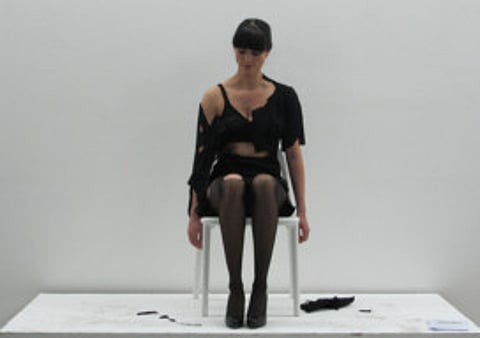
Yoko Ono’s 1964 performance titled “Cut Piece” is an iconic work in the history of contemporary art. During this performance the artist sat on stage with a pair of scissors and invited the audience to come up and cut out a piece of her clothing. The “feminist” work, presented in Japan and New York, was a participatory performance, co-created by what the audience brought to it. Germany-based Iranian artist Anahita Razmi used the same concept but a different context for her performance at the opening of her first solo show in Dubai. In her re-enactment “Re/cut piece”, the young artist wore a black Gucci dress and invited the Dubai audience to cut it up. By performing in a city associated with luxury, fashion and the nouveau riche, and focusing attention on the value of the dress, the artist infused Ono’s seminal work with new associations and meanings.
Razmi’s performance redefined the context of Ono’s piece, while also commenting on stereotypical perceptions about the Middle East. And that is the essence of her entire show. Named “Automatic Assembly Actions”, the show presents well-known works by famous artists in a different context. It juxtaposes passive automation with active intervention to deconstruct long-held perceptions and reconstruct new layers of meaning.
The centrepiece of the show is a set of collages made from hand-woven Persian carpets. Glued on to the carpets are phrases such as “permission to fire”, “you have no idea of faith”, “identity complex identity”. Because these words have been laser-cut from similar carpets, they are almost hidden in the traditional oriental patterns and appear to be covert political statements connected with the ongoing events in the Middle East. But they are in fact taken from British artist Tracey Emin’s well-known quilted textile works and express her state of mind. “The oriental carpet has so many existing social, cultural and political associations that just changing the fabric used by Emin completely changes the context of what were very personal statements about her life into something with a very different connotation. I did not make this piece political — it is the viewer who does that. So this work questions associative patterns, expectations of the viewer, and the cultural characteristics of material,” Razmi says.
Her photographic series, “Untitled YouTube Stills”, is similarly a witty and thought-provoking appropriation of well-known American photographer Cindy Sherman’s famous series “Untitled Film Stills”. Sherman photographed herself in various roles and settings reminiscent of stereotypical film scenes to create an iconic series that asked questions about the role and representation of women, the media, and the nature of the creation of art. Razmi has used a similar technique — but to examine the contemporary medium of YouTube, the most popular online platform for user-generated videos today. Using herself as the model, she has recreated a variety of images typically found online, ranging from people posing with their pets, showing off their musical talent or offering styling advice to gun-wielding revolutionaries and protesters on the streets uploaded from cell phones during the Arab Spring.
“These pictures represent the variety of images we are surrounded by today. We have a woman singing her favourite song next to a picture of the same woman being attacked by soldiers. The series conveys that YouTube features images that are staged and manipulated along with pictures that are being displayed on the news as documentation of uprisings. I am interested in exploring what happens when the ‘reality’ format of YouTube replaces the ‘fictional’ format of the medium of film, and new media forms accessible to the masses replace exclusive media such as film. And I want to examine whether certain stereotypical images, recognisable figures, settings and aesthetics can be extracted from such a mass medium,” the artist says.
Razmi is well known for her video artworks, and the two new works in this show, called “Arsenals” and “House of Strength”, illustrate her signature style of using humour and seemingly absurd connections to make strong socio-political statements. In “Arsenals”, she has juxtaposed a slow-motion video of herself blowing clouds of smoke into the camera; a soundtrack composed of music from dramatic moments and tense climactic scenes in various films; and a row of traditional sheeshas, ominously painted black. The work speaks about today’s image machinery; the drama and hype created in Western media about events in the Middle East; and perceptions about the Middle East that could transform even a banal object such as a water pipe into an arsenal of weapons.
“House of Strength” shows Razmi practising the traditional Iranian sport Varzesh-e-bastani, which is played in a “Zurkhaneh” or “House of Strength”. Women are neither allowed to participate or watch this sport, but in her video, the artist has replaced the muscular sportsmen with herself. Her repeated performance of the exercises using the traditional equipment is reminiscent of a Sisyphean task, commenting on the situation of women in traditional societies. An octagonal floor installation placed in front of the video represents the arena where this sport is held and invites viewers to step into the ring and be part of the action. “My work is not about making one particular statement. I like to change things and see what happens,” Razmi says.
Jyoti Kalsi is an arts enthusiast based in Dubai.
The show will run at Carbon 12 gallery until March 14.


