
Anoushka Shankar on hitting all the right notes in her career
Anoushka Shankar talks about growing up as the daughter of a musical legend
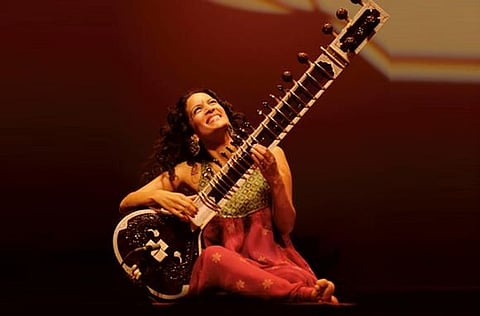
It is fascinating to watch Anoushka Shankar. What catches your attention are the 31-year-old’s hands. Not because they are the classic artistic fingers – long, tapering and supple. It is their restless energy, the way they fly around, drawing intriguing pictures in the air to emphasise each point she makes.
You catch yourself wondering where you’ve seen it before – and then it strikes you; of course, late Pandit Ravi Shankar, the man who taught the Beatles guitarist George Harrison to play the sitar, and collaborated with greats like violinist Yehudi Menuhin, conductor Zubin Mehta, among others and who won several Grammys and was Oscar-nominated for Richard Attenborough’s classic film Gandhi.
She not only looks like her sitar maestro father, she’s even imbibed his showmanship. The way she worked the audience at her Global Fusion concert in Dubai last month, presented by Bank Sarasin-Alpen and Alpen Capital Group, and the gracious and generous manner in which she gave each of the other musicians and artists their due on stage was reminiscent of Ravi Shankar. It’s clear music is in her genes.
She was hailed a child prodigy when she started sitar lessons at the age of seven on a custom-made instrument half the normal size, sitting on her father’s knees. Anoushka, now 31, performed in public with her father when she was just 13. A classical sitarist as well as a fusion enthusiast, she has acted, composed music and produced several albums that have flown off the shelves.
She was the youngest and only female to be nominated for a Grammy in the World Music Album category for Live at Carnegie Hall at the age of 22. The Grammy-winning vocalist Norah Jones is her half-sister, her father’s daughter with New York concert producer Sue Jones.
The list of artists she has collaborated with reads like a who’s who of the music world – Sting on his album Sacred Love, Nitin Sawhney’s London Undersound, Herbie Hancock’s The Imagine Project and Joshua Bell’s At Home with Friends to name a few. She’s also performed with Peter Gabriel, Elton John, Madonna, Nina Simone, and James Taylor. In 2008, she toured India with Jethro Tull.
“Of course, there is a lot of pressure from people’s expectations and high standards, not to mention constant comparisons to the greatest example in my field” she admits. Anoushka and Norah accepted the Grammy Lifetime Achievement Award on behalf of their late father last month. Although a supporter of animal rights and a spokesperson for the United Nations World Food Programme in India, music is what defines her, and Anoushka is a classicist at heart.
“Even when my music is experimental it still has a vein of Indian classical running through it,” she says. “I am very interested in ways of reinterpreting Indian classical music and I love collaborating with music from other cultures.” Her recent concert in Dubai was a visit to a much-loved city. “I have always enjoyed
performing in the UAE and I am glad to be back,” she says. “I have particularly fond memories of my first visit to Dubai for a concert of my father’s when I was about 11. We took a trip together through the desert and had an amazing experience of night-time camel rides, which was a really lovely family moment.” She pauses in her reminiscences. “It was really fun, and so I am sure I’ll be back.” She tells us what it is to be the daughter of a legend:
In many ways, my career chose me rather than the other way round. I had an unconventional upbringing, and that has influenced my music and life. Art always reflects your influences, so it makes sense that my music is global with an Indian heart, and somewhat eclectic. I was born in London and lived there until 11, before my parents – Sukanya and Ravi Shankar – began to split their time between southern California and India.
I showed some interest as a young girl in learning my father’s craft, but it was my mother, also a musician who played the tanpura – a string instrument – who most strongly encouraged me to pursue my musical dreams. My dad was reluctant at first but my mother told him: “You may as well teach her; if it doesn’t work, it’s OK.”
I started young – sitar lessons at the age of seven – so it was natural that I start performing early too. I first performed with him at 13. That, of course, was nothing compared to my father who started performing at the age of ten. I had my own sitar from the beginning. I was terrified of the instrument at that age because unlike something like a piano that I was just able to sit down and bang at, this was something that required a lot of discipline to master and was heavy. However, my father was brilliant at making the lessons fun.
People ask me whether learning music was just a lark for me as a child or whether I was serious about it. It was neither a lark, nor something I knew I wanted to do for the rest of my life. Having a teacher like my father, it’s not something that you just do without seriousness and dedication. But I was so young that it was only over the next few years as I continued to play and grow up that I became more and more sure that it was the career path that I wanted.
I get asked a lot of questions: “Was it difficult being the daughter of such a great legend? Did you feel pressured at any point to perform? Or was music the only thing you ever thought of?” Like anything else, life with such a great legend comes with its difficulties and its opportunities. There is a lot of pressure due to people’s expectations and high standards, not to mention constant comparisons to the greatest example in my field, but [being his daughter] also gave me a great musical education and career opportunities when starting out. In my opinion, there were more blessings than difficulties.
My relationship with my father was more than just that – he was also a guru, a friend, and a lot more. Our relationship was unique because it was a mix of the father-daughter, and teacher-student, as well as us being musical collaborators. The more we performed together the more collaborative the relationship became. It was almost like we had a telepathic relationship when playing together, to a level that I have never experienced with anyone else.
My childhood was simultaneously normal and magical. It couldn’t be anything else with the friends my father had – Yehudi Menuhin, Zubin Mehta, and George Harrison. As a child I’d sit at dinner parties with artists, authors and musicians. I was very lucky to have met a lot of incredible people through my father and his associations. What always struck me about truly great artists is that they never carried themselves as such, and there was a strain of humility running through them all.
On a musical level they certainly set very high standards. I recorded my first album for Angel Records, titled Anoushka, in 1998. Anourag followed in 2000, the same year I recorded the acclaimed Live At Carnegie Hall, which was released the following year. It earned me my first Grammy nomination for Best World Music Album in 2003. Awards and nominations certainly feel lovely and help one’s career on paper, but they don’t give the same fulfilment as watching listeners react to a live show.
I guess I am more work-oriented than I should be. Having toured almost non-stop since my first concert, I needed a break and decided to take 2004 off. But the vacation swiftly became a working one as I conceptualised the album that finally was recorded as Rise. Then came Breathing Under Water with Karsh Kale, in 2007. Traveller, which came out in 2011, was an experiment of two musical traditions: Spanish flamenco and Indian classical music.
I had a nomadic kind of upbringing, living between the US, UK and India occasionally. But I wouldn’t change anything because it is what has got me to where I am. As a result, however, it is very deeply ingrained in my nature to always move and now that I have a family – husband filmmaker Joe Wright who most recently directed Anna Karenina, and son Zubin, two – I am trying to change my habits, settle down and build a home in one country. I am now based in London.
I am very close to my half-sister, singer Norah Jones, though we met only when I was 16. She had been estranged from my father after he married my mother. But after the reconciliation we became very close. Now, Norah and I are sisters in every sense. Love is the biggest inspiration for the music I make so these two relationships – marriage and motherhood - have certainly been the spark for the most creative phase I have ever had.
My last album Traveller in particular was written and recorded while getting married to Joe, and being pregnant with my son Zubin. I look back fondly on it as a record of those amazing experiences in my life. Would I like to compose music for films? Of course, I am very interested in composing for films even outside of my husband being a film director. Acting is something I tried in my early twenties (in 2004’s Dance Like a Man) and neither did I feel I was brilliant at it nor that I loved it the same way that I love music.
I also am immersed in yoga, which has always been deepening and cleansing for me. It’s a great way to wash away a day or clear your head when you’re busy. It’s also good for my body, after sitting cross-legged while playing all the time. It not only stretches my body, but also my mind. Also meditation. It is an important part of my life, and give me the balance I require.
My dream is to keep performing with as many musicians as I can. I have performed with many famous artists and troupes. But there are many more out there. I’m always listening to musicians who inspire me from across the globe, and I am very excited and interested to keep working with new people because that pushes me outside of my comfort zone and helps me to grow as an artist.
Everybody expects my son Zubin to follow in our footsteps. But I am very open to anything that may interest him. My dreams for him are to find his place in life. He already has his first musical instrument – he loves his set of tabla (Indian percussion instrument), but I would like it to all remain fun and games for a little while. Five years from now? I hope to continue to grow as an artist and person. I am not big on picturing myself in the future, I am more about just moving forward now.


