An attraction for opposites
Writer, director and actor Ethan Hawke is a perfect paradox, loathing and, in the same breath, loving the temptations of fame.
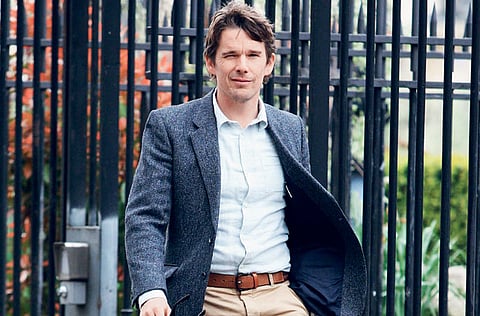
My interview with Ethan Hawke does not get off to a good start. I turn up at the restaurant in Paris where we have arranged to meet. It is a far-from-glamorous sort of place, a throwback to Fifties' bohemia, with faded posters on walls and chequered tablecloths. Time ticks by and as it does, my thoughts about Hawke take on a darker hue. No wonder he is late, I tell myself; after all, wasn't he once the "Leading Actor of the Slacker Generation", a title he got lumbered with after he made Reality Bites with Winona Ryder in 1994? And in more recent roles — especially his new film, Brooklyn's Finest, in which he plays a strung-out policeman — there is a snarlingly uncompromising quality to him. When Hawke smiles on screen, his grin seems to crawl up one side of his face.
After an hour, I assume he is not coming and leave — only to bump into him in the doorway. The fault, it turns out, is entirely mine: Messages have been sent postponing the interview, which, for some reason, have failed to arrive. Hawke, however, behaves as if he is the one in the wrong: He is apologetic, gracious and eager to make amends. In the flesh, he looks rather less chiselled than he does on screen. There is a softness and delicacy to him.
Before Sunset, which he co-wrote and starred in, was shot here and he is at present starring in a film based on Douglas Kennedy's novel, The Woman in the Fifth, with Kristin Scott Thomas. But no one in the restaurant appears to recognise him — and this, I suspect, is how he likes it.
Pulled both ways
Hawke is pushing 40 now and has been famous for more than 20 years — ever since he appeared in Peter Weir's Dead Poets Society when he was 18. More than any other actor of his generation, he has had an ambivalent attitude towards fame, keenly aware of its pitfalls and its pleasures. Once, back in 1995, he auditioned for the lead role in Titanic. Shortly after the film was released, Hawke remembers, he was sitting in a bar where Leonardo DiCaprio was also present. "I sat watching him and it was like watching a Beatle. The closest thing I've ever come to that frenzy. All the girls wanted him and all the guys wanted to fight him. I said to myself: ‘Wow man, I'm glad I didn't get that part.' But you know, secretly, I couldn't help thinking that if I had got it, maybe I could have lived exactly the life I wanted to. That I would never have had to worry about my career," Hawke says, grinning on both sides of his face now.
His eye for ambivalence is as broad as it is sharp. Brooklyn's Finest, directed by Antoine Fuqua, is one of the bleakest, bloodiest films I have seen. I wondered if Hawke had had any qualms about appearing in a film so violent and which doesn't offer its audience any glimmer of redemption. He stares at his refreshment for some time before answering.
"Antoine had also directed me in Training Day [for which Hawke received an Oscar nomination for Best Actor]. What I liked about Training Day was that there was a real darkness at the heart of it and some Hollywood touches around the edges. This is kind of taking the darkness up a notch. I love the police genre, because it gives me an opportunity to play real human beings — people who aren't superheroes, or zombies, or whatever. But do you end up glamorising violence?" he asks rhetorically.
He shakes his head and sighs. "I really don't know. I do know that I take a certain pride in making a film that doesn't show people being shot or beaten up. But you know, it's easy to get people's attention with guns. It's harder to get their attention with ideas."
Throughout his career, Hawke has mixed up a wide variety of projects: commercial films, uncommercial films, theatre — he has both acted and directed — and books. There have been two novels so far, both deservedly well received. How deliberately does he try to vary the mix and make sure his commercial profile stays reasonably high? "I have the good fortune of engaging in different things. Doing films is one aspect of my job. It's one that I've been able to divorce myself from on a personal level and tried to be a craftsman of. I mean, I don't make Daybreakers [the recently released zombie-slasher] in the same way I make Before Sunset. I had a great time making Daybreakers but I don't feel my calling on the planet is hunting vampires, you know. On the other hand, if all I did were films such as Before the Devil Knows You're Dead [the 2007 crime drama with a "non-linear" narration], I wouldn't have a career any more. I don't know, maybe I would."
His recent novel Ash Wednesday, published in 2002, was — in part, at least — a fictionalised account of his parents' romance. His mother was 17 when he was born and his father 19. They separated soon afterwards and Hawke was mainly brought up by his mother and stepfather in and around New York.
"There was a very high value placed on the arts in my family. None of them were artistes but they loved books and films and music. I grew up with people who believed that at its best, art was a religious-like calling. I mean, my stepfather thought Bob Dylan was the greatest religious figure of the 20th century — and in a way he's right, you know. They were also people who didn't define success in financial terms and I think that's had a very big influence on me."
When he was 14, Hawke asked if he could go to the casting call of a film called Explorers that he had heard about. He ended up getting the part and starring opposite River Phoenix. Did acting represent a desire to step into a different life?
"It's so hard to look back at that without filling in overly romantic notions of how it turned out. I think I've always been in danger of turning my life into an anecdote; I guess it's a fear of being boring. I do know that I struggled being a teenager and I really wanted to be a grown-up. Going and auditioning for a film felt like a ticket to being an adult."
Four years later came Dead Poets Society. Whether he liked it or not, Hawke was famous — prey to both its temptations and its entrapments. Recently, he says, he came across a journal he had kept while filming Great Expectations in 1996. "I was in shock about the combination of absolute fear I had about being successful — I was really scared that fame would rob me of my life — and the absolute arrogance that fame would want me. There was this extraordinary assumption of greatness in there, you know. I think I always had this idea that fame was a kind of Faustian pact. But then, I did do my first film with River Phoenix — and he ended up dead on the side of Sunset Boulevard."
For years, Hawke says, he reckoned he could have it all: the fame, the money, the artistic integrity and the literary reputation. "Again, that's pretty arrogant. I thought I could do all that: Run a theatre company, write a book, make the occasional film. But life doesn't work like that — or, at least, it does only for one or two people every generation. It took me a long time to realise that I didn't understand things as well as I thought I did."
In 1998, he made a high-profile marriage to Uma Thurman — the two met while filming Gattaca. They had two children and then, five years later, came an even more high-profile divorce. This was after Hawke allegedly had an affair with the couple's nanny, Ryan Shawhughes. Two years ago, he and Shawhughes married and shortly afterwards had a daughter, Clementine. Back then, though, all that was in the future. Bruised and, as he says now, depressed, Hawke went off and lived in the Chelsea Hotel in New York for two years. A famously bohemian hotel where Dylan Thomas had his fatal heart attack and Sid Vicious killed his girlfriend Nancy Spungen, the Chelsea doesn't strike one as being an ideal place in which to try to sort your head out.
"The thing I loved about it was that there were so many people there in some kind of weird state of consciousness that I felt relatively normal. The aura of celebrity goes off because everyone there thinks they are a celebrity. Looking back, I'm not sure if it was a self-destructive move or a self-reflective one. But it ended up being a couple of great years for me. They weren't happy years but it seemed like the perfect place to be in. That building worships the arts and the only things that were good in my life at that time were my children and the arts. I remember I found myself reading books I'd last read when I was 20. I think I was just trying to touch something that made me want to live."
It has been eight years since Ash Wednesday came out and that is a long gap. Does he ever use acting as a distraction from writing? He gives a strangulated groan: "It's just possible there might be something in that. I am doing another book and I'm pleased with what I've done. But publishing is a scary business and sometimes I wonder what the point of it is. Maybe it would be much better if everything was published after you were dead. The other thing is showing up on a film set and being paid a bunch of money and hanging out with cool people that's a lot more tempting. Sometimes I think the only thing that will get me to write a good book will be the dismal failure of my film career."
You have always struck me as being restless, I tell him. Is there anything in that? "The people who know me best would agree that's the case. I do have the restless spirit. Look at the facts: I start a theatre company, try to write a novel, drive across country, try being a film star, hate being a film star. Looking back, I realise that for a long time, I wasn't comfortable in my skin at all."
And what about now? It's clear from the warmth in his voice when he talks about his second wife that he is very happy with her and I wondered if he was more at ease these days, more tranquil. "I think I have come to an accommodation with the restlessness, although I haven't arrived at any Buddha-like state. This film I'm doing at the moment has this Polish director and he has a great expression: ‘And then there's the staircase.' As soon as you think you've reached some kind of plateau, you turn around and there it is," Hawke grins and gives a helpless sort of shrug, "Another staircase!"


