Over-reach can lead to a downfall
Small businesses often take more on themselves than they can deliver
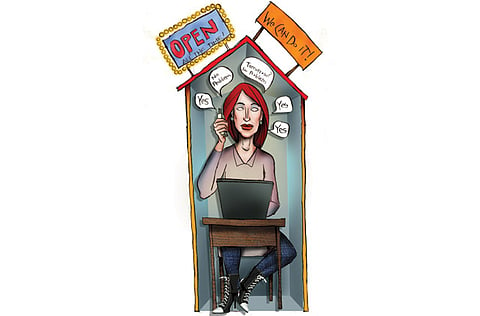
Dubai: Sometimes it pays to say ‘no'. More so for a start-up limited by funds and capacity to take on more than it can expect to deliver to clients.
"The No 1 problem of new businesses is over-trading," said Steve Williams, CEO of Gulf Finance, a specialist lender focusing on local small- and mid-sized enterprises. "It's pandemic in the region — or has been — because the opportunities are so great."
Or it was when in the four to five years leading up to mid-2008 when all layers of the economy were booming. Any business, irrespective of size, was more inclined to take on as many projects and deals coming their way. Sign up first and then think of the logistics, was their refrain.
Also, small businesses, which scavenge for the occasional contracts that come their way, would be sorely tempted by the one big deal that falls in their lap "with the promise of riches", said William.
But be warned — such contracts come with red flags. If the small business does not get paid quickly on the contract, it could in turn lead to a pile of unpaid bills and salaries.
"When you're starting out and somebody offers you a big deal more than you can potentially satisfy as a business, it's very tempting because it's fight or flight," Williams. "So it's about managing what you believe you can actually deliver and not taking on too much."
In such instances, the strategy to avoid over-trading is to take "bite-sized portions" of the new deals.
Good news
Williams was the contributing editor in the recently launched book Sink or Swim: How to Stay Afloat in Tough Economic Times by Richard Dean, business journalist and broadcaster.
Dean had good news for small businesses which have survived the downturn. "You don't need to be Google, you don't have to re-invent the wheel," he said at last week's launch of the book here. "You just have to do what you do and do it well and do it consistently."
In the book's foreword, Williams notes that amid the excess optimism in the country during the boom phase, entrepreneurs and business leaders caught the "go bigger, go faster bug", which eventually contributed to the bursting of the economic bubble.
Business owners will do well to pay heed to what Williams says. Historical data show two out of every three start-ups end up as casualties, while a third of the businesses need a good three years to succeed.
Williams believes a sustainable and reasonable rate of growth would be up to around 25 per cent annually. But during the go-go years, even that may have seemed too conservative and ineffective in cashing in on the easy profits available at the time. It would have been too easy for a business to get carried away with the promise of growth at breakneck speed.
But although a doubling or tripling of revenues and profitability may seem great on paper, it also means raising staff numbers proportionately and ordering higher stocks of raw materials. In such a context, the small business owner has to think about where to get the cash to sustain operations, Williams said.
Often, small businesses that grow at unsustainable rates do not have the structure to manage the expansion and end up struggling to fulfil orders and burdened with crippling cashflow problems.
Healthy growth rate
Williams added: "You got to really look at if that contract will pay, if you can perform on it, or, if that was a one-off, what will you be left with in the end. Very often you're left with problems."
Managing healthy growth rates is a challenge for many small- and mid-sized businesses. "It's really difficult because when you're a small business you're desperately excited about growing," said Williams. "I suppose the other thing is not to always have this ‘it'll be alright' mentality."
The big mistake many small companies make is to lose sight of the basics of money and management. Small businesses that remained afloat during the recession kept a close eye on their finances.
They can stay on track by shifting focus from what the business produces or sells to monitoring costs, revenue, profit, debt, and cashflow, Williams added. They need to obtain "good management information", process it, collate the numbers, draw up a sensible budget, and evaluate where they stand.
In the final analysis, it takes a smattering of good business principles and common sense to build a sustainable, recession-proof business.
"Yes, you have to be courageous, determined, and you have to have passion and belief, but those by themselves won't help you survive the downturn," said Williams. "You have to have a product that people want, you have to have a market that's open to that product, and have to do it as well as your competitor if not better.
"If you've got those as a small businessperson, then the passion and determination will get you noticed moving forward."
What to do
Steve Williams and Richard Dean offer practical tips on how to recession-proof a business.
Hoard cash for a rainy day, ideally a buffer equal to six months of fixed costs.
If you have to pay your suppliers in two weeks but your client is paying you in three months, then it's a problem. On paper you are making healthy profits. But in terms of cash, you're in trouble.
Make sure your company has an edge over the competition. A great product, intellectual property rights for a new design, excellent customer service, or a cool brand can give you an advantage.
Look for managers with character, an engaging personality, grasp of business fundamentals, experience and diligence. Resilient companies usually have owners and managers with who balance a range of these attributes between them.
Build a network of people around you who understand marketing, finance, debt management and get them involved in your business and ask them for advice.
Start a business with the right amount of cash. Assume you will make no revenue for 12 to 18 months and give the business a cash injection for that period to allow yourself to build up momentum.
Do not overtrade. Do expand at a sustainable annual rate of 25 per cent with conservative debt.
When you start a small business, it becomes very emotional and personal, everything you do is about you. The challenge of expanding from a small to medium business is investing in managers who are less emotional about the project and more task-oriented.
Avoid relying too much on one customer or a range of customers in one industry, which many small businesses did during the boom.
The ability to "look forward over the horizon" to predict what is coming and the ability to delegate the work.

