Obama, Republicans dig in over tough talks on debt and tax hikes
Political point-scoring in full swing as August debt default looms
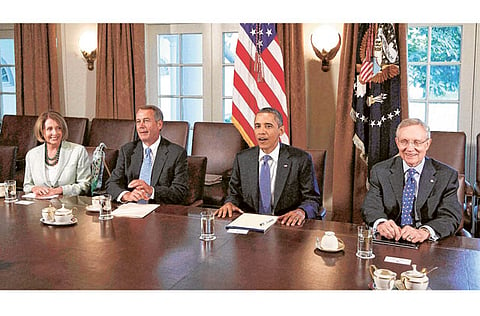
Washington: US President Barack Obama Wednesday held a fourth straight day of tough budget talks with his Republican foes after a key White House critic floated a plan to avert an early August debt default.
Obama gave only a lukewarm welcome on Tuesday to Republican Senate Minority Leader Mitch McConnell's idea, which would also save Republicans from having to forge a politically painful debt reduction deal with the White House.
White House spokesman Jay Carney said the president still sought "agreement on significant, balanced deficit reduction" — code for a blend of the spending cuts Republicans favour and tax hikes they fiercely oppose.
The talks ran about two hours without any breakthroughs, and the White House later announced the two sides would meet again yesterday.
McConnell laid out a complex legislative mechanism shortly before heading to the White House, calling it a "last-choice option" if teetering negotiations on raising the country's $14.29 trillion (Dh52.5 trillion) debt ceiling collapse.
Default will hurt
Economists and business groups warn that defaulting would hurt Washington's ability to borrow, sour already tense ties with creditors like China, send interest rates soaring and steer the fragile global economy into a tailspin.
"If we are unable to come together, we think it's extremely important that the country reassure the markets that default is not an option," said McConnell, who described himself as "increasingly pessimistic" about a deal.
Republican House Speaker John Boehner later told Fox News Channel it was "a last-ditch back-up plan" but stressed that without a default-avoiding accord "a couple of weeks from now we may be looking for all kinds of ideas".
Obama piled the pressure on Republicans to agree to his proposal to make cuts to social safety net programmes dear to Democrats while raising taxes on the richest earners in a step his opponents charge will stifle job growth.
The president warned that without a deal by August 2 elderly retirees, military veterans and others might not get government benefit cheques "because there may simply not be the money in the coffers to do it".
"I cannot guarantee that those cheques go out on August 3 if we haven't resolved this," Obama told CBS television. Earlier, McConnell and Boehner blamed Obama for the impasse in the negotiations amid apparently dimming prospects for an agreement to cut trillions of dollars in spending to offset new borrowing.
"This debt limit increase is his problem," Boehner declared, saying: "I think it's time for him to lead by putting his plan on the table, something that the Congress can pass."
Obama countered on CBS, saying: "This is not a Republican or a Democratic problem. This is a national problem."
Obama the target
McConnell, who has said that Republicans' top priority must be defeating Obama in the November 2012 elections, charged that "as long as this president is in the Oval Office, a real solution is unattainable".
Later, McConnell unveiled a plan to allow Obama to request $2.5 trillion in new borrowing in three tranches: $700 billion now, $900 billion in June 2012 — when the president's re-election battle will be in full swing — and another $900 billion sometime afterwards.
Congress could reject the request in a "resolution of disapproval", which Obama could veto, and failure to rally two-thirds of lawmakers to override that step would automatically allow the debt increase, he explained.
Obama would be required to propose spending cuts to offset the new borrowing and would not be allowed to seek tax increases, McConnell said. The plan would give Republicans several chances to vote against any debt increase, as demanded by core supporters in the "Tea Party" movement.
Stand-off
President Barack Obama and top lawmakers met again Wednesday in an effort to forge a budget deal to clear the way for Congress to raise the $14.3 trillion (Dh52.5 trillion) debt ceiling. On August 2 the Treasury Department says it will not have enough money to cover debt service, military salaries and other obligations.
- June 29: The IMF says US must lift debt limit soon to avoid a ‘severe shock' to global markets and a fragile economic recovery.
- July 3: Obama and Boehner meet at the White House to discuss a more ambitious ‘grand bargain' that would save roughly $4 trillion over 10 years through an overhaul of the tax code and changes to popular benefit programmes.
- July 6: Reuters reports a small team of US Treasury officials are looking at options to stave off default should Congress fail to raise the limit. The Obama administration insists there is no contingency plan in place.
- July 7: Obama says Republicans and Democrats still far apart on many issues but all agree on the need to raise debt ceiling.
- July 8: A dismal jobs report focuses new attention on sputtering economy. Obama says uncertainty over debt ceiling talks is hurting economic expansion.
- July 9: Boehner says a ‘grand bargain' is out of reach because Republicans will not accept the tax, and he calls for a more modest $2 trillion package relying mostly on spending cuts.
- July 10: During a testy, brief meeting at the White House, Obama and congressional leaders agree on little more than the need to meet again the following day.
- July 11: The follow-up meeting breaks little new ground, but Obama pressures both Democrats and Republicans to make concessions that would clear the way for a deal. Another meeting is planned for July 12.
- July 12: Senate Republican leader Mitch McConnell offers a backup plan for raising debt limit that would allow the deficit-reduction effort to be shelved. Obama warns if debt-limit impasse is not resolved, government benefits for older Americans may be at risk.

