Obama could take a leaf out of Reagan's book
Observers see parallels in the two presidencies
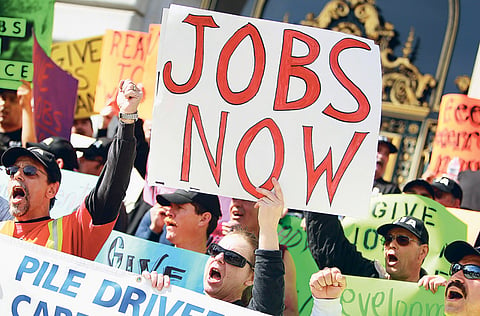
Washington : A charismatic president sweeps into office amid economic turmoil, promising to turn the country around. Instead, things get worse. The unemployment rate climbs into double digits and the federal budget deficit soars, sending his approval ratings plummeting and triggering unrelenting criticism of his economic strategy.
It's the tale of President Barack Obama's first year in office — but also of Ronald Reagan's nearly three decades ago.
As the economy staggers out of the Great Recession, there are some key similarities to the nation's last severe economic slump in the early 1980s that offer clues about stoking a recovery — and the political implications if one doesn't happen quickly enough.
A clearly articulated economic strategy, bolstered by his ability to project a sense of optimism that conditions would improve, was crucial to Reagan's success. That is the main lesson for Obama, who has been criticised for not providing a clear economic vision, said Dean Baker, co-director of the liberal Center for Economic and Policy Research.
Message
"‘We're going to cut your taxes and get the economy going again.' It was a clear message," Baker said of Reagan's efforts. "Whether it worked doesn't really matter. It was something people could identify with as ‘Here's what they're doing'. My expectation is that Obama is going to have problems because he hasn't put forward a clear plan."
The nation's continued economic troubles have sent Obama's approval ratings spiralling just as they did Reagan's. Though Obama's rating hit a new low of 46 per cent last week, it has yet to plunge to the 35 per cent Reagan hit in early 1983. But even when Reagan's political prospects and the nation's economic outlook appeared bleakest, his clear strategy helped him rebuild support, said Annelise Anderson, an economist and senior fellow at the Hoover Institution who worked in the Reagan White House.
"In the Reagan administration, you had enormous certainty about what the objectives of the administration were," she said. "In this administration, there's a huge amount of uncertainty. We don't know what's going to happen on health care. We don't know what's going to happen on energy."
Many Republicans say Obama should follow Reagan's recession-fighting strategy, which hinged on across-the-board tax cuts. The period following the 16-month recession from 1981 to 1982 is a textbook example of the post-Second World War trend of strong growth following deep downturns. The nation's economic output shot up 9.3 per cent in the second quarter of 1983, a few months after the recession officially ended, and the gross domestic product grew at a brisk rate of more than 7 per cent in the year after that. Reagan pulled his approval ratings out of a nose-dive and won re-election in 1984.
"Do what Ronald Reagan did, and you will solve the problem," Representative Dan Burton publicly advised Obama in winter. It's not so simple. There are significant differences between the two recessions. Although the unemployment rate was worse in the early 1980s, most economists agree that the Great Recession that began in late 2007 has been worse.

