DIFC's sub-economy accounts for 1.1% of national economy
Financial services to drive three-fold increase in contribution this year
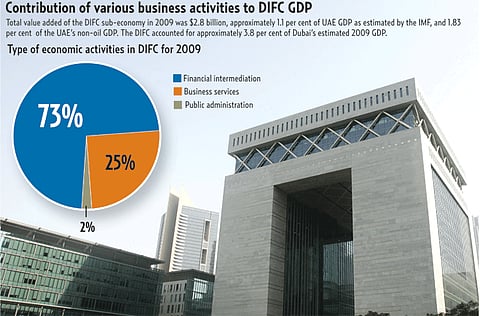
Dubai: The Dubai International Financial Centre's sub-economy was worth about $2.8 billion (Dh10.3 billion) in 2009 and contributed 1.8 per cent of the non-oil gross domestic product of the UAE (1.1 per cent of total GDP) and 3.8 per cent of Dubai's GDP, the DIFC said in a report on Sunday.
At the end-December 2009, there were 706 active companies at the Centre. By last month, the number had grown to 782 companies.
Despite the global economic challenges, statistics show the number of active companies in the DIFC in 2009 remained stable.
These active companies comprised 292 regulated companies (234 authorised firms, 56 ancillary service providers and two authorised market institutions) and 410 non-regulated companies offering business infrastructure and services necessary for the activities of regulated firms.
"The consistent and uniform contribution to the UAE's economy during one of the most severe financial [downturns] the world experienced proves the success of DIFC's strategy," said Ahmad Humaid Al Tayer, Governor of the DIFC, in a statement.
"We continue to build a business ecosystem that supports the growth of our clients and is attracting more companies to the Centre."
DIFC officials said the contribution of the financial centre to the national economy is expected to be significantly higher with a three-fold jump in the contribution of the financial services business in 2010.
According to statistics compiled by the DIFC's economic research team, the nominal GDP of the financial centre fell 2.4 per cent between 2008 and 2009 in line with the decline of financial activity in most major financial centres across the world due to the financial downturn.
Resilience
"The minimal decline also reflects a sign of resilience by the companies operating within the centre. Compared to many other international financial centres, the decline was relatively small," said Nasser Saidi, DIFC chief economist, told reporters.
The slight drop in the GDP of the DIFC had an uneven sector distribution, as the financial sector GDP declined by almost 9 per cent in 2009 and the public sector by more than 15 per cent.
However, the report shows that the combined drop was offset by the 25 per cent increase in business services. The financial activities sector accounted for 73.2 per cent of the total value added in the DIFC, while the business services accounted for 24.2 per cent. The rest was attributed to wholesalers, retail and public administration.
Within the financial activities sector, the broadly categorised ‘activities auxiliary to financial service and insurance', which include capital market advisory and investment banking, gained an importance on par with the core financial activities.
Professional, scientific and technical activities dominated the business activities.
Downstream benefits
A recent study, commissioned by the DIFC and conducted by McKinsey in the first quarter of 2010, found that for every dollar of revenue generated by the DIFC, the UAE economy benefited by approximately $17 in the form of residential rent, schools, services and the injection of disposable income into the UAE economy.

