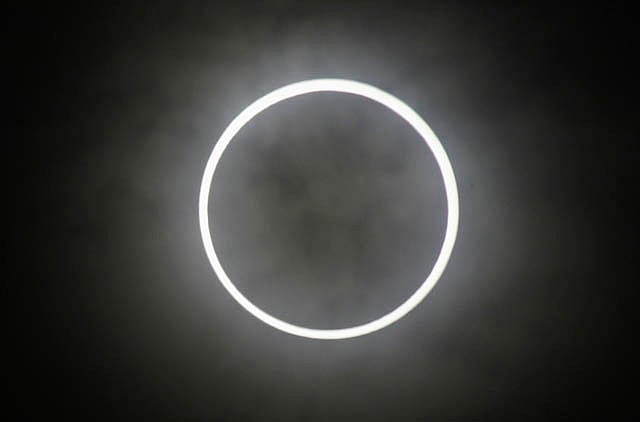
Tokyo: Millions of Asians watched as a rare "ring of fire" eclipse crossed their skies on Monday - Japan's first in more than 170 years.
The annular eclipse, in which the moon passes in front of the sun leaving only a golden ring around its edges, was visible to wide areas across the continent.
It will move across the Pacific and also be seen in parts of the western United States.
In Japan, "eclipse tours" were arranged at schools and parks, on pleasure boats and even private airplanes. Similar events were held in China and Taiwan as well.
The eclipse was broadcast live on TV in Tokyo, where such an eclipse hasn't been visible since 1839.
The Taipei Astronomical Museum opened its doors at dawn and Hong Kong's Space Museum set up solar-filtered telescopes outside its building on the Kowloon waterfront.
Japanese TV crews watched from the top of Mount Fuji and even staked out a zoo south of Tokyo to capture the reaction of the chimpanzees - who didn't seem to notice.
A light rain fell on Tokyo as the eclipse began, but the clouds thinned as it reached its peak, providing near perfect conditions. "It was a very mysterious sight," said Kaori Sasaki, who joined a crowd in downtown Tokyo to watch event. "I've never seen anything like it."
Hong Kong skywatchers weren't so lucky. Several hundred people gathered along the Kowloon waterfront on Hong Kong's famed Victoria Harbor, most of them students or commuters on their way to work.
The eclipse was already underway as the sun began to rise, but heavy clouds obstructed the view.
The eclipse will follow a narrow 13,700-kilometre path for 3 hours and 30 minutes. The ring phenomenon will last about five minutes, depending on location.
People outside the narrow band for prime viewing will see a partial eclipse. "Ring of Fire" eclipses are not as dramatic as a total eclipse, when the disk of the sun is entirely blocked by the moon.
The moon is too far from Earth and appears too small in the sky to blot out the sun completely.
Doctors and education officials have warned of eye injuries from improper viewing.
Before the event started, Japan's Education Minister Hirofumi Hirano demonstrated how to use eclipse glasses in a televised news conference.
Police also cautioned against traffic accidents - warning drivers to keep their eyes on the road.
Sign up for the Daily Briefing
Get the latest news and updates straight to your inbox
Network Links
GN StoreDownload our app
© Al Nisr Publishing LLC 2026. All rights reserved.