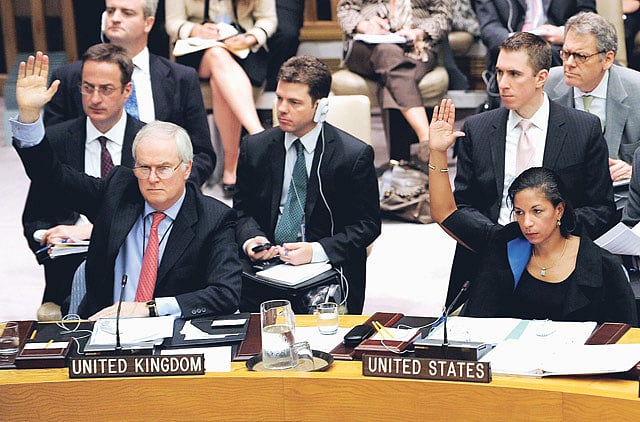
Washington: President Barack Obama wasted no time in hailing Wednesday's passage by the UN Security Council of a resolution targeting Iran's nuclear programme as "the toughest sanctions ever faced by the Iranian government."
While that may be true, almost no one believes the new resolution any more than the three before it targeting Iran, will on its own stop Iran's nuclear programme.
What the resolution does, some nuclear and Iran experts say, is increase the cost Iran pays — both diplomatic and financial, for pursuing a nuclear programme that much of the world community (including crucial Iranian commercial partners Russia and China) has deemed to be in violation of international requirements and a threat to international security.
Springboard
"Is this going to change Iran's behaviour? In the short term, no," says Daryl Kimball, executive director of the Arms Control Association in Washington. "But what the resolution has the potential to do, especially given the Russian and Chinese votes [in favour], is change the calculations in Tehran over the value of pursuing their nuclear programme in the manner they've chosen," he adds. "To start with, it's going to become more difficult [for Iran] to get the parts and materials it needs to continue advancing."
The resolution is expected to serve as a kind of springboard from which countries, such as the US, or members of the European Union, can advance other, more biting measures against the regime in Tehran.
Within hours of its passage, members of Congress were lining up to tout the Security Council's action as the catalyst for proceeding to final approval of Iran sanctions legislation that has passed both houses of Congress.
European Union members are scheduled to meet June 20 to consider additional sanctions on Iran.
The draft resolution the Obama administration originally offered at the Security Council included sanctions on Iran's energy sector, but those were stripped out over Russian and Chinese objections.
Common theme
Indeed, the expectation that the UN resolution would not affect Iran's nuclear course was a common theme among foreign-policy analysts reacting to the council's action.
"These are not the crippling sanctions that Secretary of State Hillary Clinton had promised about a year ago," says James Lindsay, director of studies at the Council on Foreign Relations in New York. "The end result," he adds in a commentary on the resolution, "is that the high-stakes game of chicken over Iran's nuclear programme will continue."
Sign up for the Daily Briefing
Get the latest news and updates straight to your inbox
Network Links
GN StoreDownload our app
© Al Nisr Publishing LLC 2026. All rights reserved.