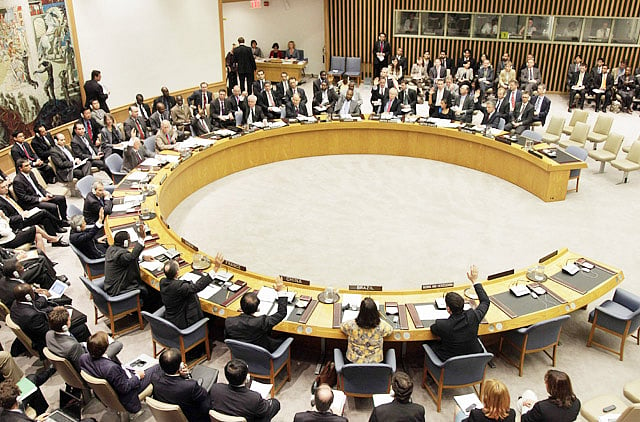
Dubai: Iran was slapped with the toughest set of sanctions it has faced to date following a UN Security Council vote Wednesday with Brazil and Turkey voting against the bill and Lebanon abstaining, but Tehran dismissed the measures as “annoying flies, like a used tissue”.
Iranian foreign ministry spokesman Ramin Mehmanparast also called the vote an "incorrect" step that would further "complicate" the situation.
The sanctions target Iran’s powerful Revolutionary Guard, ballistic missiles and nuclear-related investments. Oil exports, the lifeblood of Iran’s economy, are not affected because targeting them would have cost the US essential support from Russia and China.
President Barack Obama said the sanctions are the toughest Iran has ever faced. They required several months of difficult negotiations by the five veto-wielding permanent UN Security Council members – the US, Russia, China, Britain and France – and non-member Germany. This is the fourth round of sanctions aimed at getting Iran into serious discussions on its nuclear ambitions.
“Actions do have consequences, and today the Iranian government will face some of those consequences," Obama said.
He left the door open to diplomacy but said Iran "will find itself more isolated, less prosperous and less secure" unless it meets its obligations under the Nuclear Nonproliferation Treaty.
Iranian President Mahmoud Ahmadinejad, on an official visit in Tajikistan, dismissed the new resolution. "From right and from left, they adopt sanctions, but for us they are annoying flies, like a used tissue," he said.
In addition to the sanctions passed on Wednesday, the EU is also planning to impose additional sanctions, to pressure Iran to halt its nuclear programme. Iran insists it is within its rights to continue its nuclear programme and has always maintained it is meant for peaceful purposes.
Many experts believe the sanctions will have no effect on Iran's nuclear programme but would end up punishing the people of Iran.
"All economic sanctions are not effective, if you look to prime examples such as Cuba, Iraq and Libya, but I think the West is running out of options," Mustafa Alani, programme director of the Security and Terrorism Studies at the Gulf News Research Centre in Dubai, told Gulf News.
"The only other option is military action, and it is extremely unfavourable among Security Council members during this time."
According to Catherine Ashton, the European Union's high representative for foreign affairs, Britain, France and Germany would work closely with her to agree upon additional measures to pressure Iran — besides adding four more Iranian companies, including two banks and an insurance company — to a UN blacklist
Tehran insists its program is peaceful and aimed at producing nuclear energy. The US and its allies say Iran is trying to produce nuclear weapons" they want Iran to suspend uranium enrichment and start negotiations aimed at ensuring that it uses nuclear technology only for peaceful purposes.
The new resolution bans Iran from pursuing "any activity related to ballistic missiles capable of delivering nuclear weapons," bars Iranian investment in activities such as uranium mining and prohibits Iran from buying several categories of heavy weapons including attack helicopters and missiles. Iran, however, already has most of what it would need to make a weapon.
Iran's top nuclear negotiator, Saeed Jalili, warned that "choosing the option of confrontation will bring Iran's resolute response," according to Iran's official news agency. He did not elaborate.
Iran's UN Ambassador Mohammad Khazaee accused the United States, Britain and their allies of abusing the Security Council to attack Iran. "No amount of pressure and mischief will be able to break our nation's determination to pursue and defend its legal and inalienable rights," Khazaee said.
"Iran is one of the most powerful and stable countries in the region and never bowed – and will never bow – to the hostile actions and pressures by these few powers and will continue to defend its rights."
US Ambassador Susan Rice dismissed Khazaee's statement as "ridiculous ... reprehensible, offensive, and inaccurate" and declared that "these sanctions are as tough as they are smart and precise."
The resolution was approved by a vote of 12-2 with Lebanon abstaining and Brazil and Turkey voting "no." Turkey and Brazil, both non-permanent council members, brokered a fuel-swap agreement with Iran that they offered as an alternative solution to concerns Tehran may be enriching uranium for nuclear weapons.
Lebanon’s UN Ambassador Nawaf Salam said he abstained because the government failed to "reach a final position." A UN diplomat, speaking on condition of anonymity because the government debate was private, said the Cabinet was split, 14-14, on whether to vote no or abstain.
In Moscow, the Itar-Tass news agency reported that Ahmadinejad will not take part in the summit of the Shanghai Cooperation Organization in Uzbekistan beginning Thursday.
The group was created in 2001 to address religious extremism and border security in Central Asia, and has grown into a bloc aimed at defying US interests in the region. Ahmadinejad is scheduled to tour the World Expo in Shanghai this week, but is not expected to hold talks with senior Chinese leaders.
With additional inputs from AP
Sign up for the Daily Briefing
Get the latest news and updates straight to your inbox
Network Links
GN StoreDownload our app
© Al Nisr Publishing LLC 2026. All rights reserved.