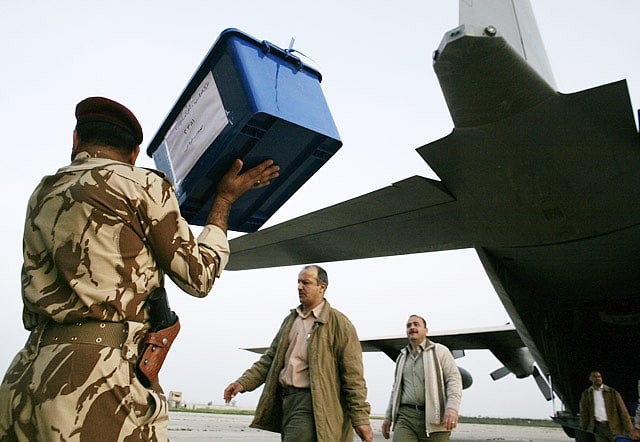
Baghdad: Early estimates from a range of Iraqi parties on Monday predicted a coalition led by Iraqi Prime Minister Nouri Al Maliki would take the lead in the parliamentary election, though official results were not expected for a few days.
A win by Al Maliki could signal Iraqis' rejection of the religious parties that have dominated the country since the US-led invasion in 2003. The prime minister has been trying to distance himself from his party's religious roots and portray himself as more of a nationalist.
Sunday's voting was the latest test of Iraq's fragile democracy and will determine whether the country can overcome the deep sectarian divides that have plagued it for the past seven years.
Turnout for Iraq's second election for a full parliamentary term was 62 per cent of about 19 million eligible voters, the election commission said. That is lower than the last full parliamentary election in December 2005, in which roughly 76 per cent of eligible voters turned out.
Officials attributed the drop to a combination of voter intimidation, more stringent ID requirements at the polls and a drop in voter excitement. A spate of attacks on election day - some directly on voters and polling stations - killed 36 people.
The election commission said at a news conference that initial results for some provinces as well as some districts in Baghdad - an area key to determining any winner - will be announced on Tuesday. But full results are not expected for a few more days.
But officials of the various parties were present during regional vote counts after the polls closed on Sunday, giving them a sense of where the race is heading.
Abbas Al Bayati from Al Maliki's State of Law coalition said early information from the coalition's representatives showed the list did well in Baghdad - where 68 of the parliament's 325 seats will come from - and in the Shiite south.
Regional officials in other parties who observed local vote counts also acknowledged that Al Maliki had done the best, although they spoke anonymously because official results had not yet been announced.
An official from a competing Shiite party opposing Al Maliki said the State of Law coalition appeared to be in the lead. He asked not to be named because of the sensitivity of the issue.
Officials from former Prime Minister Eyad Allawi's Iraqiya alliance said their list had done well in a number of heavily Sunni regions.
Allawi is fierce critic of Al Maliki who has said the government needs to do more to bring about reconciliation between the country's warring sects. His coalition included a number of high-profile Sunni candidates as well.
But even officials from Al Maliki's State of Law acknowledged that they did not have enough seats to form an outright majority, meaning they would have to work with other coalitions to form a government, a tough task considering Al Maliki's fractured relations with opposing political parties.
By all accounts, a small number of seats are expected to separate the first and second place blocs, which could further complicate and prolong the political wrangling required to form a government.
Turnout healthy despite violent attacks
More than 55 per cent of Iraqis voted in parliamentary election despite attempts by insurgents to disrupt the landmark vote with attacks that killed 38 people, officials said.
"It [turnout] is between 55 and 60 per cent," said Hamdiya Al Hussaini, a commissioner of Iraq's independent electoral commission, or IHEC.
Lawmaker Haider Al Ebadi, a State of Law candidate and member of Maliki's Dawa party, said initial results suggested the coalition was ahead in 10 provinces.
"In Baghdad and south of Baghdad, the State of Law was number one. But the special voting and voters abroad, this has not been concluded yet and could alter the outcome," he said.
There were 250,000 voters abroad, he said, compared to expectations that more than one million Iraqis might vote overseas. Most Iraqis abroad are believed to be minority Sunnis and their votes could be crucial for the chances of a secular, Shiite-Sunni alliance headed by former premier Eyad Allawi.
Real stake
The scale of the Sunni vote will indicate whether Sunnis feel they have a real stake in Iraq's nascent democracy after the shock of the US-led 2003 invasion, when they lost their relatively privileged position under Saddam Hussain.
Many Sunnis felt targeted when a Shiite-led panel vetoed around 500 candidates, including a top Sunni politician, before the vote, for alleged links to Saddam's outlawed Baath party. Sunnis felt under-represented after the 2005 election for a full-term parliament, which sealed the grip on power of majority Shiites and minority Kurds oppressed by Saddam.
Al Maliki faces a stiff challenge from his former Shiite Islamist allies grouped in the Iraqi National Alliance (INA).
The powerful Supreme Islamic Iraqi Council (ISCI), which is part of that bloc, said the vote appeared evenly split between Al Maliki and INA in early counting.
Allawi's bloc, Iraqiya, was running third, ISCI said.
Thaer Al Naqeeb, an Iraqiya candidate and close aide to Allawi, said results were not clear so far but initial figures put Iraqiya ahead in the northern and western provinces. Iraqiya got between 70-90 per cent of votes in those provinces, he said.
In Iraqi Kurdistan, a new party was challenging President Jalal Talabani's Patriotic Union of Kurdistan (PUK), one of two groups that have dominated Kurdish politics for decades.
A robust showing by the reformist Goran list could weaken the hand of the PUK and Massoud Barzani's Kurdistan Democratic Party in any coalition talks in Baghdad. The relative cohesion of the Kurds has allowed them to play kingmaker in the past.
"It was a generally fair election," said a source in Barzani's office, adding that he did not believe Goran had done as well as some people had expected.
Sign up for the Daily Briefing
Get the latest news and updates straight to your inbox
Network Links
GN StoreDownload our app
© Al Nisr Publishing LLC 2026. All rights reserved.