Beirut: Hezbollah’s “divine” victories in 2000 and 2006 against Israel earned the Party of God and its Secretary-General, Hassan Nasrallah, widespread support throughout the Arab World. Beyond the Shiite community, most Sunnis displayed genuine admiration, even adulation for the prowess demonstrated by young commandoes who fought allegedly invincible enemies. Not any more. By adopting extremist positions in Lebanon and now in Syria, Hezbollah squandered its popularity, standing with the oppressors against those who fought for freedom.
Punctuated criticisms, which used to be limited to political tenors, have now spilled into the public sphere, as Lebanese and Syrians no longer refrained to condemn the Hezbollah’s military involvements in Syria.
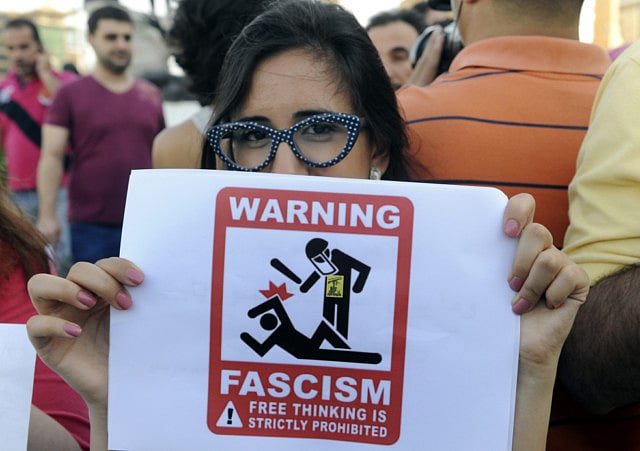
A few days ago, around 50 Lebanese and Syrian demonstrators gathered around Martyrs Square, carrying “Free Syria” flags. Dozens of placards expressed solidarity with Qusayr, where Hezbollah deployed its forces, while many chanted “curse your soul, Hafez [Al Assad]” and “come on, step down Bashar/Hezbollah.” Several flyers redrew the party’s insignia, changing the word “Hezbollah” to “hurriyah” (freedom).
Although their numbers were limited, demonstrators were quite vocal, willing to expand on their messages to television stations that readily broadcast the event. Interestingly, there were no counter-protests, although a pro-Syrian/Hezbollah event under the auspices of the pro-Syria Marada Party led by Sulaiman Frangie, was held elsewhere. While Frangie pledged eternal loyalty to the muqawamah (resistance) and to Bashar Al Assad, Martyrs Square demonstrators cautioned that Hezbollah wanted to drag Lebanon into a new civil war.
Several interviewees made the link between the fighting in Qusayr and clashes in Tripoli and Sidon, though what was truly noteworthy was the absence of Internal Security Forces and the Army, both of which opted to keep their distance.
“I’m Syrian,” said Muayyad Al Bunni, who continued: “We felt we should do something because we heard that Hezbollah is now killing our brothers in Syria. We are in Lebanon, Hezbollah’s country, so we decided to make our voices heard.”
Neither the ISF nor the Army would have permitted such utterances in the past. Who organised the Facebook-mobilised demonstration was not clear although “Karim” volunteered responsibility. He did not disclose his full name even if he did not mince his words as he denounced Hezbollah. “As Lebanese,” he reiterated, “we do not accept what they are doing and this does not represent us. This bypasses not only our constitution but our sense of liberty, and everything that Lebanon is supposed to stand for.”
The last time such comments were uttered in Martyrs Square was in March 2005. It remained to be determined whether a new chapter of that suspended Lebanon Spring was about to open.
Sign up for the Daily Briefing
Get the latest news and updates straight to your inbox
Network Links
GN StoreDownload our app
© Al Nisr Publishing LLC 2026. All rights reserved.