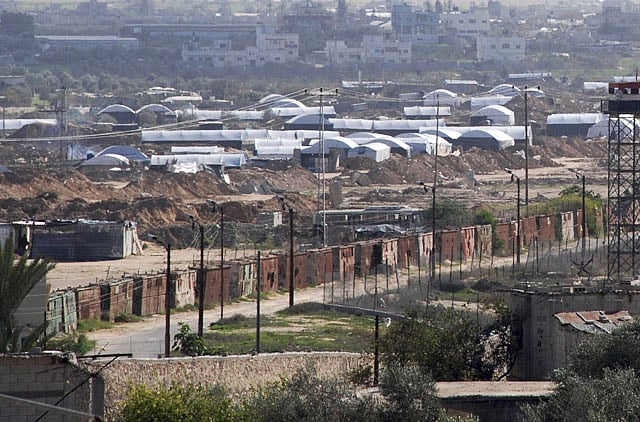
Cairo: Faced with opposition from Islamists and human rights groups, the Egyptian government is at pains to sell a controversial plan to build an underground barrier along the border with the Gaza Strip.
"The construction works being carried out by the Egyptian Army there are part of a plan to protect Egypt's borders," said Mufeed Shebah, the Minister of Parliamentary Affairs.
He told an acrimonious session of the parliament early this month that the barrier does not target "our brothers" in Gaza. "These construction works are a legal way to protect Egypt's borders not from our brotherly people in Gaza but from the professional smugglers and exporters of terror," Shehab said on January 3.
"These measures are not new. They build on steps prompted by a series of events, including the storming of the Rafah (border) crossing by hundreds of thousands of Palestinians on January 23, 2009."
He said that Egypt had arrested several infiltrators in possession of explosives who had entered the country through these tunnels to destabilise it.
Other Egyptian officials estimate that more than 1,000 tunnels have been built to smuggle different contraband goods including weapons and drugs.
Opponents to the barrier say that the underground barrier will add to the ordeal of around 1.5 million people in Gaza who have been under an Israeli siege since the Islamist group Hamas seized control of the enclave in 2007.
"Egypt alone sent around 30 aid convoys to the Gaza Strip in 2009," said Hossam Zaki, a spokesman for the Egyptian Foreign Ministry.
Full control
Al Wafd, Egypt's oldest liberal party, has declared support for these measures. "As part of its sovereignty, Egypt has the right to close and eliminate the tunnels in order to have full control over its borders," the opposition party said in a statement. However, Al Wafd urged the Egyptian government to permanently open the border crossing with Gaza to allow the movement of individuals and essential goods for the Palestinians.
The government's rationale seems to have gained ground in this country of 80 million people after an Egyptian border soldier was killed allegedly by a Hamas sniper on January 6 as scores of young Palestinians were shown on TV screens hurling stones at Egyptian border guards.
"Egypt has the right to protect its borders in all ways, which do not contradict the international law," said Mahmoud Mohieddin, a lawyer. "This wall will plug in holes in our borders," he told Gulf News.
Mohieddin blames Hamas for the current dilemma in Gaza. The construction of the Gaza barrier has, meanwhile, received the blessing of the Islamic Research Centre, an influential arm of Al Azhar, which is Sunni Islam's prestigious seat of learning.
"The tunnels between Gaza and Egypt do a big harm to Egypt's security as they are used in smuggling drugs and other illicit substances," the centre said in a statement.
Sign up for the Daily Briefing
Get the latest news and updates straight to your inbox
Network Links
GN StoreDownload our app
© Al Nisr Publishing LLC 2026. All rights reserved.