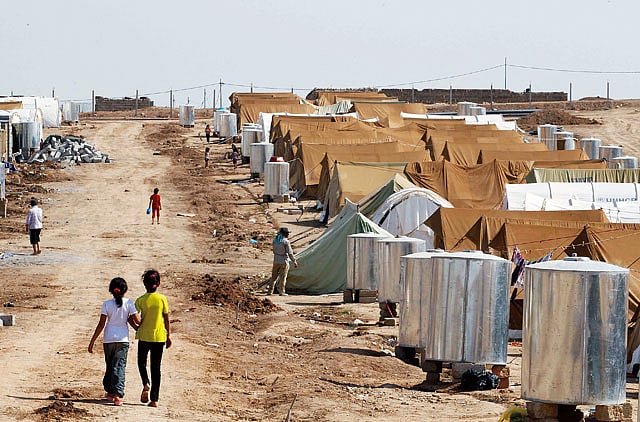
As the violence in Syria plays out daily in the world’s media, in one remote corner of the country a small difference is being made. Some 600 Syrian refugees a day are making their way slowly over the border with Iraq, walking for days weighed down by all they can carry.
Close to the border lies Domiz refugee camp, in northern Iraq, built on a former military camp. Until last spring, the land was littered with explosive devices, many concealed, which were a huge hazard. But then the international Mines Advisory Group (MAG) stepped in to clear the land of these weapons and munitions so the sprawling camp could grow further.
Today MAG posts skull and crossbones signs beside known minefields, warning the straggle of Syrian refugees to stay clear.
“It was a difficult journey with torrential rain and terrible mud, all the while carrying clothes and trying to keep watch over our children,” says exhausted refugee Niem Khalid.
“When we passed the border, we met MAG teams who told us about the minefield and advised us where to walk. They showed us the skull and crossbones signs and told us what they meant.”
Having one more danger pointed out was a shock, he admits. “We had no idea. We were not thinking about anything other than being free.”
The pressure on camps is immense – more than 1.4 million Syrian refugees have already fled to neighbouring countries. Many continue to register in northern Iraq every day. And since hundreds per day make the crossing at the border close to Shilikye village to reach the Domiz camp, MAG’s work in the mine-ridden area is more crucial than ever.
As well as helping desperate refugees cross safely, MAG is also aiding expansion of the camp by clearing contaminated land in the surrounding area. So far it has cleared 78 landmines, and more than 220,000 square metres of land to house the expanding camp.
“It’s a desperate situation,” said MAG chief executive Nick Roseveare, during a visit to the Domiz camp in April.
“Overcrowding is clearly an issue. Conditions are difficult and there is huge pressure on facilities. People are living in near destitution in the rain and mud, with diseases like measles rampant. And as the spring and summer come, families – most likely women and children – will venture out to the surrounding countryside to collect fruit and wild flowers to supplement their meagre rations.
“Due to years of conflict, this part of Iraq is heavily contaminated with landmines and unexploded ordnance. Educating families in the camp about the risks will be vital if we are to avoid more unnecessary tragedy.”
Thousands killed every year
According to the United Nations, every year landmines kill between 15,000 and 20,000 people – many of them children, women and the elderly – and severely maim countless more. Mines are scattered in some 78 countries – a reminder of conflicts that have been over for years or even decades. Based in Manchester, UK, the co-laureate 1997 Nobel Peace Prize- winning charity is one of the world’s leading mine clearance organisations. MAG has worked in countries around the world including Afghanistan, Gaza, Iraq, Lebanon, Pakistan, Somalia and Sudan.. As a neutral and impartial humanitarian organisation, MAG clears the dangerous remnants of conflict, targeting land in everyday use to make it safe for people to live, work and farm, and for children to play.
Born in 1989 following the withdrawal of Soviet troops from Afghanistan, MAG started tackling the huge problems of landmines and unexploded weapons including bombs, bullets, mines, shells and grenades. As an advisory group in the early days, its reports on the dangers facing civilians in Afghanistan and Cambodia had a huge international impact, and it expanded to report on northern Iraq, Somaliland, Angola and other countries where the need for mine clearance was huge.
Two years after it was founded, the group won funding to start a pioneering clearance programme in Iraq. Schemes in Cambodia and Angola followed as MAG drove forward the International Campaign to Ban Landmines.
The late Princess Diana was a supporter. “My Angola experience was to see what has been done, slowly and perilously, to get these mines out of the earth,” she told a 1997 seminar. “It is the men of the Mines Advisory Group who do this hazardous work… and I pay my tribute to the work these men do on our behalf.”
Over the past two decades in Iraq, MAG has cleared 600 minefields, released 70 million square metres of land, and destroyed 165,000 landmines and two million pieces of ordnance.
Yet hazards remain, says Syrian refugee Abdullah who recently made the crossing to Domiz camp with his wife, mother and eight children. “We travelled for days,” he says. “I have lived in Sham [Damascus] for 10 years, but since the violence things have become difficult: no food, no water, no fuel. After three days in another village, we headed to the border.
We didn’t know anything about the mine contamination. But when we arrived, we saw the MAG team who told us which path to take.”
In spite of the charity’s efforts, dangers remain, says Wirya Mustafa, field operations manager at MAG’s Dohuk base in Iraq, as the rainy season means landmines that lay in previously marked areas can slide into the stream, or float towards
the crossing.
“Washout causes landmines originally laid in lines to move from their original positions, which means they can drift into areas we haven’t marked,” Wirya explains.
When refugees cross at night, the dangers are huge, he adds. “We know that worries about crossing the border mean many Syrians are coming at night, hiding among the reeds and using the stream as shelter. With no one there to warn them, this could be fatal.”
There have been several casualties in Somalia. Schoolboy Abdi-Najib Hirad Said lost a leg, a hand and an eye after an object he found blew up when he and his friends were playing a game with it.
“We found it under a bridge. We picked it up and playfully threw it,” he says. The next thing he remembers was an explosion. “I was blown into the air – nothing else I remember.” His friend was killed instantly.
MAG’s community liaison teams are in the area trying to prevent further tragedies, helping local people recognise mines and other unexploded devices, as well as working with respected locals who report suspicious devices to mine clearance teams.
MAG has transformed communities worldwide, keeping generations of people safe from harm. “MAG is proud of its record through good times and bad in northern Iraq, and privileged to have excellent relations with both the authorities and local communities,” said MAG chief Nick.
Having a people-focused solution and clearing the areas where people live, play and work, means using local teams.
“My family had a very hard time in the [Sri Lankan civil] war, and fled from place to place – many, many times,” says Kandeepan Sutharsini, mother of an 11-year-old boy and now a deminer in MAG Sri Lanka’s all-female Mine Action Team. “I was hit in the stomach by shrapnel in the war, and my father was hit three days later – we are both OK now though.”
Working with MAG brings Kandeepan great satisfaction. “We are women together in this team, and we share a lot together and help each other,” she says.
“If we didn’t do this work, it would be impossible for people to come home. MAG pays us, and the donors pay MAG, so the donors can be proud of what we are achieving here.”
Offering hope and opportunities
For others in the demining teams, such as Sok Kheurn who works in a MAG Cambodia Mine Action Team funded by World Vision Cambodia, helping to save others is a lifeline. As a former soldier, he lost a leg in 1991 so had already been scarred by war in Cambodia. He married in 2000 and had a daughter.
“Being an amputee caused many problems in my marriage, and I split up with my wife,” says Sok. “I tried to live a normal life after becoming an amputee, but I felt as if I was going nowhere and doing nothing, stuck with feeling useless.
“I want to thank MAG and World Vision for giving an amputee like me the opportunity to get a job, especially a job like demining that helps society. Perhaps people will stop looking down on amputees, and believing we can’t do anything useful with our lives. Now I have a real purpose in my work. I want to help reduce the number of people who may be disabled by landmines.”
Turning a traumatic experience into a positive contribution drives many who support MAG. London 7/7 bus bomb survivor Lisa French transformed the terror of her experience into hope for others, volunteering with a demining group in Cambodia. Tears came to her eyes as she watched an amputee who worked as a palm oil tapper shinning down a tree – years after he stepped on the landmine that cost him a leg.
“The people MAG recruit to become deminers are a true inspiration to me,” she says. “They are true heroes.”
Watching MAG working in the field first hand was also a moving experience for Stuart Hughes, BBC World Affairs producer and a landmine survivor himself. “There is no other mine action agency that approaches mine clearance the way MAG does,” he says.
For the BBC’s former war correspondent Martin Bell OBE, the reason for MAG’s success is simple. “They are universally respected,”
he says. “I know of no aid agency or non-governmental organisation, relative to its size, which has saved more lives than MAG, helped more people and done more around the world to tackle the scourge of the landmine.”
For that steady stream of refugees pouring from Syria over ground still contaminated by the deadly devices of war, the work of MAG and its teams is a lifesaver.
In the words of Syrian refugee Abdullah, “I’m glad MAG was there to tell us about the dangers when we arrived. I came here for my children – I just want them to be safe.’’
Sign up for the Daily Briefing
Get the latest news and updates straight to your inbox
Network Links
GN StoreDownload our app
© Al Nisr Publishing LLC 2026. All rights reserved.