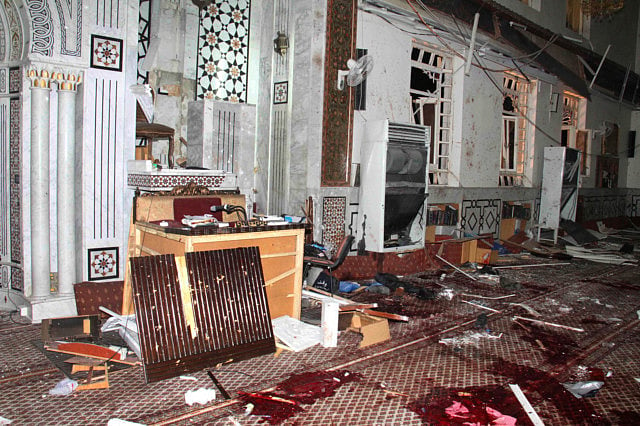
Beirut: Syria’s president has vowed to rid the country of extremists whom he blamed for a suicide bombing that killed 42 people, including a top Sunni preacher.
Friday’s statement by Bashar Al Assad came hours after the explosion ripped through a mosque in the heart of Damascus, killing Shaikh Mohammad Saeed Ramadan Al Butti.
It was one of the most stunning assassinations of the two-year civil war and the first time a suicide bomber struck inside a mosque.
Al Butti was a staunch supporter of Al Assad. More than 84 were wounded in the attack.
In the statement carried by Syria’s state news agency, Al Assad says Al Buti represented true Islam in facing “the forces of darkness and extremist” ideology.
Al Assad says his forces will “wipe out” and “clean our country” of the attackers.
The slaying of Al Butti removes one of the few remaining pillars of support for Al Assad among the majority Sunni sect that has risen up against him.
It also marks a new low in the Syrian civil war: While suicide bombings blamed on extremists fighting with the rebels have become common, Thursday’s attack was the first time a suicide bomber detonated his explosives inside a mosque.
A prolific writer whose sermons were regularly broadcast on TV, the 84-year-old Al Butti was killed while giving a religious lesson to students at the Eman Mosque in the central Mazraa district of Damascus.
The most senior religious figure to be killed in Syria’s civil war, his assassination was a major blow to Syria’s embattled leader, who is fighting mainly Sunni rebels seeking his ouster. Al Butti has been a vocal supporter of the regime since the early days of Al Assad’s father and predecessor, the late President Hafez Al Assad, providing Sunni cover and legitimacy to their rule. Sunnis are the majority sect in Syria while Al Assad is from the minority Alawite sect - an offshoot of Shiite Islam.
“The blood of Sheik Al Butti will be a fire that ignites all the world,” said Grand Mufti Ahmad Badr Al Deen Hassoun, the country’s top state-appointed Sunni cleric and an Al Assad loyalist.
Syrian TV showed footage of wounded people and bodies with severed limbs on the mosque’s blood-stained floor, and later, corpses covered in white body bags lined up in rows. Sirens wailed through the capital as ambulances rushed to the scene of the explosion, which was sealed off by the military.
Among those killed was Al Butti’s grandson, the TV said.
The bombing was among the most serious security breaches in the capital. An attack in July that targeted a high-level government crisis meeting killed four top regime officials, including Al Assad’s brother-in-law and the defense minister.
Last month, a car bomb that struck in the same area, which houses the headquarters of Syria’s ruling Baath party, killed at least 53 people and wounded more than 200 others in one of the deadliest Damascus bombings of the civil war.
A small, frail man, Al Butti was well-known in the Arab world as a religious scholar and longtime imam at the eighth-century Omayyad Mosque, a Damascus landmark. State TV said he has written 60 books and religious publications.
In recent months, Syrian TV has carried Al Butti’s sermons from mosques in Damascus live every week. He also has a regular religious TV programme.
There was no immediate claim of responsibility for Thursday’s attack.
Among the opposition, there was a mixture of suspicion and shock that an elderly religious figure such as Al Botti would be targeted by a suicide bomber inside a mosque.
“I don’t know of a single opposition group that could do something like this,” said Walid al-Bunni, a spokesman for the Syrian National Coalition opposition group, speaking on Al Arabiya TV.
In Lebanon, security officials said 150 people, mostly women and children, walked for six hours in rugged mountains covered with snow to reach safety in the Lebanese border town of Chebaa. They said eight wounded Syrians were brought on mules from Beit Jan and taken in ambulances to hospitals in Chebaa.
The officials, who spoke on condition of anonymity because they were not authorized to speak to the media, said the Syrians fled from the town of Beit Jan, near the Golan Heights.
Meanwhile, the United Nations will investigate the possible use of chemical weapons in Syria, which would amount to a crime against humanity, Secretary-General Ban Ki-moon announced Thursday.
The investigation could be broader than the Syrian government’s request for an independent probe of a purported chemical weapons attack on Tuesday. Ban said he was aware of allegations of other, similar attacks and hoped the probe would ultimately help secure Syria’s chemical weapons stockpile.
The secretary-general said investigators would look into Syria’s allegation that rebels carried out a chemical weapons attack on Khan Al Assal village in northern Aleppo province. The rebels blamed regime forces for the attack.
Sign up for the Daily Briefing
Get the latest news and updates straight to your inbox
Network Links
GN StoreDownload our app
© Al Nisr Publishing LLC 2026. All rights reserved.