Philippines holds vital polls for reforms
Graft-tainted candidates underlin nation’s deep-rooted problems
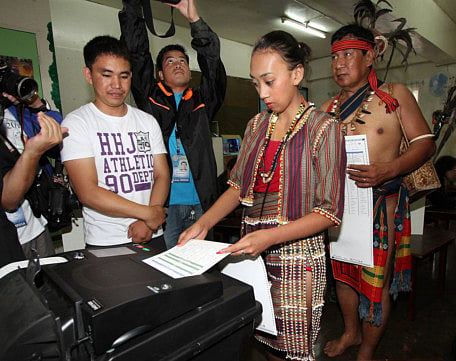
Manila: The Philippines held elections on Monday seen as crucial for President Benigno Aquino’s bold reform agenda, as deadly violence and graft-tainted candidates underlined the nation’s deep-rooted problems.
Aquino called for the mid-term polls, in which thousands of local leaders plus national legislators will be elected, to be a referendum on his efforts to transform a corrupt political system and an underperforming economy.
“The president is asking voters to put their confidence in those on the administration slate to help him carry out the rest of his reform agenda,” presidential spokeswoman Abigail Valte told AFP.
Aquino swept into power in 2010 on a promise to fight corruption that he blames for crushing poverty in the country of 100 million people.
Opinion polls show he remains one of the country’s most popular presidents, with the Philippines enjoying faster economic growth than every other nation in the Asia-Pacific except for China.
But, with presidents only allowed to serve one term of six years, Aquino is in a rush to implement more ambitious reforms and make an enduring impact on graft.
Monday’s elections — in which more than 18,000 positions, from town councillors up to provincial governors and members of the legislature, are being contested — are vital to shore up support for his efforts.
Most crucial is control of both houses of Congress.
Aquino is confident of securing big majorities in both houses from an alliance of a wide range of parties, enabling him to pass legislation much more easily than his first three years when he did not have control of the Senate.
One of Aquino’s biggest reforms is a planned peace deal with Muslim rebels to end a decades-long insurgency in the south that has claimed an estimated 150,000 lives and curtailed economic growth.
The peace accord would require parliamentary endorsement.
Aquino’s aides have also said he is focused on passing legislation that would expand the tax base, including from the mining sector, to pay for more social security services.
Nevertheless, amid the hope, the elections highlighted the enduring nature of many of the darkest traditions that have smothered Philippine politics since the end of Ferdinand Marcos’s dictatorship in 1986.
The Philippines is infamous for a brutal brand of democracy where politicians — particularly at local and provincial levels — are willing to bribe, intimidate or kill to ensure they win.
On Monday, seven people were killed in the south as politicians’ security forces battled each other or launched attacks on voters. More than 60 people were killed in pre-poll violence.
Meanwhile there was a host of candidates with links to corruption or violence, part of a “culture of impunity” in which powerful figures easily skirt around the justice system.
Among them was Imelda Marcos, 83-year-old wife of the ex-dictator, who was widely expected to win a second term in the lower house representing a northern province which has for decades remained a family stronghold.
Joseph Estrada, a former president evicted in a popular uprising in 2001 and later convicted of committing plunder while in office, was running to become mayor of Manila, the nation’s capital.
Sign up for the Daily Briefing
Get the latest news and updates straight to your inbox
Network Links
GN StoreDownload our app
© Al Nisr Publishing LLC 2026. All rights reserved.