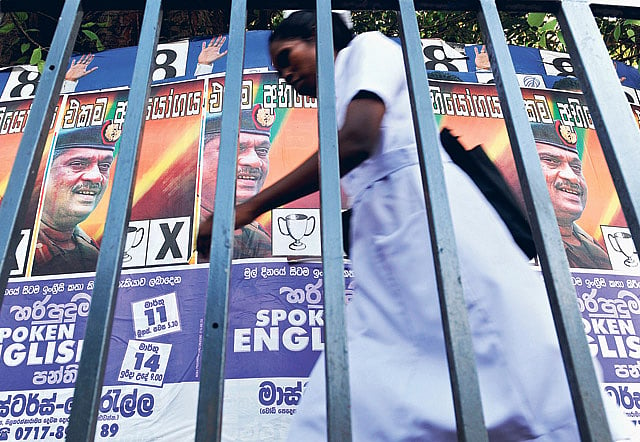
Colombo: The former Sri Lankan army chief who lost his opposition bid for the presidency objected yesterday to his court-martial hearing, saying the panel formed to decide his fate was biased against him, an ally said.
The arrest of Gen Sarath Fonseka has been condemned by opposition and human rights groups, who accuse the government of retaliating against a man who dared challenge President Mahinda Rajapakse in his re-election bid.
The court martial yesterday of Fonseka, considered one of the heroes of the government's war against the Tamil Tiger rebels, has been shrouded in secrecy, with the military barring reporters from the event and refusing to release a detailed account of the proceedings.
Military spokesman Major General Prasad Samarasinghe said Fonseka, accompanied by his lawyer, appeared before a three-member panel at the country's navy headquarters to face charges that he prepared the groundwork for his presidential campaign while still in military uniform.
Purchase violation
A second charge that Fonseka violated regulations in purchasing military hardware will be taken up today, he said.
Fonseka objected to the court martial soon after it began yesterday and said the presiding panel of three officers was biased because it included two men whom he had disciplined when he ran the army, said Anura Dissanayake a lawmaker and Fonseka ally. The panel's third member was a close relative of the current army commander who initiated the court martial, he said.
Fonseka also argued that an army commander cannot face a court martial.
Police used tear gas and batons to disperse a protest in support of Fonseka and arrested 14 people, according to Fonseka's party, the Democratic National Alliance. Police spokesman Prishantha Jayakody said the protesters blocked traffic and clashed with police leading to the arrests. All were released on bail, he said.
"Sarath Fonseka's arrest continues the Rajapakse government's post-election crackdown on political opposition," said Sam Zarifi, Amnesty International's Asia-Pacific director. Fonseka's wife, Anoma, said she opted not to attend the hearing because the charges against her husband were "a joke".
Fonseka's supporters have denied the charges brought against him, saying the government is punishing the retired general for challenging Rajapakse and is attempting to cow the opposition before April 8 parliamentary elections. Despite his detention Fonseka is running for a seat in the election.
Fonseka quit the army and challenged Rajapakse in the January 26 election, losing out by 18 per cent.
Celebrated general
- Born on December 17, 1950, in Ambalangoda, a coastal town in the island nation's southwest. He joined the army in 1970 as a staff officer and gradually rose through the ranks.
- Fonseka has held a large number of staff appointments including the office of chief of staff of the Sri Lankan army, the post he relinquished to take reins as commander of the army.
- As deputy general officer commanding operation ‘Riviresa', he participated in the capture of Jaffna from the Tamil Tigers, in December 1995.
- Fonseka, was also involved in operations ‘Balawegaya' and ‘Jayasikuru', which led to the capture of Elephant Pass and Mankulam. The 6th Battalion of his Sri Lanka Sinha Regiment, which was under siege at Elephant Pass in 1991, repulsed the LTTE attack with reinforcements. He was wounded in 1993 in the ‘Yaldewi' operation.
- On April 25, 2006, Fonseka survived an LTTE suicide bomb attack by a pregnant LTTE operative who infiltrated the army base by attending the regular maternity clinic provided for civilians at the army base military hospital. He was seriously injured and nine others were killed.
- On May 18, 2009, the army, under the leadership of Gen. Fonseka, together with the Sri Lanka Navy and Sri Lanka Air Force, completely defeated the LTTE after 26 years of civil war. Fonseka is considered a national hero by the majority of Sri Lankans as a result this achievement.
- Fonseka was made the chief of defence staff by the president effective from July 15, 2009. He is the first chief of defence staff appointed under the newly approved Chief of Defence Staff Act.
- Fonseka officially handed over his resignation to the president through the secretary of defence on November 12, 2009. He left the office on November 16.
Sign up for the Daily Briefing
Get the latest news and updates straight to your inbox
Network Links
GN StoreDownload our app
© Al Nisr Publishing LLC 2026. All rights reserved.