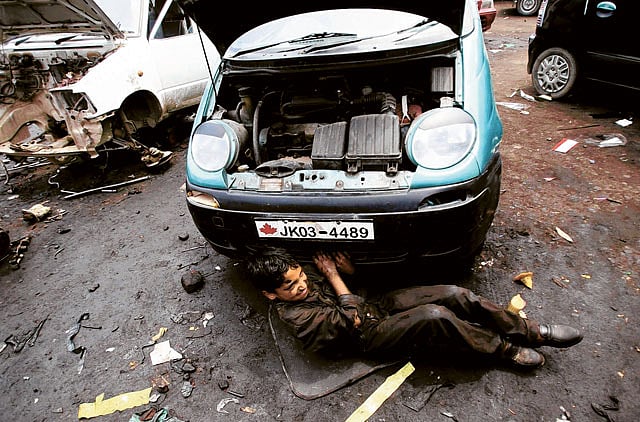
New Delhi: A boy of 10 by the name of Ansar sat in bewilderment on the floor of a Delhi police station last week, hours after being rescued from a grimy sweatshop to which his father had sold him. He had been forced to work 12-hour days unpaid.
"My father promised he would come back for me. He said I could go to school," Ansar repeated over and again, casting his brown eyes downwards as tears began to well up.
It is three weeks since the child was abandoned in a slum in the Nand Nagri suburb of India's capital. He and his father had travelled by train for more than 20 hours from Bihar, an impoverished state in the north of the country.
Ansar had been assured he was going to Delhi to get an education, but he was instead put to work with 10 other children in a cramped and dirty room. There he toiled in temperatures as high as 42C to make bindis — small items of jewellery worn on the forehead by southern Asian women. The children were forced to sit hunched over a wooden table from noon to midnight six days a week.
Most earned £1 a day to send back to their families in Bihar but Ansar, still learning how to stick glitter and small rhinestones to the bindis, was regarded as an apprentice and so received no pay. Ansar's employer had paid his father Rs1,000 (£12) to hand over the boy.
Ansar clung daily to the hope that his father would return as promised and send him to school.
"I still love him — he's my father — but the work makes me sad and the boss shouts at us," he said. "I have no friends here. I want to go back to my village and play cricket with my best friend Masoor."
Surveillance
Ansar had attended school for a year before being sent to Delhi, but until last week his chances of returning to the classroom were slim. With seven mouths to feed, Ansar's parents were depending on the eventual income of their second-born child for their family's survival.
A total of 23 children aged between 10 and 14 were rescued last Thursday in a raid on four residential properties. The owners were taken by surprise as 40 police officers armed with lathis (long canes usually used for crowd control) poured out of three vehicles. Bachpan Bachao Andolan (BBA), a group that campaigns for the abolition of child labour, had been conducting surveillance and tipped off police about the presence of child workers.
Guided by BBA activists, the officers charged up narrow staircases into the tiny rooms in which the exploited children were working. As they grabbed the owners, forcing one to the ground, social workers moved in to reassure the frightened, half-naked minors.
Fearful of missing targets, many of the children, crouching over their low tables, continued working on the bindis. After being gently urged to dress themselves, the boys were ushered down the stairs and into waiting cars. Local men were openly hostile to the police and the officers had to disperse an agitated crowd.
Police raid
The police had to move fast as word spread through the slum. The last sweatshop was in a street several hundred yards away and officers had to give chase to a young man suspected of running to warn the owners. Six more children were rescued at the last sweatshop.
The Indian government estimates the country has 5m child labourers under the age of 14, but the BBA believes that up to 50m are being forced to work.
Yesterday the group was celebrating an announcement by Mallikarjun Kharge, India's employment minister, that a law would be introduced banning child labour throughout the country. "This is the result of a 30-year campaign," said Bhuwan Ribhu, an activist.
The children rescued last week had been making goods for three Indian companies selling largely on the domestic market, although some products were believed to be destined for the United States.
The sweatshop owners who were arrested were unapologetic. "It's cheap labour. If adults were doing the work we would have to pay them a lot more," said a man who gave his name as Zubair. The owners have since been charged and remanded in custody.
Ansar and the 22 other children were taken to BBA's Mukti Ashram school on the outskirts of Delhi. His eyes lit up when he was told he would be going to school.
"If I don't get an education my life will never come to anything," he said. "When I grow up I want to visit London."
— The Times Newspapers Limited 2012
Sign up for the Daily Briefing
Get the latest news and updates straight to your inbox
Network Links
GN StoreDownload our app
© Al Nisr Publishing LLC 2026. All rights reserved.