Mumbai: Special judge of the 26/11 court, M L Tahaliyani, will pronounce the sentencing of terrorist Ajmal Kasab in the Mumbai terror attacks tomorrow after the prosecution yesterday pressed for a death penalty for the accused even as the defence appealed for a lesser punishment of life sentence.
While defence lawyer K P Pawar pleaded for life sentence for Kasab, who was found guilty on Monday of mass murder and waging a war against India, the prosecution came strongly with several reasons why the accused should get nothing less than a death penalty.
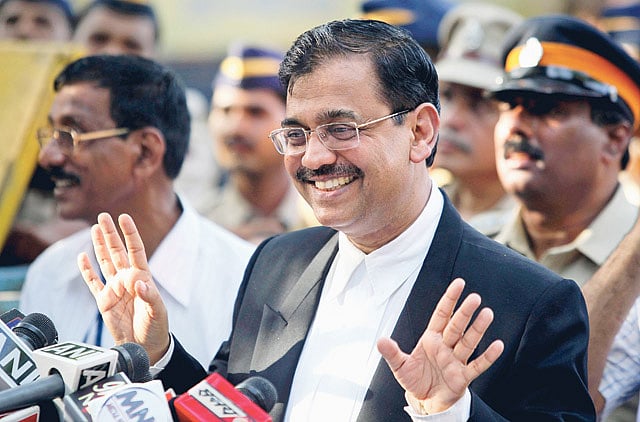
Describing Kasab as a "killing machine" and that the "manufacturing facility of this killing machine" was in Pakistan, Special Prosecutor Ujwal Nikam came up with harsh words for the accused.
"Kasab is an agent of the devil himself, a disgrace to society and the entire human race. He should be hanged to death as the acts of Kasab are much more heinous than his silent death." Without the death penalty, India will continue to remain a soft target for every terror organisation, he added.
Nikam's arguments, tinged with drama and emotion, pointed out to the "exceptional depravity of Kasab since it has been proved that he was in a joyous mood after seeing passengers at the Chhatrapati Shivaji Terminus (CST) dying in pain and agony. He enjoyed the killings of innocent persons which included the old and the young, Hindus and Muslims, and others."
Most of these victims were helpless, defenceless and there was no provocation at the time of the execution, he said. Out of 72 persons that Kasab and his colleague Abu Esmail killed, 52 were at CST, seven inside and nine outside Cama Hospital as well as two who died in the taxi bomb blast at Vileparle and the shooting down of policeman Tukaram Ombale at Girgaum Chowpatty from where the accused was captured. "Amongst these victims were eight women and seven children. Kasab can be legally called depraved."
Had hoped to kill more
Even in his confessional statement, Nikam pointed out that Kasab had stated "he was unhappy because they [he and nine other terrorists] were delayed in the trawler on the high seas for one-and-a-half hours and reached Mumbai at around 9pm. Kasab was disappointed and angry because he did not see the crowds at CST."
The terrorists had hoped that if they had reached at 7.30pm, they could have left heaps of dead bodies. "No human being would talk like this," said Nikam.
On Nikam's arguments that Kasab was "mature" enough to understand his acts and that he had voluntarily joined the Lashkar-e-Taiba, Pawar asked for documentary evidence of Kasab's age. He said the Supreme Court had given a ruling that death penalty should not be given to a very young or very old person.
The court however rejected his argument since Kasab's age was already certified by medical experts as 22. Pawar even argued that his client should be given life since he could reform and rehabilitate, a point which Nikam earlier pointed as not possible as in the confession Kasab hoped that more suicide missions like his should get ready to come and kill.
All through Nikam's and later Pawar's submissions to the court, Kasab sat with his head resting on one hand, not clear whether he was dozing or just closing his eyes. When the court closed at 5 pm, he was helped out by two policemen.
Sign up for the Daily Briefing
Get the latest news and updates straight to your inbox
Network Links
GN StoreDownload our app
© Al Nisr Publishing LLC 2026. All rights reserved.