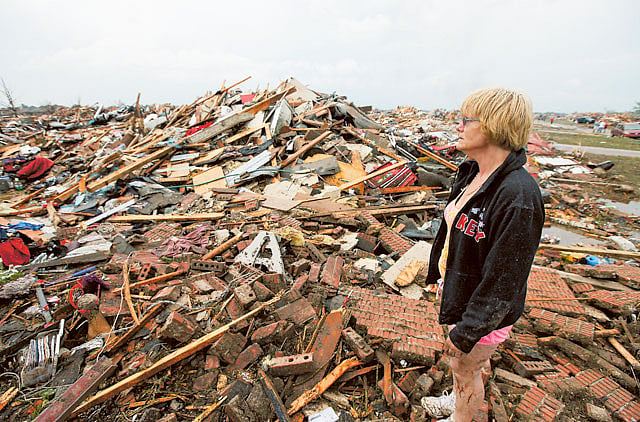
Here are the 10 deadliest tornadoes to touch down in the US, according to the National Oceanic and Atmospheric Administration:
1. The “Tri-State Tornado” killed 695 people and injured 2,027, travelling more than 500km through Missouri, Illinois and Indiana on March 18, 1925.
2. The “Natchez Tornado” killed 317 people and injured 109 on May 6, 1840, along the Mississippi River in Louisiana and Mississippi. The official death toll may not have included slaves, according to the Federal Emergency Management Agency.
3. The “St Louis Tornado” killed 255 people and injured 1,000 on May 27, 1896, in Missouri and Illinois.
4. The “Tupelo Tornado” killed 216 people and injured 700 on April 5, 1936, in the northeastern Mississippi city.
5. The “Gainesville Tornado” was a pair of storms that converged April 6, 1936, in Gainesville, Georgia, killing 203 people and injuring 1,600.
6. The “Woodward Tornado” wreaked havoc across parts of Texas, Oklahoma and Kansas on April 9, 1947. The storm killed 181 people and injured 970,
7. The tornado that struck Joplin, Missouri, on May 22, 2011, killed 158 people and injured more than a thousand. The storm packed winds in excess of 300km/hour and was on the ground for more than 35km.
8. The “Amite/Pine/Purvis Tornado” killed 143 people and injured 770 on April 24, 1908. The storm left only seven houses intact in Purvis, Mississippi, and also caused damage in Amite, Louisiana.
9. The “New Richmond Tornado” killed 117 people and injured 200 on June 12, 1899, in New Richmond, Wisconsin.
10. The “Flint Tornado” killed 115 people and injured 844 on June 8, 1953, in Flint, Michigan. The tornado was the deadliest twister ever recorded in the state.
What causes tornadoes?
A tornado is a vortex of violently circulating winds that extends from the base of a cloud to the Earth’s surface. The strongest tornadoes often develop with storms that have a large area of strong wind rotation — called a mesocyclone — within the storm cloud.
The mesocyclone is created by strong updrafts in the storm and wind shear, which causes the air near the surface, whether ground or water, to spin horizontally — like a rolling pin. This spin then tilts to a more or less vertical axis and is stretched by strong updrafts, which intensifies the rotation. Strong downdrafts that wrap around the rear of the storm help to bring the rotation down to the Earth’s surface. A tornado can form at the boundary between the strong updrafts and downdrafts.
What are the signs of a tornado?
A tornado usually first appears as a rotation in a huge thundercloud, often behind heavy rain or hail. The sky often turns green, yellow or black. The sound can be deafening, like the rumble of a freight train.
How does a tornado move?
Tornadoes often travel from southwest to northeast. They may last only a few minutes or more than an hour and can be nearly stationary or travel at speeds of more than 100km an hour, often leaving a trail of destruction. If a tornado looks as if it’s not moving, it may either be moving straight away or straight towards you.
When do tornadoes happen?
Peak months for tornadoes are June and July, but they can happen any time from March to October. Winter tornadoes are very rare. Tornadoes often happen in the afternoon or early evening.
How much damage do they cause?
Many tornadoes do little more than uproot trees and cause minor damage to barns and sheds, but the more violent tornadoes can be devastating. The most severe tornadoes can level houses and cause a path of destruction more than 100 kilometres long and a kilometre wide.
Where do tornadoes occur?
Although tornadoes occur in many parts of the world, these destructive forces of nature are found most frequently in the United States east of the Rocky Mountains during the spring and summer months. In an average year, 800 to 1,000 tornadoes are reported nationwide, resulting in 80 deaths and over 1,500 injuries. No other place in the entire world has this amount of tornados.
Why does the US have more tornadoes than any other part of the world?
It is mostly due to the unique geography of the country which breeds many strong, long-lived storms, especially in the region that has become known as “tornado alley”.
What is it about tornado alley that creates so many tornadoes?
Tornado alley is mostly flat farm land. During tornado season, weather generally travels east. As it passes over the Rocky Mountains it cools down, then heats up quickly over tornado alley where it has unobstructed opportunity to develop into powerful thunder cells.
Sign up for the Daily Briefing
Get the latest news and updates straight to your inbox
Network Links
GN StoreDownload our app
© Al Nisr Publishing LLC 2026. All rights reserved.