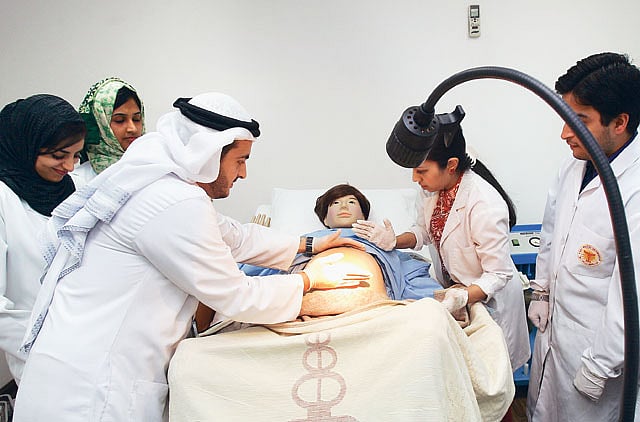
Nol is nine months pregnant and is relying on Gulf Medical University (GMU) students in Ajman for the successful delivery of her baby girl.
For Nol, giving birth many times a day is simply part of her role as a second generation simulation model in GMU's simulation centre established in 2008 as a mock hospital.
The centre was established as a promise to the community to deliver highly qualified and efficient doctors.
"The simulation centre provides a safe and non-threatening environment for medical students to learn psychomotor skills," said Professor Manda Venkatramana, Dean of GMU. "Instead of initially learning medical skills on real patients, students first practise on simulations and once they've perfected their skills they then transfer to real patients," he added.
Realistic vital signs
Similarly the third generation high-tech simulator affectionately referred to by students as Sim Man can at any moment have a programmed medical emergency ranging from cardiac arrest to choking, complete with realistic vital signs and speech.
"Our students come in teams and learn to manage various emergency room situations complete with hysterical relatives," said Dr Erum Khan, simulation instructor at GMUSC.
"They learn important hands-on skills as it's completely safe to make mistakes here," she added.
The various emergency conditions of Sim Man are programmed from the centre's control room. The students' medical performance is assessed in real-time to the control room for critical analysis and played back to them in the multimedia debriefing room to enhance their learning experience.
Simulation technology for educational purposes is rooted in the aviation industry but has branched out to the medical field and is an increasingly emerging trend in medical education.
"Simulation technology is pretty recent in the medical field and is only available to complement medical teachings, because we definitely need real patients for students to interact with," said Khan.
However, the simulation centre serves to enhance students' learning experience, allowing them to move at a faster pace.
"Through the simulation centre we can now try procedures that we wouldn't be able to try until much later in medical school," said Ahmad Salem, a third year medical undergraduate at GMU.
Very stressful
"Previously the case would have been that the first time we carried out any procedure would be on real patients, which would naturally have be very stressful," he added.
"The first time I did a procedure on the Sim Man I made so many mistakes, but I've done it so many times now that it's almost become automatic, so I'm hoping that when it comes to the real situation that routine will just kick back in," said Karim Bayaanzay, third year GMU undergraduate.
Students also get a chance to practise simple medical procedures, like drawing blood and stitching wounds at the simulation centre on more basic models.
The centre also gives male students a chance to explore the gynaecology and obstetrics areas of medicine, which was an option previously not available to them because of cultural sensitivities.
Update
Gulf Medical University (GMU) is currently undergoing a one million square foot expansion to incorporate a 300-bed teaching hospital and new simulation centre on campus.
The project is estimated to be completed within the next two years and will be home to the country's cheapest hospital, Thumbay Moideen, President of GMU, told Gulf News.
The expansion project will be executed in three phases, with the first phase costing Dh350 million.
Sign up for the Daily Briefing
Get the latest news and updates straight to your inbox
Network Links
GN StoreDownload our app
© Al Nisr Publishing LLC 2026. All rights reserved.