Thermal to green power
Wind, solar and hydro power serve as catalysts in India's rapidly evolving alternative energy sector
The current financial year for the power sector in India has been marred by a series of negative news: continuing coal shortages, roadblocks from the Ministry of Environment and Forests enforcing no-go areas for coal mining, and the Ministry of Petroleum and Natural Gas refusing to allocate any further gas from the KG D6 fields for the power sector, especially for power plants under construction.
End result: the Ministry of Power repeatedly revised capacity-addition targets downwards. The Central Electricity Authority (CEA) estimates that under the circumstances, total new capacity by the end of the 11th Five Year Plan in March 2012 will be 62,000 megawatts (MW). The country will be able to add only 18,600 MW of power-generation capacity in 2011-12, compared to the 20,359 MW added in 2010-11. Much of this will be on account of a shortage of power-grade coal in the country, with thermal coal imports expected to grow to 85 million tonnes by 2012.
National Thermal Power Corporation, the country's largest generator, recently scaled down growth targets. "We will be able to do about 70,000 MW by 2017; the remaining 5,000 MW looks difficult due to coal shortage and environment issues," says Chairman and Managing Director Arup Roy Choudhury.
During the 12th Five Year Plan, starting in 2012, the Planning Commission targets creating an additional 100,000 MW of generation capacity, with 50 per cent to be delivered by the private sector, as against 33 per cent currently generated by independent power producers. Private generators in the country are dependent on imported coal because of the shortage of domestic coal as well as unsuitability of Indian coal for supercritical power plants, which require a higher grade of thermal coal. The state-owned Coal India Limited, the sole entity controlling the supply of domestic coal, cannot meet demand due to infrastructure issues such as the non-availability of rail wagons as well as security issues following Maoist insurgency in mine areas. As a result, the United Progressive Alliance's oft-proclaimed slogan of Power for All by 2012 is likely to remain just that.
Green power
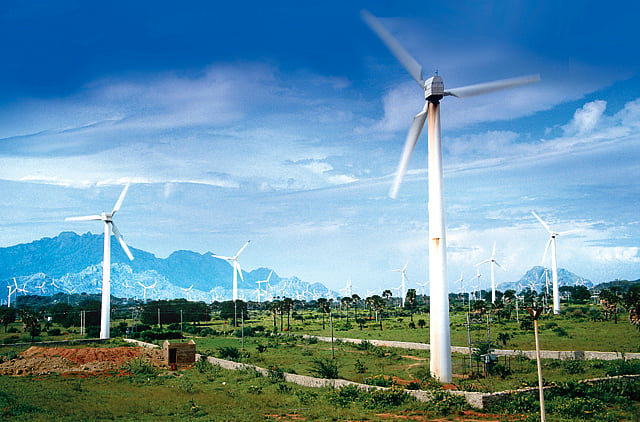
However, there is a perceptible move towards using renewable energy and a greener economy. According to the Ministry of New and Renewable Energy (MNRE), the existing share of renewable-based capacity is 10.9 per cent (excluding large hydro projects) of the total installed capacity of 170 gigawatts in 2010. By the end of 2011, the share will increase to close to 15 per cent with the growth of each segment. This includes 16,000 MW of wind, 2,939 MW of small hydro power, 1,562 MW of (bagasse-based) cogeneration, more than 1,000 MW of biomass, 73.46 MW from waste to power and 30 MW of solar photovoltaic (PV) for grid connected power. An ambitious programme that may just be achievable.
"The wind sector is expected to grow at 30 to 40 per cent in India. World over, the wind sector is growing at 28 per cent," says Tulsi Tanti, Chairman Suzlon Energy. "However, with the streamlining of guidelines and more efficient turbines coming into the market, the sector will record a fast growth in comparison to the last decade." He adds that as more efficient technologies come in, the wind sector in states such as Rajasthan, Madhya Pradesh, Gujarat, Tamil Nadu and Maharashtra will record growth.
India has equally aggressive capacity addition plans in the renewable sector. The National Solar Mission, unveiled in the second half of 2010, aims to deploy 20,000 MW of solar power by 2022 and also plans to deploy 20 million solar lighting systems in rural areas by the same year. Recently, India connected its first megawatt-sized solar plant to the grid, a three-MW plant in Mulshi, Maharashtra, whose power is being purchased by Tata Power.
A June report by KPMG said solar power can meet 5 to 7 per cent of India's power needs in the next ten years, bringing down coal imports by 30 per cent, which works out to a saving of $5.5 billion (Dh20 billion) per year on coal import cost by 2022. It expects the country's solar power to attain grid parity by 2017-2019. This is largely due to the cost of solar power moving down, even as conventional power costs are expected to rise 4 to 5 per cent yearly over the next five years, says Santosh Kamath, Head, Renewable Energy Practice, KPMG, and one of the authors of the study.
Biomass, too, is emerging as a viable alternative source of power. A 10 MW biomass plant in Tamil Nadu was connected to the grid in July by Orient Green Power Company. R Kulothungan, Senior Vice-President, Projects, Orient Green Power, said, "Discrepancies in tariff structure in the sector is dampening its growth, while a uniform tariff structure will boost the sector." Developers say that only a tariff above Rs5 (about 40 fils) a unit is financially viable. Unlike solar and wind, where the fuel is free of cost, biomass power producers spend 60 per cent of the capital in acquiring fuel for the plant.
Last month, the US government's Overseas Private Investment Corporation (OPIC) said it intends to infuse $820 million for renewable energy sector projects in India in the current calendar year. "By the end of this calendar year we hope to have generated $520 million in new investments from American companies, and on top of that $300 million of private equity," OPIC President and Chief Executive, Elizabeth Littlefield, said at an event coinciding with US Secretary of State Hillary Clinton's July visit, IANS reported. Littlefield said her agency doubled the clean energy project portfolio in India in a year and this now stands at 2,200 MW.
Pushing renewable energy further is trade in renewable energy certificates, creating a nascent carbon trades market in the country.
Opting for a cleaner source
India, currently the eighth largest importer of LNG, could become second largest in Asia after China by 2032, a 2010 report by McKinsey said. India has an LNG import capacity of 13.5 million tonnes per annum (mtpa) through two terminals at Dahej and Hazira, accounting for about 20 per cent of the country's gas requirements. Petronet, which runs the Dahej terminal, is constructing a five-mtpa terminal at Kochi in Kerala that is expected to start operations in the third quarter of 2012. Another LNG terminal at Dabhol, Maharashtra, with a 2.5-mtpa capacity, is also likely to start operating in 2012.
Sign up for the Daily Briefing
Get the latest news and updates straight to your inbox
Network Links
GN StoreDownload our app
© Al Nisr Publishing LLC 2026. All rights reserved.